Citizenship · Argentina
Real estate in Argentina: buying as a foreigner, prices and taxes

Updated: October 2026·16 min read·Expert reviewed
Terms and costs verified: October 2026
Contents
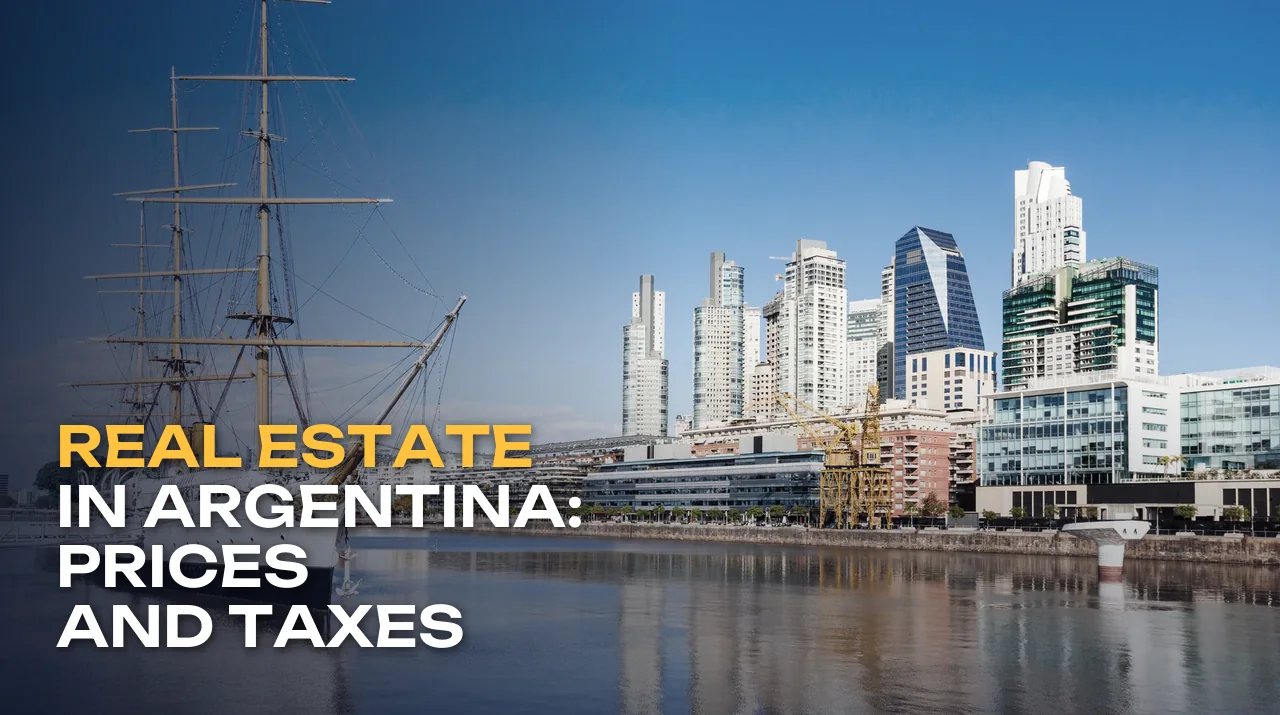
Foreigners buy urban real estate in Argentina with no nationality restrictions: all they need is a tax number and a notary. The average price of a flat in Buenos Aires in September 2026 was $2,484 per m², about $3,400 in Palermo and $6,165 in Puerto Madero. A two-room 50 m² flat costs $131,000 on average. One point up front: buying property gives neither citizenship nor a residence permit. Below are prices by district, the purchase procedure, taxes and fees, rentals and the place of property in an investor's plans. Terms, cost and procedure of the programme are on the page Argentina's citizenship programme.
Real estate in Argentina: in brief
In brief: a foreigner can buy a flat or house in Argentina on the same terms as a citizen. The transaction is handled by a notary, settlement is in dollars, and the purchase costs are stamp duty, the notary and registration. The programme does not offer citizenship for real estate.
Argentina's property market runs on dollars: prices are quoted and transactions settled in US dollars, and mortgages are almost out of reach for foreigners. After many years of decline, prices in Buenos Aires have stabilised: in 2026 the average flat price rose by about 1.4% and remains 11.5% below its historic peak. For a buyer with dollars, this is a moderately priced market compared with European capitals.
Property interests investors for three reasons: a home for the family during trips or after a move, rental income, and a long-term bet on economic recovery. But Argentine real estate has its own risks: economic instability, currency rules and rental rules that differ from Europe's. All of this is covered below.
Real estate, citizenship and residence
In brief: buying property does not give citizenship and is not grounds for a residence permit. The citizenship-by-investment programme accepts only a contribution to the Treasury or a bond.
Unlike Turkey, which grants citizenship for real estate from $400,000, or Greece, which issues a golden visa for buying a home, in Argentina ownership does not by itself confer any status. The citizenship-by-investment programme has announced two options: a $350,000 contribution or an $800,000 bond. Searches for "Argentine citizenship by real estate" and "residence through property purchase" have a different answer in practice.
Property can help with residence indirectly. Income from letting a flat, including one abroad, is grounds for rentier residence if it is sufficient and arrives in Argentina through a bank. And home ownership confirms an address and ties to the country at naturalisation. More in the articles Argentine residence permit and the cost of Argentine citizenship. If the family chooses citizenship by investment, the cost estimate for the Argentina programme will show the amount for your family.
Prices by district in Buenos Aires
In brief: the average flat price in Buenos Aires is $2,484 per m². The most expensive district is Puerto Madero at $6,165 per m², followed by Palermo, Belgrano and Recoleta. The southern districts are the cheapest.
Asking prices from listings, not transaction prices. The final price is usually lower after negotiation.
Zonaprop index, September 2026
Puerto Madero is a new district by the former docks with skyscrapers, waterfront promenades and offices: prices and rents here are higher than in the rest of the city. Palermo is a green district with parks, restaurants and old-town-style streets, popular with foreigners and young families. Belgrano and Núñez in the north are quiet districts with good schools. Recoleta is the classic centre, with early twentieth-century architecture.
The southern districts, such as Lugano, Nueva Pompeya and La Boca, are noticeably cheaper, but they are usually not a foreign buyer's first choice because of infrastructure and safety. Listing prices are higher than actual transaction prices: negotiating is the norm in the Buenos Aires market. On life in the districts, see the article living in Argentina.
How a foreigner buys a flat
In brief: a tax number, choosing a property, a reservation, a preliminary contract, the notary's checks, the notarial deed and registration with the property registry.
- Tax number. A buyer without a DNI obtains a CUIT: since 2 March 2026 it has replaced the former CDI number. A non-resident obtains it through a representative in Argentina.
- Choosing a property. Through an agency or directly from the seller.
- Reservation. A small deposit holds the property while the checks are carried out.
- Preliminary contract. It fixes the price, the payment procedure and the completion date, but does not transfer ownership.
- Notary's checks. The notary checks the ownership history, encumbrances, debts and the seller's right to sell.
- Notarial deed. It is signed before the notary, after which the title is registered with the registry.
The buyer chooses the notary, and that is the main safeguard of the transaction: the notary usually checks 20 years of title history, registry certificates on mortgages and attachments, the absence of restrictions on the seller and of tax debts on the property. Foreigners can also buy through an Argentine company, such as a simplified joint-stock company, whose members are identified by their tax numbers.
Payment is made in dollars, usually in cash in a bank vault or by transfer under the foreign exchange market rules. For a foreigner the money route matters just as much as when paying the programme contribution: the bank and the notary check the origin of the funds. More in the article a bank account in Argentina.
Purchase costs
In brief: the main costs are stamp duty of 3.5% in Buenos Aires, the notary and registration. For a sole home where the family lives permanently, there is a stamp duty exemption up to a threshold.
| Purchase cost | How much | Usually paid by |
|---|---|---|
| Stamp duty in Buenos Aires | 3.5%, up to 226.1 million pesos 2.7% | Split by agreement |
| Stamp duty exemption | A sole home for permanent residence, within the threshold | Buyer, subject to conditions |
| Notary | At the notary's tariff | The buyer chooses the notary |
| Registration of title | Property registry fees | Buyer |
| Agency commission | Under the agency agreement | Usually both buyer and seller |
Stamp duty in Buenos Aires is calculated on the highest of three values: the transaction price, the reference value or the cadastral valuation. The rate is 3.5%, and 2.7% for transactions up to 226.1 million pesos. Since 1 January 2026 a buyer of a sole home for permanent residence has been exempt from the duty up to this threshold and pays only on the excess. For a foreigner's investment flat the exemption usually does not apply. Other provinces set their own rates.
How the costs are split between buyer and seller is a matter of negotiation, so ask the notary for a cost estimate before signing the preliminary contract.
Igor VencReal Estate Managing Director, BRIDGES
Want to buy a home in Argentina? We will find options
We will take into account your budget, city and purpose: to live in, to let or to obtain residence.
Owner's taxes
In brief: since 2026 income from the sale of real estate has been exempt from income tax. The owner pays the city or provincial property tax, tax on rental income and, if a resident or if the property is in Argentina, the personal assets tax.
Law 27.802 exempted income from the sale of real estate from 1 January 2026 for residents and non-residents: previously the sale of a home bought after 2018 was taxed at 15%. Each year the owner pays property tax where the property is located; in Buenos Aires this is the city tax based on cadastral value. Rental income is subject to income tax, and for a non-resident the tax is withheld under the non-resident rules.
The personal assets tax is paid by residents on assets in the country and abroad, and by non-residents on assets in Argentina through a responsible party. The rates are falling: from 0.5% to 0.75% in 2026, and 0.25% from 2027. More in the article taxes in Argentina.
Renting out: yields and rules
In brief: at the end of 2023 Decree 70/2023 repealed the rental law with its rigid terms and indexation. The parties now agree freely, including on the currency and the term.
Until 2023 the rental law set a minimum lease term of three years and annual indexation, which put landlords off. Decree 70/2023 repealed that law, and the supply of rentals grew. Leases are now concluded on free terms: in pesos with indexation or in dollars, for a term chosen by the parties.
Renting a two-room flat in Buenos Aires in September 2026 cost from about 650,000 pesos a month in Lugano to about 1.27 million pesos in Puerto Madero, and about 1 million pesos in Palermo. The rental yield in dollars depends on the district, the peso exchange rate and maintenance costs. For a foreign owner, a property manager who finds tenants, collects rent and pays taxes is essential.

Rural land and country houses
In brief: Decree 70/2023 repealed the law restricting foreigners' purchases of rural land. In September 2026 the Supreme Court overturned the ruling that had suspended that repeal.
Since 2011 Law 26.737 had limited foreign ownership of rural land: no more than 15% of the country's land, no more than 30% of that share for any one nationality, no more than 1,000 hectares in the core agricultural zone, and a ban on plots near large bodies of water and in border zones. Decree 70/2023 repealed the law, but a court suspended the repeal. At the end of September 2026 the Supreme Court overturned the appeal chamber's ruling, and the restrictions ceased to apply.
Congress may still review Decree 70/2023, so for large land purchases lawyers advise factoring in the legal risk. The restrictions never applied to Argentine citizens: this is one of the rights citizenship confers. More in the article what Argentine citizenship gives you.
Other cities: Córdoba, Mendoza, Bariloche, Rosario
In brief: outside Buenos Aires property is cheaper. Foreigners buy in Córdoba and Rosario for universities and business, in Mendoza for winemaking and mountains, and in Bariloche for nature and tourism.
Córdoba is the country's second city, with large universities and a calm pace of life, and prices there are lower than in the capital. Mendoza, at the foot of the Andes, is known for its vineyards: some foreigners buy houses among the vines or stakes in winemaking projects. Bariloche in Patagonia is a resort with ski slopes and lakes, where housing demand is linked to tourism. Rosario is a major port and business centre in Santa Fe province.
The provinces have their own stamp duties and property taxes, and the market is less liquid than in Buenos Aires. When buying outside the capital, a local notary and checks of the land documents are especially important, particularly in the suburbs and the countryside.
New developments and buying off-plan
In brief: new buildings in Argentina are often developed through trusts into which investors pay money on a schedule. This is cheaper than a finished home, but the risk is higher: the developer, the trust agreement and the schedule are checked.
A common structure is a trust in which investors fund construction in stages and receive flats at cost. The price is lower than for a finished home, but the investor bears the risk of delays, rising costs and disputes between participants. Before joining such a trust, a lawyer checks the agreement, the land title, the permits, the developer's reputation and the exit procedure.
Buying a finished flat from a developer after the building is completed is simpler: the notary checks the title and the building's registration. For a foreign buyer with no experience of the local market, a finished home is usually preferable.
Mortgages
In brief: mortgages in Argentina are available mainly to residents with a DNI and documented local income. Foreigners without residence buy with their own funds.
Since 2024 Argentine banks have brought back inflation-indexed mortgages, and demand for them has grown. Loans are granted to residents with an identity card, a tax number and documented income in the country. For a foreigner who does not live in Argentina a mortgage is practically unavailable, and the purchase is made with their own funds. Since 2026 Buenos Aires has not charged stamp duty on a mortgage for a sole home.
Buying by power of attorney and managing the property
In brief: you can buy a flat without being present, using a notarised power of attorney with an apostille and translation. A property manager helps let and maintain the property.
The power of attorney is executed before a notary in the buyer's country, apostilled and translated into Spanish by an Argentine sworn translator. The notary in Argentina checks the representative's authority before the transaction. The buyer transfers the purchase money personally, and the representative signs the documents.
After the purchase a foreign owner needs a property manager, who finds tenants, signs leases, collects rent, pays taxes and utilities and looks after the flat. The manager's services are usually paid as a percentage of the rent.
Risks of buying
In brief: the main risks are economic instability, slow liquidity, debts on the property and misjudging the price from listings.
- The economy. Argentina's history of crises affects demand and prices, even though the market runs on dollars.
- Liquidity. A sale can take months, especially for expensive properties.
- Debts and encumbrances. These are checked by the notary before the transaction.
- Listing prices. The actual transaction price is lower, and negotiation is a must.
- Currency rules. How sale proceeds can be taken out depends on the seller's status and the rules on the transaction date.
For an investor who obtains citizenship through a contribution, property in Argentina is a separate decision. It is bought to live in during trips, for a family that is relocating, or as a long-term investment, but not as part of the programme. On currency and the economy, see the article the peso and Argentina's economy.
Where buyers go wrong
In brief: they count on citizenship for real estate, do not obtain a tax number in advance, leave the choice of notary to the seller and compare listing prices with transaction prices.
- They expect citizenship or residence for the purchase. Property confers no status.
- They come to the transaction without a tax number. Without a CUIT the notary will not register the title.
- They accept the seller's notary. The buyer chooses the notary.
- They buy at the listing price. Negotiating is the norm in the Buenos Aires market.
- They do not budget for stamp duty. For an investment flat it is usually 3.5%.
What to check before buying
In brief: the purpose of the purchase, the tax number, the money route, the notary and the full cost estimate. What we do and what remains for you is shown on the page an Argentine passport by investment.
- Why you are buying: to live in, to let or as a long-term investment.
- Whether you have a CUIT tax number and how to obtain one.
- Where the payment money will come from and how.
- Which notary handles the transaction and what they check.
- The estimate: stamp duty, notary, registration, agency.
How much tax is due on buying a home in Argentina? We will work it out
We will compare the taxes in your country now and after the move.
Igor VencReal Estate Managing Director, BRIDGES
Share this article
Frequently asked
Questions people ask before deciding
01Can a foreigner buy a flat in Argentina?
Yes. Foreigners buy urban property with no nationality restrictions. A CUIT tax number and a notary are required.
02Does buying property give citizenship or a residence permit?
No. The citizenship-by-investment programme accepts a $350,000 contribution or an $800,000 bond, and property is not grounds for a residence permit.
03How much does a flat in Buenos Aires cost?
In September 2026 the average price was $2,484 per m². A 40 m² studio costs about $110,000, a two-room 50 m² flat about $131,000, a three-room 70 m² flat about $180,000.
04Which district is the most expensive?
Puerto Madero: $6,165 per m². Next come Palermo at about $3,400, Belgrano at about $2,900 and Recoleta at about $2,700.
05What are the purchase costs?
Stamp duty in Buenos Aires of 3.5%, or 2.7% below the threshold, plus the notary, registration and the agency's commission.
06Is the sale of a flat taxed?
Since 1 January 2026 income from the sale of real estate has been exempt from income tax for residents and non-residents.
07Can you buy rural land?
Decree 70/2023 lifted the restrictions on foreigners, and in September 2026 the Supreme Court overturned the ruling that had suspended the repeal. Congress may still review the decree.
08Can you let out a flat?
Yes. Since the rental law was repealed, the parties freely agree on the term, currency and indexation.
09Can you buy a flat remotely?
Yes, by power of attorney executed with an apostille and translation. The notary checks the representative's authority.
10Are mortgages available to foreigners?
Mortgages are granted mainly to residents with a DNI and local income. Foreigners without residence buy with their own funds.
11Can you buy a flat off-plan?
Yes, often through a trust. It is cheaper, but the risk is higher: the developer, the contract and the schedule are checked.
12Where besides Buenos Aires do foreigners buy?
In Córdoba and Rosario for universities and business, in Mendoza for winemaking, in Bariloche for nature and tourism.
13In what currency are transactions made?
In US dollars: prices are quoted in dollars, and payment is made in cash at a bank or by transfer under the foreign exchange market rules.
Transparency
How this material was prepared
- Author
- Igor Venc, real Estate Managing Director, BRIDGES
- Terms and costs last verified
- October 2026
- Sources
- official government authorities of the relevant country and state publications
- Methodology
- government minimum requirements are stated separately from due diligence charges, state fees, legal and banking costs
Sources and methodology
Figures, terms and timelines are checked against official sources as of October 2026. Link availability verified in August 2026. Third-party blogs and agent websites are not used as a source of programme terms.
- [1]EUR-LexOfficial texts of European Union legislationeur-lex.europa.eu/homepage.html
- [2]European Commission - Migration and Home AffairsEntry and residence rules in the EUhome-affairs.ec.europa.eu/index_en
Methodology: tables and charts state government minimum investment requirements; due diligence charges, state fees, legal, banking and other costs are calculated separately and are not included in the minimum thresholds.
About the author
Related materials
What to read next
 ArticleTurkish citizenship for real estate in 2026: a complete guide to the $400,000 threshold
 ArticleProperty in Greece 2026: How a Foreigner Can Buy, Prices, Taxes, Residency
 ArticleReal estate in Portugal 2026: how a foreigner buys, prices, taxes, step by step
News+1 story on 3 November
Related news
 Argentina · 11 OctArgentina citizenship by investment ban bills: risks for investors
 Greece · 3 NovGreece: the 15% home purchase tax will depend on tax residency, not on your passport
 European Union · 1 NovEuropean Union: updated social security rules for living and working in two countries enter into force
Personal programme selection is conducted by Anna Kovalevskaya, Head of Legal, BRIDGES.
Want a home and Argentine citizenship? We will help you arrange it
We will set out the steps from the first documents to the final status, with the timing of each.
