News · Portugal
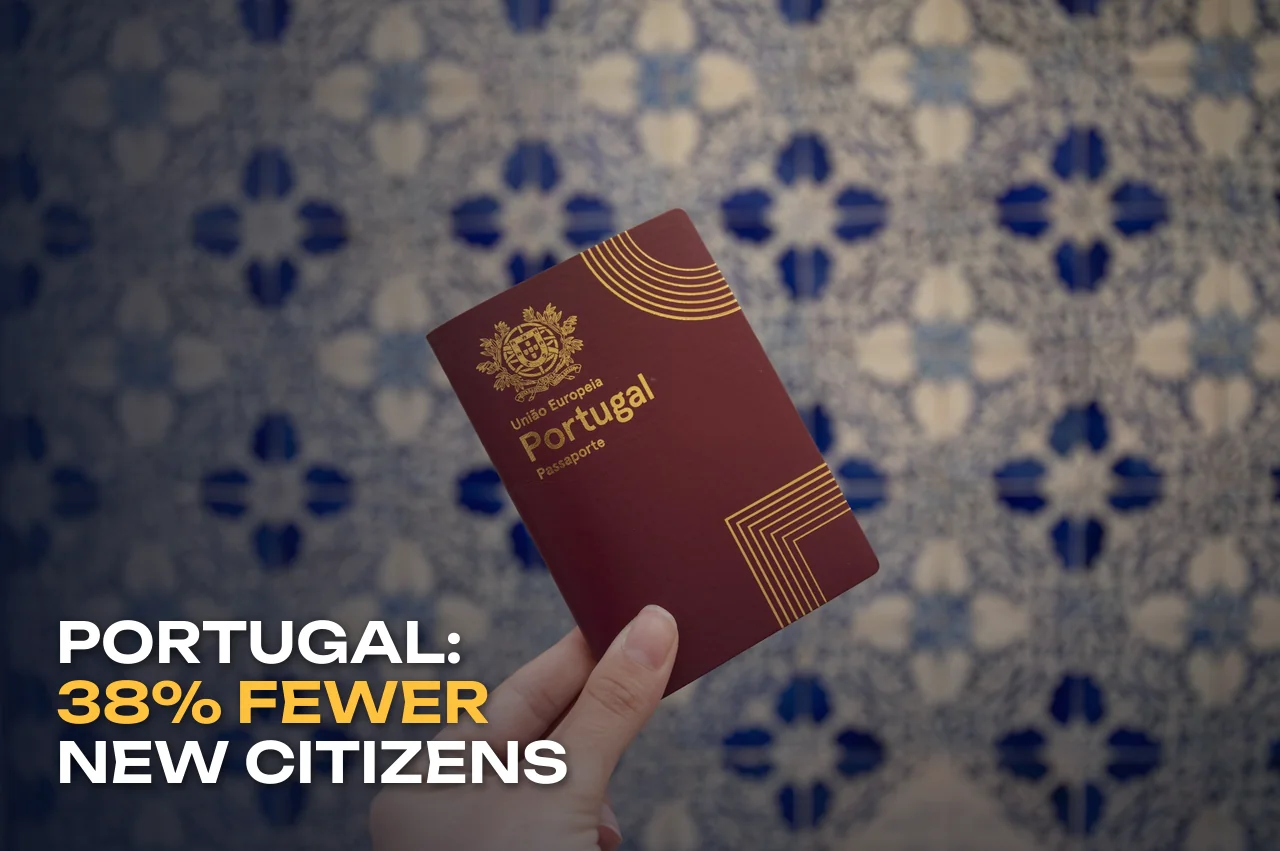
Portugal: 12,829 residents acquired citizenship in 2025, 38% fewer than a year earlier

Updated: October 2026·12 min read·Expert reviewed
Terms and costs verified: October 2026
Contents
Statistics Portugal, INE, has updated its data on new citizens for 2025. Portuguese citizenship went to 12,829 foreigners living in the country. A year earlier the figure was 20,624, so it fell by 38%. If people living abroad are included, acquisitions of citizenship almost halved: 25,829 against 46,840. Meanwhile, a new wording of the nationality law has applied since 19 May 2026, and the road to a passport is now longer: 10 years of residence instead of 5 for most foreigners. I explain what the figures show, what changed in the law and how to act if you live in Portugal or plan to move there.
In brief
- According to INE, 12,829 foreigners living in Portugal acquired Portuguese citizenship in 2025, 38% fewer than in 2024 (20,624).
- In total, foreigners acquired citizenship 25,829 times, 45% fewer than a year earlier (46,840). The steepest fall was among people living abroad, who saw numbers halve.
- Naturalisation based on residence among residents of the country almost halved, from 15,021 to 7,966 people.
- Only citizenship through marriage or civil union with a Portuguese citizen grew: 4,036 against 2,633.
- The new wording of the nationality law has applied since 19 May 2026: 7 years of residence for nationals of Portuguese-speaking countries and EU citizens, 10 years for everyone else. Applications filed earlier are decided under the old rules.
What the statistics show
INE keeps separate statistics on the acquisition of citizenship by foreigners. Data for 2025 appeared in the institute's database on 28 September 2026. The statistics divide new citizens into two groups: those living in Portugal and those living abroad. The second group is mainly people who obtain citizenship by descent or on special grounds without moving to the country.
For anyone planning a move, the first group matters more. In 2025, 12,829 residents of Portugal acquired citizenship, against 20,624 in 2024. To see the scale, it helps to look at earlier years: according to INE's demographic publication for 2023, 20,844 residents of the country acquired citizenship in 2022 and 16,985 in 2023. So 2025 is the lowest year of the last four, even though the number of foreigners in the country has grown sharply over that time. INE estimates that 1,597,539 foreigners lived in Portugal at the end of 2025, 14% of the population, and their number has more than doubled since 2021.
| Indicator | 2024 | 2025 | Change |
|---|---|---|---|
| All acquisitions of citizenship by foreigners | 46,840 | 25,829 | -45% |
| Of which residents of Portugal | 20,624 | 12,829 | -38% |
| Of which people living abroad | 26,216 | 13,000 | -50% |
| Naturalisation, total | 39,279 | 18,593 | -53% |
| Naturalisation of residents of Portugal | 17,882 | 10,616 | -41% |
An important detail: the statistics count completed acquisitions of citizenship, that is, cases where a decision has been taken and the citizenship registered. They do not show the number of applications filed. So the fall does not mean fewer people want citizenship. It shows how many cases the state brought to a close during the year. We described how the queue at the Institute of Registries and Notary, IRN, works in our piece on the citizenship backlog.
What this means for you. If you live in Portugal and are waiting for a decision, the statistics confirm what is visible in practice: cases are closing more slowly than before. Allow more time for the decision than older estimates suggested.
The grounds on which citizenship was granted
INE breaks down acquisitions of citizenship by ground. The main route for people who have moved to Portugal is naturalisation based on the period of legal residence. In 2025, 8,166 people acquired citizenship on this ground, 7,966 of them residents of the country. In 2024 there were 15,267, of whom 15,021 were residents. This is the most visible fall among all grounds for people living in the country.
The second large block is descendants of Portuguese Sephardic Jews. On this ground 7,906 people acquired citizenship, against 21,603 a year earlier. Almost all of them live abroad, so this group accounted for most of the overall fall. The breakdown by previous citizenship tells the same story: the number of new citizens from Israel fell from 17,647 to 6,155.
| Ground | 2024 | 2025 |
|---|---|---|
| Naturalisation based on residence in Portugal | 15,267 | 8,166 |
| Descendants of Portuguese Sephardic Jews | 21,603 | 7,906 |
| Marriage or civil union with a Portuguese citizen | 2,633 | 4,036 |
| Minor children of a new citizen | 4,342 | 2,568 |
| Children of foreigners born in Portugal | 1,916 | 1,976 |
| Ascendants of Portuguese citizens by origin | 433 | 497 |
The only ground that grew noticeably is marriage or civil union with a Portuguese citizen. In 2025, 4,036 people acquired citizenship this way, against 2,633 in 2024. We cover this route in detail in our article on citizenship through marriage. Children of foreigners born in Portugal held steady: 1,976 against 1,916. The number of children who acquire citizenship after a parent, on the other hand, fell: 2,568 against 4,342. This is logical: if parents obtain citizenship less often, so do their children.
What this means for you. Naturalisation based on residence slowed the most in 2025. If this is your route, prepare documents in advance and answer IRN requests without delay: every pause in a case adds months.
Where the new citizens come from
Among residents of Portugal who acquired citizenship, Brazilian nationals are still the largest group: 4,363 people in 2025 against 7,187 a year earlier. The number of new citizens from Cape Verde, Guinea-Bissau and Sao Tome and Principe fell sharply: in 2024 these Portuguese-speaking countries accounted for thousands of new citizens, in 2025 only for hundreds. More on what a link with Portuguese-speaking countries offers is in our article on Sao Tome and the community of Portuguese-speaking countries.
| Previous citizenship (residents of Portugal) | 2024 | 2025 |
|---|---|---|
| Brazil | 7,187 | 4,363 |
| Angola | 2,003 | 1,035 |
| India | 680 | 991 |
| Nepal | 860 | 904 |
| Cape Verde | 2,265 | 711 |
| Ukraine | 971 | 590 |
| Guinea-Bissau | 1,440 | 585 |
| Sao Tome and Principe | 799 | 340 |
Against this background, nationals of India and Nepal stand out: their numbers did not fall but grew. India rose to 991 people from 680, Nepal to 904 from 860. INE does not give reasons for the rise. Overall, by previous citizenship of residents, the Americas lead as a region, followed by Asia and Africa, while Europe's share is small: 1,453 new citizens from European countries.
What changed in the nationality law
Apart from the statistics, it is important to understand that the rules of the game have already changed. Portugal's parliament approved amendments to the nationality law on 1 April 2026, the President promulgated them on 3 May, and on 18 May the law was published in the official gazette as Organic Law 1/2026. It entered into force the next day, 19 May 2026. A correction to the text was later published in the official gazette.
The main change is the period. Under the previous wording of the law, 5 years of legal residence were enough for a foreigner. Now nationals of Portuguese-speaking countries and EU citizens wait 7 years, and other foreigners 10 years. Breaks in residence are allowed: all periods of legal residence are added up, but only if they fall within a window of 9 years for nationals of Portuguese-speaking countries and EU citizens and 12 years for others. For stateless persons the period is 4 years, with a 6-year window.
| Requirement | Under the new wording of the law |
|---|---|
| Legal residence period | 7 years for nationals of Portuguese-speaking countries and EU citizens, 10 years for everyone else |
| How the period is counted | all periods of legal residence are added up if they fall within 9 years (Portuguese-speaking countries and EU) or 12 years (others) |
| Language and culture | test or certificate: language, culture, history and national symbols of Portugal |
| Civic knowledge | the basic rights and duties of a citizen and how the state is organised |
| Declaration | a solemn declaration of adherence to the principles of the democratic rule of law |
| Criminal record | no sentence of actual imprisonment over 3 years for serious crimes listed in the law |
| Security and sanctions | no threat to national security, no UN or EU sanctions |
| Means of subsistence | the applicant can support themselves |
| Applications already filed | decided under the previous wording of the law |
The knowledge requirements are also broader. Previously, applicants had to prove knowledge of Portuguese. Now a test or certificate must show knowledge of the language, culture, history and national symbols of Portugal, and the applicant must know the basic rights and duties of a citizen and how the state is organised. Nationals of Portuguese-speaking countries are presumed to know the language unless a clear gap becomes apparent when they apply. The new conditions also include a solemn declaration of adherence to the principles of the democratic rule of law and the ability to support oneself. On the language and courses, see our article on Portuguese for relocation.
The special routes have changed too. The provision on naturalisation of descendants of Portuguese Sephardic Jews has been removed from the law. Great-grandchildren of Portuguese citizens by origin can obtain citizenship without the general period, but only after 5 years of legal residence in the country. Children of foreigners born in Portugal are granted citizenship if one parent has lived in the country legally for at least 5 years and the child attends school. For marriage, the law clarifies: if the marriage or civil union has lasted more than 6 years or the couple has children with Portuguese citizenship, the state does not oppose the acquisition of citizenship, except in cases of serious convictions and security threats. Details on the descent route are in our article on citizenship by descent.
What this means for you. For most foreigners moving to Portugal now, the road to a passport is 10 years of legal residence. For nationals of Brazil, other Portuguese-speaking countries and the EU it is 7 years. Plan your move with this horizon in mind.
Sofia MendesInvestment Programs Expert, BRIDGES
Want Portuguese citizenship? We will work out your timeline
We will check which wording of the law applies to your case, how many years you have left and which documents are missing.
If you have already applied
For those who managed to apply before 19 May 2026, there is good news. The law states plainly that cases under consideration on the date the amendments took effect are governed by the previous wording of the law. So if your naturalisation application was filed under the 5-year rule and is being processed, the new 10 years do not apply to you, and you do not need to sit the new test on culture and history.
The problem lies elsewhere, in the timing. As the statistics show, the state closed noticeably fewer cases in 2025 than in 2024. So the main task for those waiting is to keep the case from stalling. If IRN sends a request, reply quickly and in full. Keep track of criminal record certificates and other documents with an expiry date: if IRN asks for them to be renewed, it is better to have a plan ready. While the case is in progress, it is important to keep your legal status in the country and renew your residence permit on time; on renewals at AIMA, see our piece on renewals until January 2027 and our article on residence permit renewal.
We have described the path of an application from filing to passport and the documents usually requested in our articles on citizenship documents and the citizenship timeline. A real example of naturalisation after 5 years with A2-level Portuguese is in a client case.
What this means for you. If your application was filed before 19 May 2026, it is decided under the old rules. Do not file it again or change the ground without advice: a new application will fall under the new law.
What this means for the golden visa and other residence permits
Many people choose Portugal precisely for a future EU passport. The Portuguese golden visa, or the ARI programme, lets you live in the country while spending little time there. Time holding this residence permit counts as legal residence, but most investors now need 10 years to reach citizenship rather than 5. Other changes to the programme are covered in our article on golden visa changes in 2026.
The same applies to the D7 visa for financially independent people and the D8 visa for remote workers. These visas still give legal status and the right to live in Portugal, but the horizon to a passport is longer. For some clients this changes the calculation: sometimes it makes more sense to think about permanent residence, which can be obtained earlier than citizenship. The two statuses are compared in our article on permanent residence or citizenship.
The Portuguese passport itself has not lost its value: it is an EU passport with the right to live and work in every member state and visa-free access to most countries of the world. Its ranking is on the Portugal passport index page, and travel is covered in our article on visa-free countries for Portuguese passport holders. Portugal allows dual citizenship; see our article on Portuguese dual citizenship.
What this means for you. If an EU passport is your main goal, compare not only the cost of residence but also the real time to citizenship under the new law. For most foreigners in Portugal this is now 10 years.
What to do
Identify which wording applies
If your application was filed before 19 May 2026, the previous rules apply. If not, the new ones: 7 or 10 years.
Count your residence period
Add up your periods of legal residence and check whether they fit within the 9 or 12-year window.
Start preparing for the test
The new law requires knowledge of the language, culture, history and symbols of the country. It is better to learn them early.
Keep your status without gaps
Renew your residence permit on time: a gap in legal residence can push back the date.
Reply to requests quickly
If your case is already at IRN, every unanswered request stops the process.
A general overview is in our article on Portuguese citizenship and our guide to naturalisation. Everything about the country and its programmes is on the Portugal page. To go through your own case, book an online consultation; all BRIDGES services are on the home page.
Moving to Portugal? We will draw up a plan to the passport
We will choose a residence permit and map out the route to citizenship under the new rules.
Sofia MendesInvestment Programs Expert, BRIDGES
How this article was prepared
Sources: the database of Statistics Portugal, INE, indicators on the acquisition of Portuguese citizenship by foreigners by previous citizenship and by type of acquisition, updated on 28 September 2026; INE's release on resident population estimates for the end of 2025, dated 22 June 2026; INE's publication Demographic Statistics 2023, dated 15 November 2024; Organic Law 1/2026 of 18 May 2026 amending the nationality law, published in Portugal's official gazette, and the correction to it. Percentage changes are our calculation from INE data and are rounded. This article does not replace advice on your own case.
Share this article
Frequently asked
Questions people ask before deciding
01How many foreigners acquired Portuguese citizenship in 2025?
According to INE, 25,829 people, of whom 12,829 live in Portugal. In 2024 the figures were 46,840 and 20,624.
02Why did the figures fall?
INE counts completed cases, not applications filed. The steepest falls were in naturalisation based on residence and in citizenship for Sephardic descendants.
03How long do you now need to live in Portugal for citizenship?
Since 19 May 2026, 7 years for nationals of Portuguese-speaking countries and EU citizens and 10 years for other foreigners.
04What happens to applications filed before 19 May 2026?
They are decided under the previous wording of the law, that is, under the 5-year rule and the earlier requirements.
05Does the golden visa count towards the period?
Yes, it is legal residence. But for most investors the time to citizenship is now 10 years.
About the author
Related materials
What to read next
 ArticlePortuguese citizenship by naturalization in 2026: qualification 10 years, language A2, test
 ComparisonResidence permit for investment in 2026: Greece, Portugal or UAE - what to choose
News+5 stories on 29 October
Related news
 Portugal · 28 OctPortugal opens online renewal for residence permits expiring by 31 January 2027
 Portugal · 23 OctPortugal: 690,000 citizenship applications await a decision as the queue grows 38% in a year
 Portugal · 21 OctPortugal charges non-residents 7.5% IMT: who pays, who gets the difference back and what the 2027 budget has to do with it
Personal programme selection is conducted by Anna Kovalevskaya, Head of Legal, BRIDGES.
Want Portuguese citizenship? We will work out your timeline
We will check which wording of the law applies to your case, how many years you have left and which documents are missing.
