Updated
SRV-CR-SC
Structure change
Changing a foreign companystructure to fit a new task
Four scenarios solve different problems: transferring shares, reorganising the group, moving the company to another jurisdiction and building a new structure. We compare the applicable options against the same set of criteria — what happens to the company history, contracts, licences, the bank account and the owner’s tax position — and calculate the consequences before the first step.
- We compare several scenarios before the procedure starts
- We account for taxes, banks, assets and existing contracts
- We coordinate action in the old and the new jurisdiction
01 / Situations
The structure was built for a different task and no longer solves it
A structure change starts with the business reason: it determines what should be kept, moved, split or closed.
The bank will not work with the jurisdiction
The company operates, but its country of registration limits access to banking and to settlements with counterparties.
Substance requirements have grown
Maintaining an office, a director, staff and other infrastructure has stopped being economically justified.
A partner is leaving
A share has to be transferred, control adjusted and powers redistributed without stopping the business.
The group has become complicated
Several companies duplicate functions, increase costs and complicate banking and management processes.
The owner’s tax residency has changed
The existing structure has to be tested against the owner’s new position.
A line of business is closing
It has to be decided whether to close one company, sell an asset or reshape the group.
02 / Why BRIDGES
Three parties assess a structure change, and their criteria differ
The registry looks at formal availability, the tax authority at the substance of the transaction, the bank at the new ownership configuration. Agreement from one does not replace the other two, so the decision is prepared on all three fronts at once.
Formal availability
The registry of the country of exit checks for outstanding debts, filed accounts and compliance with the procedure; the registry of the country of entry checks the company against its own requirements. A direct move does not exist between every pair of countries. Availability is confirmed before documents are prepared.
Substance of the transaction
The tax authority looks not at the name of the scenario but at what actually moves: shares, assets, functions or control. That is where the consequences arise for the company and the owner, including exit taxation and the rules of the owner’s country of residence. The calculation is done before the deal.
The new configuration
When the jurisdiction or the ownership changes, the bank reviews the company again and decides for itself: continue, request documents or close the account. The banking question is therefore handled alongside the choice of scenario, not after the registration steps.
03 / Options
How a company structure can change
Four scenarios solve different problems. Which of them applies is determined by the jurisdictions, the state of the company and the composition of its owners.
Redomiciliation — moving the company
The legal entity moves to another jurisdiction and continues to exist, where both countries allow it. As a rule the incorporation date and corporate history are preserved; the constitution, the address and the governing bodies change. The country of exit normally requires no outstanding debts and up-to-date filings.
Group reorganisation
Companies merge, split or redistribute functions. It solves the problem of simplifying a group or separating lines of business between owners. Assets and liabilities transfer under the rules of the relevant jurisdiction; shareholder resolutions are required, sometimes creditor and regulator consents.
Sale or transfer of shares
The company keeps operating while the owners or the balance of control change. An agreement, corporate resolutions and changes to the register of members are prepared. The bank reviews the new ownership, and the seller’s tax position is calculated before the deal.
Liquidation and a new structure
The existing company is closed and the activity moves to a new one. Used where a direct move is not available or not worth it. The old company completes settlements, filings and distribution of assets; the new one is registered, opens accounts and re-signs the contracts.
04 / Scenarios compared
Four scenarios against the same criteria
The table shows the direction of the consequences, not a ready answer. What happens in your case depends on the pair of jurisdictions, the constitution, the ownership and the bank’s position — all of which are checked before a scenario is chosen.
Scenario finder
Which scenario is closer to your task
Three questions about the future configuration. The answer shows a direction, not a decision: admissibility is checked against the pair of jurisdictions, the articles and the bank’s position.
Does the same legal entity need to be kept?
Now
Company- Legal entity
- Jurisdiction
- Ownership
After
Transfer of shares- The same one
- Unchanged
- Changes — that is the purpose
| Legal entity | The same one | May change depending on the form | The same one, if both countries allow the move | A new one is created |
|---|---|---|---|---|
| Incorporation date and history | Preserved | Depends on the form of reorganisation | As a rule preserved | Start again from zero |
| Jurisdiction | Unchanged | May change in a cross-border form | Changes | Changes |
| Ownership | Changes — that is the purpose | May be redistributed between owners | Preserved | Set again from the start |
| Existing contracts | Continue, though some require consent | Transfer under the rules of the jurisdiction | As a rule continue | Have to be re-signed |
| Licences and permits | Usually require notice to the regulator | Are re-issued | More often obtained again in the country of entry | Obtained again |
| Bank account | The bank runs a fresh review | The bank runs a fresh review | The bank runs a fresh review | Opened from scratch |
| Tax for the owner | Calculated before the deal, usually in the seller’s country of residence | Depends on the form and on the assets transferred | Checked in both countries, including any exit tax | Arises on the distribution of the old company’s assets |
| What gets closed | Nothing | The merged or divided companies | The registration in the country of exit | The old company in full |
| When it applies | The company works, the owners or control change | The group has grown complex or lines are being separated | Both countries allow the move and there are no debts | A move is unavailable or not economically justified |
Whether a move is available between a specific pair of countries, and whether contracts, licences and the account survive it, is confirmed by the review and by the decisions of third parties. None of it is promised in advance.
05 / Assessment
What is checked before a scenario is chosen
The scenario is chosen by what the review shows, not by preference. The eight points below determine which options are available to your company at all.
Availability in both jurisdictions
Whether the country of exit allows the company to leave its register and continue existing, and whether the country of entry will admit it and on what terms.
State of the company
Debts, outstanding filings, a suspended status in the register. Until these are cleared, the registry will not release the company.
Constitution and shareholders agreement
How decisions are taken, pre-emption rights over shares, restrictions on change of control and on a member leaving.
Change of control clauses
Loan, distribution and licence agreements often require the counterparty’s consent when the owner or the jurisdiction changes.
Licences and regulators
Whether the licence is tied to the jurisdiction and to the entity, whether it can be re-issued and how quickly the regulator has to be notified.
The bank’s position
Whether the bank will continue to serve the company in its new configuration or a new account will be needed. The bank decides.
Assets and encumbrances
Real estate, shares, receivables, pledges and disputes: what transfers automatically, what is dealt with separately and where tax arises.
The owner’s tax position
The owner’s country of residence, controlled foreign company rules and the consequences of transferring shares or assets.
The review comes before the scenario is chosen. The reverse order — a decision first, constraints discovered later — is the most expensive way to do this.
06 / Honest limits
Solutions we do not use
Some structure change requests we decline — and we explain why.
Moving away from creditors
A move or reorganisation once claims have arisen is open to challenge and creates personal risk for the owner and the director.
A sham transfer of shares
Transferring a share to a nominal buyer while keeping real control does not survive banking or tax review.
Hiding history and beneficiaries
Past operations and the ownership record stay visible to banks and registries through any change of form or jurisdiction.
Promising the account will survive
When the jurisdiction or the owners change, the bank runs a fresh review and decides on its own.
A move without checking both jurisdictions
Until exit and entry are both confirmed as available, redomiciliation is an assumption rather than a plan.
A structure that exists only on paper
A configuration without real management and activity creates tax and banking problems instead of solving them.
The structure has to match the real activity, management and control of the company.
07 / Scope of change
What is checked and what is done to reach a completed structure
First the review of availability and consequences, then the registry action. The reverse order is expensive here.
Availability of the scenarios
Whether a move or the chosen form of reorganisation is permitted in the specific jurisdictions and on what conditions.
Tax consequences
What arises on the transfer of shares, assets, functions and control — for the company and for the owners.
Banking feasibility
Whether the existing service can continue or accounts will be needed for the new configuration. The decision stays with the bank.
Contracts, licences and assets
Whether they transfer automatically, require consent or need fresh paperwork; how shares, property and receivables move.
Preparation and resolutions
Bringing filings up to date, obtaining consents, corporate resolutions, agreements, translations and legalisation.
Registration steps
Filing and follow-up with the registries of the country of exit and of entry, responses to queries, coordination of local agents.
Banks and corporate records
Notices to banks, counterparties and registries, and aligning the records with the new configuration.
Closing the old configuration
Final filings, settlements, deregistration and closing the accounts to the agreed extent.
BRIDGES GLOBAL is responsible for the review, the costing, the documents and the coordination. Registration steps are performed by registries and local agents, account decisions are taken by banks, and consents are given by members and counterparties.
08 / What you get
What you are left with after the structure change
The result is measured in documents and in a clear list of what happens next.
Before the work starts
- The list of scenarios available to your company
- A comparison of legal, tax and banking consequences
- A recommended option with the reasoning behind it
- Scope of work, indicative timing and a costing by stage
Corporate documents
- The new ownership and management structure
- Resolutions of members and governing bodies
- Updated registers and registration documents
- Documents on the transfer of shares or assets, where applicable
- Confirmation of the registration steps completed
Banks, accounting and archive
- A plan of banking and reporting changes
- A document set for banks and counterparties
- An archive covering the original and the new structure
- A list of continuing obligations and their deadlines
Whether contracts, licences and bank accounts survive is confirmed by the review and by third-party decisions, not promised in advance.
09 / Time and cost
What the time and cost depend on
Calculated from the chosen scenario, the number of jurisdictions and the state of the company.
The chosen scenario
Transferring shares, reorganisation, a move and building a new structure differ in scope of work and in timing.
Number of jurisdictions
A move and a reorganisation involve both countries: their own fees, their own agents, their own timelines.
State of the company
Debts and outstanding filings are cleared first: without that the registry will not release the company.
Assets, contracts and consents
Real estate, shares and licences are handled separately, and consents from members and counterparties add preparation time.
Timing and cost are given after the company and the jurisdictions have been reviewed: before that, any figure would be invented.
10 / How it works
How the work runs
Every stage ends with a result that shows it is closed.
Reviewing the task
What has to change, what matters to keep, what the constraints are. The result is a fixed objective for the project.
Options and costing
Available scenarios with their consequences, timing and budget. The result is a decision on the chosen path.
Preparation
Documents and filings in order, consents obtained, resolutions ready. The result is a structure ready to be changed.
Execution
Registration and corporate steps in one or both jurisdictions. The result is the change formally recorded.
Completion
Documents, banks, accounting and archive aligned with the new configuration. The result is the old structure closed to the agreed extent.
Indicative timings are given after the specific jurisdictions have been checked: registry, bank and third-party timelines are outside our control.
11 / Preparation
What we will need from you
The full picture is needed before the costing: on incomplete data, comparing scenarios loses its meaning.
Company documents
Constitutional documents, current registers of members and directors, the latest financial statements.
Owners and consents
Details of owners and beneficiaries, and consents from members in the manner set by the constitution.
Assets and liabilities
A list of assets, details of debts, disputes and encumbrances, current contracts and licences.
Accounts and the goal
Information on bank accounts, the reason for changing the structure, the countries under consideration and any deadlines.
If the final option is not yet decided, describing the business task and providing the current structure is enough.
12 / Team
Who runs the work
The lead expert is a BRIDGES GLOBAL tax consultant. Lawyers review the state of the company and prepare the documents; registration steps are performed by local agents in both jurisdictions and coordinated by BRIDGES GLOBAL.
 Nikos PappasBanking Relations SpecialistTax consequences of the scenarios and banking compliance for the new configuration
 Robert HaasCorporate LawyerReview of the company, documents, debts and obligations
 Klara RihterHead of Compliance and Due DiligenceCoordination of local agents, registries and banks
 Irena SokolovskaHead of Europe OfficeOffices and the partner network
14 / Questions
Answers to common questions
Yes, where both jurisdictions allow redomiciliation: the legal entity continues to exist and the incorporation date and corporate history are as a rule preserved. Between many popular pairs of countries no direct move exists — then a reorganisation or a new company with a transfer of activity is considered.
Only where the law of both sides allows it: one country permits the company to leave its register and continue existing, the other permits entry. The specific pair is checked separately, together with the conditions on filings, debts and consents. There is no universal list that works for any company.
As a rule the legal entity, the incorporation date, the corporate history and rights under existing contracts. The constitution, the registered address, the registration number and often the governing bodies change. What survives in your case depends on the requirements of the country of entry.
The bank decides. When the jurisdiction or the ownership changes it runs a fresh review and may either continue the relationship or require an account for the new configuration. That is why the banking question is handled alongside the choice of scenario, not after the registration steps.
Where the legal entity survives, contracts usually continue, but some contain change of control or change of jurisdiction clauses and require the counterparty’s consent. Licences are more often tied to the jurisdiction and to the entity: they are re-issued or obtained again.
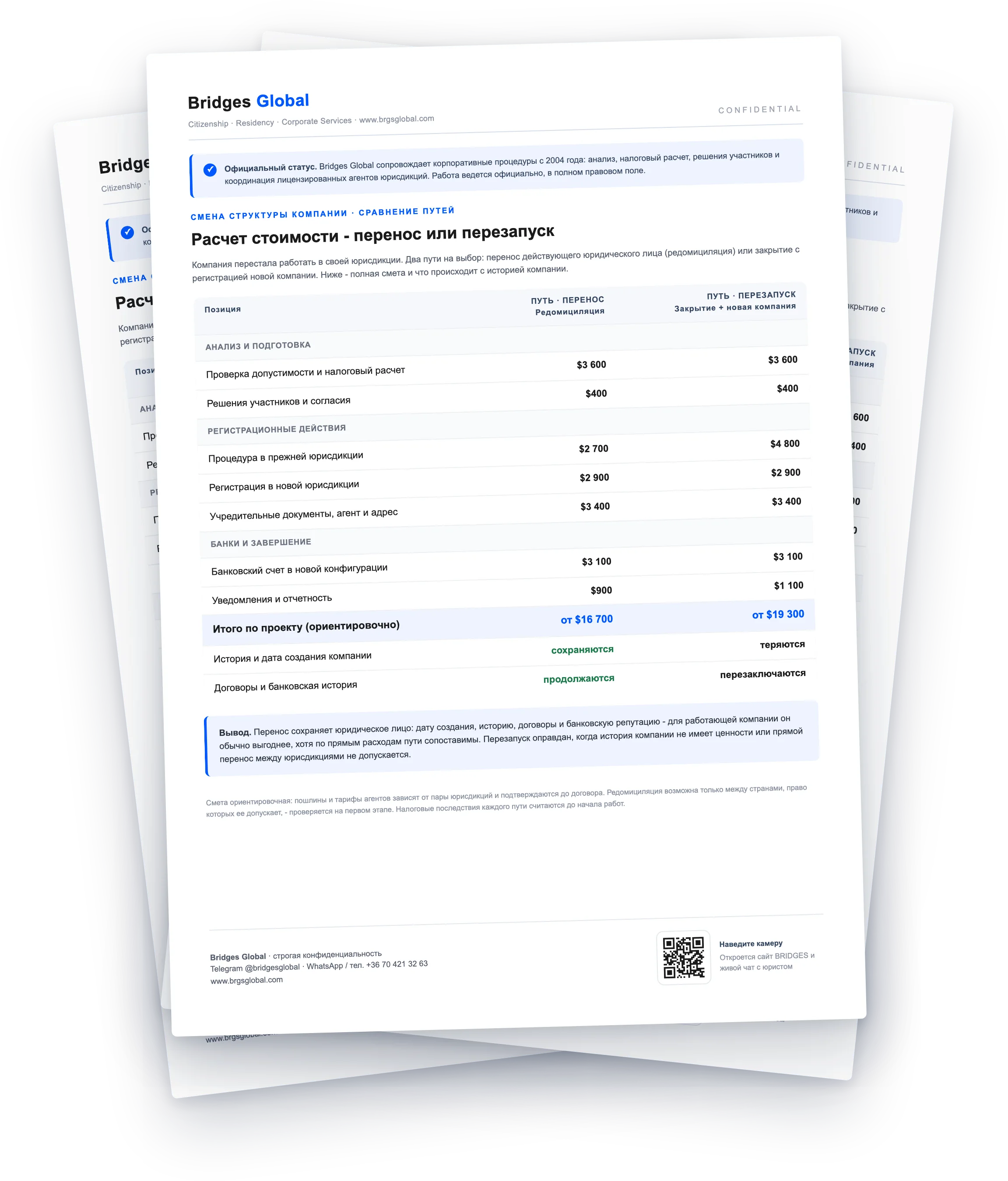
A move keeps the same entity with its history, contracts and obligations. A new company starts the history again: contracts are re-signed, accounts are opened from scratch, compliance is passed anew, and the old company still has to be closed properly. The direct costs of the second route are often lower, but they should be weighed against those losses.
When the company has to keep working and what should change is the ownership or the balance of control: a partner leaving, an investor coming in, a redistribution within a family. The jurisdiction does not change, so this scenario does not solve problems tied to the country of registration.
Most often the consequences arise for the seller in their country of tax residence, and sometimes additionally in the company’s country — for example where its assets are linked to real estate. Exemptions and double tax treaty rules apply in a number of cases. The calculation is done before the deal.
Obligations by themselves do not prevent a change, but they alter the order of steps: the registry of the country of exit normally requires confirmation that settlements are complete, and a move that bypasses existing claims is open to challenge and creates personal risk for the owner and director. Where funds are insufficient, an insolvency procedure is considered.
Transfer or distribute them before the procedure is completed, documenting the transfer of title and calculating the tax. Assets left in a company struck off the register pass to the state in a number of jurisdictions, and recovering them becomes a separate court matter.
It depends on the scenario and the jurisdictions: transferring shares is usually the shortest procedure, while a move and a reorganisation require approvals in two countries. Preparation is added to the registration steps — filings, consents from members and counterparties. We give an indication after the review.
The constitution and the shareholders agreement determine how the decision is taken: in some cases a majority is enough, in others unanimity or pre-emption rights apply. Whether consents are needed from creditors, banks, regulators or contractual counterparties is checked separately.
In many jurisdictions yes — by power of attorney and with notarised and apostilled documents. Some steps require personal attendance: most often banking procedures and signing before a notary. What can be done remotely in your case we will say after checking the requirements of both jurisdictions.
On the scenario, the number of jurisdictions, the state of the company, the number of owners, the assets and liabilities, the re-issuing of contracts and licences, the banking steps and the depth of the tax analysis. The work of local specialists and government fees are accounted for separately at actual cost.
INITIAL ASSESSMENT
Tell us what outcome your family needs
We will design a solution for your case, choose the country and the right status, and take the whole process through to the result.