Residency · Portugal
Climate and weather in Portugal 2026: by season and region, where it's warmer

Updated: June 2026·12 min read·Expert reviewed
Terms and costs verified: June 2026
Contents
Portugal is one of the warmest, sunniest countries in Western Europe, but "warm Portugal" is a stretchable notion. Between rainy green Porto and sunny Algarve the climate difference is significant, and Madeira lives in eternal-spring mode year-round. This breakdown is a weather map by month and region: where winter is barely felt, where summer goes above 40 degrees, what the Atlantic water temperature is, and which month is actually good for swimming. Figures are based on open climate data and are approximate - actual weather varies year to year.
The big picture: why Portugal is so comfortable to live in
Portugal lies at Europe's southwestern tip, and its climate is shaped by two factors at once: the warm Mediterranean to the south and the cold Atlantic to the west. This combination produces a mild but non-uniform climate - in the south and center it's typically Mediterranean (a hot dry summer and mild rainy winter), while in the north it becomes oceanic - cooler and noticeably more humid.
The main thing a relocator should understand: "Portugal" isn't one climate, but several climatic worlds within a compact area. From green rainy Porto to sun-scorched Algarve is only about 550 km by road, but the difference in sun and rain is huge. And beyond the mainland lie the islands - Madeira and the Azores - with their own, even milder oceanic character.
For most newcomers, Portugal's climate is one of the main arguments in favor of relocating. Winters are warm by European standards, summer is long, there's plenty of sun, and there's simply no sharp frost near the coast. If you're just considering the country, it's useful to connect the weather with the geography right away - covered in detail in our article onthe best places to live in Portugal.
Two climates in one country: Mediterranean and oceanic
Climatologists divide mainland Portugal into two large zones, and understanding this boundary immediately explains why Lisbon is dry and sunny, while Porto is more often overcast and damp.
- Mediterranean climate- this is the center and south of the country: Lisbon, the Algarve, Alentejo. Summer here is hot and almost rain-free, winter is mild and humid but short. There's a lot of sun, and precipitation is compressed into the cold months.
- Oceanic (maritime) climate- this is the north: Porto, Braga, Minho. The Atlantic tempers the summer heat but brings far more rain and cloud cover. It's greener, cooler, and more humid year-round here.
The border between the zones runs roughly through the country's center and shifts depending on proximity to the sea and elevation. The farther south and closer to the coast, the drier and sunnier. The farther north and higher into the mountains, the more precipitation and the cooler it is.
This duality isn't a flaw, it's a choice. If you love a dry hot summer and mild winter, head south. If you value greenery, coolness, and can't stand exhausting heat, the north suits better. This is exactly why whenmoving to Portugalwe always advise settling on your climate priorities first, and only then on a specific city.
The seasons: what to expect from each time of year
The seasons in Portugal are expressed mildly, with no sharp transitions, but there are differences between them, and it's important to understand them for daily life. The figures below are approximate, as averaged climate values.
- Winter (December-February)- the wettest time. By day near the coast it's usually 12-16°C, rain comes in waves, but between them are clear sunny days. There's no frost on the plains, heating is turned on, but winter is essentially "autumn-like".
- Spring (March-May)- one of the best seasons: the rain retreats, everything blooms, a comfortable 16-22°C by day. Ideal for living and traveling around the country.
- Summer (June-August)- hot and dry. 25-30°C on the coast, much higher inland. Almost no rain, sun from morning to evening.
- Autumn (September-November)- a long, warm "Indian summer". September and October are often warmer than spring, the sea is at its warmest, and the first rains don't arrive until November.
A key feature for daily life: the "shoulder season" in Portugal is more comfortable than in most European countries. Spring and autumn here are long and mild, and winter looks more like a cool rainy autumn than a real winter.
The Algarve: the sunniest region, where winter is barely noticeable
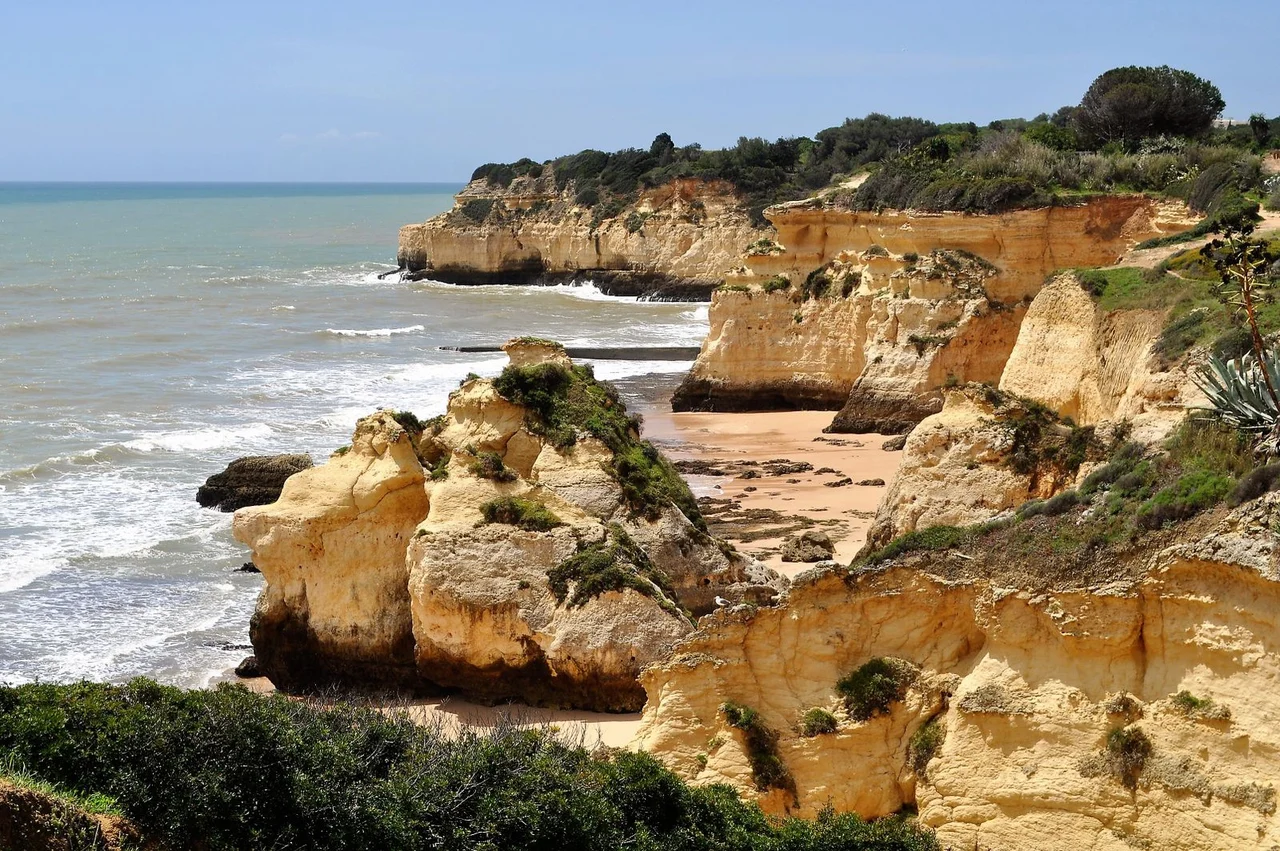
The Algarve is Portugal's southern province, and it's exactly where those seeking the mildest possible climate go for sun. According to open data, the region gets roughly 300 sunny days and about 3,000 hours of sunshine a year - one of the highest figures in Europe (approximate numbers).
What this means in practice:
- Winter is mild and sunny.By day it's usually 15-18°C, the thermometer almost never drops below 5°C, and snow only occurs in mountains away from the coast. In winter you can walk around in a light jacket and dine on a terrace here.
- Summer is hot but dry.In July-August, highs are around 29°C by the sea, with practically no rain. The heat is easier to bear than in humid regions.
- Autumn and spring are long.The swimming season stretches out, and the heat's peak is softened by the sea breeze.
It's exactly the combination of a mild winter and dry summer that makes the Algarve a magnet for pensioners and those seeking "eternal summer". A warm climate is one reason the region is so popular with relocators; details on life here are in our guidelife in the Algarve.
Lisbon and the center: warm, sunny, moderate winter rain
The capital and the country's central part are the golden middle of Portugal's climate. Lisbon is one of the warmest and sunniest capitals in Europe, yet without the coast's exhausting heat and without the north's dampness.
What a year in Lisbon looks like (approximate):
- Summer:average temperature around 23-24°C, daytime highs around 28°C. Dry, sunny, saved by the Atlantic breeze.
- Winter:12-15°C by day, moderate rain in waves. Snow near the coast is practically nonexistent, no frost.
- Spring and autumn:mild and comfortable, with plenty of sunny days.
Rain in Lisbon is concentrated in the cold half of the year (roughly November-March), and the annual precipitation total is about 800 mm, noticeably less than in the north. In summer, rain is rare. This makes the capital convenient for year-round living: warm, bright, but without extreme heat.
For families, rentiers, and remote professionals, the country's center is a frequent choice for its balance of climate, infrastructure, and connectivity. If you're planning to live on passive income, it's useful to weigh the weather against the practicalities of living in our article onretirement life in Portugal.
Porto and the north: greener, cooler, and noticeably rainier
Northern Portugal is a whole different story. The Atlantic calls the shots here: the air is humid, the sky is often overcast, and almost twice as much rain falls as in the south. But it's exactly this abundance of moisture that makes the north the country's greenest region, home to vineyards and famous port wine.
Porto's climate in figures (approximate):
- Temperature.Porto is on average about 3°C cooler than Lisbon year-round. About 25°C by day in summer, about 10-14°C in winter.
- Precipitation.The annual total reaches roughly 1,250 mm - almost 50% more than Lisbon. About 150 rainy days a year.
- Cloud cover.There are noticeably more overcast, gray days, especially from October to March.
This doesn't mean the north is bad - the climate here is simply more temperate and "European", closer to Atlantic France or northern Spain than to postcard southern sun. Many like it exactly for the mild, non-scorching summer and lush greenery. But for those fleeing rain and gray skies, northern Portugal suits worse than the south.
Madeira: the island of eternal spring, year-round
Madeira is a Portuguese island in the Atlantic roughly a thousand kilometers southwest of the mainland, and it has a completely distinct subtropical climate. It's not for nothing called the island of eternal spring: the temperature here stays in a narrow, comfortable range year-round.
Approximate figures:
- Winter:on the coast, about 20-21°C by day from December to April. This is warmer than spring on the mainland.
- Summer:about 25-27°C in July-September. Heat like on the mainland south is practically absent - the ocean tempers the warmth.
- On average:from ~17°C in winter to ~25°C in summer, with no sharp swings.
Rain on Madeira concentrates from October to mid-April, noticeably more often on the island's northern, windward side, while the southern coast (where the capital Funchal sits) is drier and sunnier. Thanks to the moisture, the island is covered in lush greenery, earning it the name Garden of the Atlantic.
For those who tolerate neither winter cold nor summer heat well, Madeira is an almost ideal climate: steady, mild, no extremes. The downside is island logistics and more limited choices compared to the mainland.
Where's warmest in Portugal: a short answer for relocators
If you boil it all down to a practical choice, the picture looks like this. The warmest and sunniest mainland region isThe Algarve: a mild winter, a dry hot summer, and roughly 300 sunny days a year. If your goal is minimum cold and maximum sun, along with a warm sea, the choice is obvious.
Let's rank the regions by "warmth" for living:
- The Algarve- the warmest and sunniest, the mildest winter, warm sea. Ideal for those fleeing the cold.
- Lisbon and the center- a very warm and sunny balance without extremes, with developed infrastructure.
- Madeira- eternal spring: no cold, no heat, but it's an island with its own logistics.
- Inland south (Alentejo)- the hottest in summer, but winter nights are cooler, and the heat can be tiring.
- Porto and the north- mild, but cooler and rainier; for lovers of greenery and non-scorching summers.
- The Azores- steady and mild, but humid and changeable, with no hot summer.
There's no universal answer: "warmer" for one person is the Algarve's dry sun, for another it's Madeira's steady mildness with no heat. So climate should always be tried on for your lifestyle, and it's also worth factoring in relocation practicalities - we cover them inour guide to Portugal.
What to pay attention to when choosing a climate: an expert's view
Over years of supporting relocations, we see the same climate-assessment mistakes again and again. They're easy to avoid if you know in advance.
- "South means hot year-round."In winter it's cool in the evening even in the Algarve, and homes often lack central heating. A warm winter isn't the same as a hot one.
- Underestimating the cold Atlantic.Many expect a warm sea all season, but the water in the center and north is bracing even in summer. For a warm sea, go south.
- Ignoring the coast/inland difference.50 km inland from the sea, and instead of a breeze there's summer heat above 35°C. This is critical for those who dislike heat.
- The north's humidity.Porto and Minho are beautiful and green, but there are many gray rainy days there - this isn't postcard sunny Portugal.
- The islands aren't the mainland.Madeira and the Azores have a milder climate, but they're separate logistics and a different pace of life.
The best way not to make a mistake is to visit your chosen region in the off-season, not just in summer, and experience the climate firsthand. Then the move will be a conscious decision, not one driven by emotions from vacation photos.
Bottom line: Portugal's climate as an argument for relocating
Portugal's climate is one of the most comfortable in Europe, but it isn't uniform, and that's its strength. The country lets you choose weather to suit yourself: the Algarve's dry sunny warmth, Lisbon's balanced climate, the north's green coolness, or Madeira's eternal spring. The common denominator is a mild winter with no frost near the coast, a long warm summer, and abundant sun, especially in the south and center.
The main benchmarks for a relocator: for sun and a warm sea, go south; for mildness without heat, go to the islands; for greenery and coolness, go north; and the center offers a golden middle. The Atlantic is cooler than it seems, and the south's inland areas are genuinely hot in summer - these two nuances are important to factor in beforehand.
The good news is that climate is just one factor, and it can and should be weighed against taxes, visas, and the cost of living. Current official information about the country is conveniently checked on the government portalgov.pt, and we cover the practicalities of relocating in detail in our articles onmoving to Portugaland the best places to live. Climate is the reason, and a competent relocation plan turns it into reality.
Not sure which country and status to choose?
We will compare suitable residency programs on budget, timelines and stay requirements - with a full cost calculation for your family.
Free of charge, we reply right away, no obligation.
The Azores: a mild but humid oceanic climate
The Azores are another autonomous region of Portugal in the middle of the Atlantic, and the climate here is the most "maritime" of all. It's a mild subtropical oceanic climate: temperatures are steady, but humidity is high, and the weather is changeable and shifts quickly throughout the day.
An approximate picture:
- Winter:about 12-15°C by day, no cold snaps.
- Summer:about 20-24°C by day - noticeably cooler than the mainland south, the ocean cools the air.
- Humidity:high, averaging 70-80%, hence the lush greenery and frequent short showers.
The main feature of the Azores is variability. In a single day you can see sun, fog, rain, and clearing again. Thanks to the warm Gulf Stream current, the islands know neither heat nor cold, but you shouldn't expect a stable "beach" summer here either.
The Azores are chosen by lovers of nature, quiet, and green landscapes, not those chasing a suntan. For permanent living, it's a niche but very distinctive option with a consistently mild, extreme-free climate.
"When a client says 'I want warm Portugal', I always clarify: what exactly does warm mean to you. For someone it's the Algarve's dry sun with a light jacket in winter, for someone else it's Madeira's steady eternal spring with no heat or cold, and for someone else the green cool north is more comfortable. The most common mistake is judging climate by summer vacation photos: people don't expect that homes without heating are cool in winter, that the Atlantic is bracing even in July, and that 50 km from the sea it's above 35 degrees in summer. I always advise visiting your chosen region in the off-season and living there for at least a couple of weeks. Climate isn't numbers in a table, it's your daily well-being for years ahead, and it needs to be tried on for your lifestyle."
Inland areas and Alentejo: summer heat near 40
Drive inland from the ocean coast, and the mild maritime climate gives way to a much harsher continental one. Inland areas, especially the southern province of Alentejo, genuinely scorch in summer.
What's important to know:
- Intense heat.In cities like Evora and Beja, summer often sees 33-40°C, and at the peak of heatwaves the thermometer can climb even higher. This is the hottest part of the country.
- Dryness.Little precipitation - Alentejo has only about 70 rainy days a year, with summer practically rain-free.
- Swings.Away from the sea, the gap between daytime heat and nighttime coolness is greater, and in winter nights can be noticeably colder than on the coast.
This contrast is important to factor in when choosing where to live. A home 50 km from the sea can end up in a completely different climate than a coastal town: instead of a refreshing breeze, dry heat above 35°C for most of summer. Those who don't tolerate heat well should consider the south's inland areas cautiously, favoring the coastal strip.
Sea temperature: when you can actually swim in the Atlantic
This is where newcomers' main disappointment lies: the ocean in Portugal is colder than expected from a sunny southern country. The Atlantic is noticeably cooler than the Mediterranean, and cold currents and upwelling of deep water near the coast are to blame. Even at the height of summer, the water in the north and center is bracing.
Approximate water temperatures:
- The Algarve (south):the warmest sea. About 22-25°C in August-September on the eastern (sheltered) coast, a bit cooler on the western.
- Lisbon and the center:about 18-21°C in summer, warmest in September. 14-17°C in winter.
- North (Porto):the coldest stretch - even in summer the water can be 6-7°C colder than in the south.
The practical takeaway: the comfortable swimming season on the mainland runs roughly from July to October, and the best months for the sea are August, September, and even October, when the water is warmest and the beaches less packed. September and October near the Lisbon coast are often considered the ideal time for swimming. If a warm sea matters, choose the Algarve, not the north.
Summary table: Portugal's climate by region and season
Let's gather everything into one summary table for a clear comparison of the regions. Air temperature values are given as approximate daytime figures, precipitation as a general characteristic of the season. This is a framework for choosing, not a precise forecast.
| Region | Season | Air temp by day (approx.) | Precipitation |
|---|---|---|---|
| The Algarve (south) | Summer | ~28-29 °C | Practically none |
| The Algarve (south) | Winter | ~15-18 °C | Rare, mild winter |
| Lisbon (center) | Summer | ~28 °C | Dry |
| Lisbon (center) | Winter | ~12-15 °C | Moderate, in waves |
| Porto (north) | Summer | ~25 °C | Rain possible |
| Porto (north) | Winter | ~10-14 °C | Frequent, ~150 days/year |
| Alentejo (inland) | Summer | ~33-40 °C | Very dry |
| Madeira | Year-round | ~17-27 °C | More often on the island's north side |
| The Azores | Year-round | ~12-24 °C | Frequent, high humidity |
The main takeaway from the table: the farther south and closer to the coast, the warmer and drier; the farther north and deeper inland, the more extremes (rain in the north, heat in the south's interior). The islands offer the most even climate, with no swings.
Frequently asked
Questions people ask before deciding
01What's the climate like in Portugal overall?
Portugal's climate is mild: in the south and center it's Mediterranean, with a hot dry summer and mild rainy winter; in the north it's oceanic, cooler and more humid. Near the coast there's no frost, and there's plenty of sun, especially in the south. The islands of Madeira and the Azores have an even steadier subtropical climate.
02Where's the warmest place in Portugal?
The warmest and sunniest mainland region is the Algarve in the south: a mild winter of about 15-18°C by day, a dry hot summer, and roughly 300 sunny days a year (approximate). If you need a steady climate with no heat or cold year-round, Madeira with its eternal spring feels warmest.
03How many sunny days does the Algarve have?
According to open data, the Algarve gets roughly 300 sunny days and about 3,000 hours of sunshine a year - one of the highest figures in Europe (approximate numbers). It's exactly the abundance of sun and the mild winter that make the region so popular with relocators and pensioners.
04Is it cold in Portugal in winter?
Near the coast, winter is warm by European standards: about 12-15°C by day in Lisbon, 15-18°C in the Algarve, with practically no frost or snow. It's more a cool rainy autumn than a real winter. It's coldest in the north and inland areas, where nights can be noticeably colder.
05Is it true that Porto gets a lot of rain?
Yes, northern Portugal is noticeably rainier than the south. Porto gets roughly 1,250 mm of precipitation a year - almost 50% more than Lisbon, with about 150 rainy days (approximate). Because of the abundant moisture, the north is very green, but there are more overcast, gray days there, especially from October to March.
06What's the climate like on Madeira?
Madeira is called the island of eternal spring: the subtropical oceanic climate holds the temperature in a narrow, comfortable range - roughly from 17°C in winter to 25°C in summer (approximate). There's no heat like on the mainland south, the ocean tempers the warmth. Rain is more common on the island's north side, the south is drier and sunnier.
07Is the sea warm in Portugal?
The Atlantic is cooler than the Mediterranean because of cold currents. The warmest sea is in the south, in the Algarve: about 22-25°C in August-September on the sheltered eastern coast. Near Lisbon it's about 18-21°C in summer, while in the north the water is bracing even in summer. For a warm sea, head south.
08Which month is best for swimming in Portugal?
The comfortable swimming season on the mainland runs roughly from July to October. The best months are August, September, and even October, when the water is warmest after a long summer and the beaches are less crowded. Near the Lisbon coast, September and October are often considered the ideal time for the sea.
09How hot is summer in Portugal's inland areas?
Very hot. Away from the ocean, especially in the southern province of Alentejo (the cities of Evora, Beja), summer often sees 33-40°C, and at heatwave peaks it can go even higher. There's almost no rain. This is the hottest part of the country, and for those who don't tolerate heat well, the coastal strip with the sea breeze suits better.
10What's the climate like in the Azores?
The Azores have a mild subtropical oceanic climate: about 12-15°C by day in winter, 20-24°C in summer - cooler than the mainland south. Humidity is high (70-80%), the weather is changeable, and both sun and rain are possible in a single day. There's no hot beach summer here, but it's mild and very green year-round.
11How does northern Portugal's climate differ from the south's?
The north (Porto, Minho) is oceanic: about 3°C cooler year-round, more humid and greener, with almost twice as much rain. The south (the Algarve, the center) is Mediterranean: hotter, drier, and sunnier, with a mild winter. Roughly speaking, the north resembles Atlantic France, while the south is postcard southern sun.
12Which region of Portugal to choose for climate?
If you want maximum sun and a warm sea, choose the Algarve. Need a balance of climate and infrastructure - the center and Lisbon. A steady climate with no heat or cold - Madeira. Love greenery and a mild summer - the north. There's no universal answer: climate should be tried on for your lifestyle, and ideally checked in the off-season, not just in summer.
Transparency
How this material was prepared
- Author
- Irena Sokolovska, head of Europe Office, BRIDGES
- Terms and costs last verified
- June 2026
- Sources
- official government authorities of the relevant country and state publications
- Methodology
- government minimum requirements are stated separately from due diligence charges, state fees, legal and banking costs
Sources and methodology
Figures, terms and timelines are checked against official sources as of June 2026. Link availability verified in August 2026. Third-party blogs and agent websites are not used as a source of programme terms.
- [1]Agência para a Integração, Migrações e Asilo (AIMA)Residence permits and how to applyaima.gov.pt/en
- [2]Portal das FinançasTax regimes and obligations of residentswww.portaldasfinancas.gov.pt
Methodology: tables and charts state government minimum investment requirements; due diligence charges, state fees, legal, banking and other costs are calculated separately and are not included in the minimum thresholds.
About the author
Related materials
What to read next
 ArticlePortuguese citizenship by descent in 2026: by parents, grandparents and birth
 ComparisonResidence permit for investment in 2026: Greece, Portugal or UAE - what to choose
 AnalysisWhat is due diligence and why the Caribbean is rejecting applications
Personal programme selection is conducted by Anna Kovalevskaya, Head of Legal, BRIDGES.
Residency in Portugal: timelines and requirements
Grounds, document list, presence requirements and what is needed for renewal.