Residency · Italy
Real estate in Italy by the sea 2026: regions, prices, and nuances

Updated: June 2026·11 min read·Expert reviewed
Terms and costs verified: June 2026
Contents
A house by the sea in Italy is a dream that costs some the price of a city apartment, and others the price of a good car. The spread is huge: per square meter in Amalfi or Forte dei Marmi more is asked than for a whole house in Calabria. So that buying a seaside apartment in Italy doesn't turn into disappointment, it's important to understand in advance the map of the coasts, real price levels, and the pitfalls of resort real estate - from seasonality and condominium fees to coastal restrictions. We break it down by region - from prestigious Liguria to budget Sicily - and say that buying housing on its own won't give a residence permit.
Map of Italy's coasts: from luxury to budget
Italy has about eight thousand kilometers of coastline - and prices along it differ several times over. Before looking for an apartment in Italy on the coast, it's useful to keep a simple map in mind: the North and part of the Center - expensive and prestigious, the South and the Adriatic - noticeably more affordable.
The premium belt includesLiguria(the Italian Riviera),The Tuscan coast(Versilia, Forte dei Marmi),The Amalfi Coastin Campania and the northSardiniawith the legendary Costa Smeralda. In spirit, the lakes join here too - Como, Garda, Maggiore - which formally aren't the sea, but hold a premium level of prices and demand.
The affordable belt is above allCalabria, Sicily, Apulia(especially inland from trendy Salento),Abruzzoand Marcheon the Adriatic. Here a house by the sea in Italy can genuinely be bought for money that wouldn't be enough for a studio in the North. The price difference isn't just prestige, but also seasonality, infrastructure, airport proximity, and resale liquidity.
Liguria: the Italian Riviera and sea views
Liguria is the showcase of Italian luxury on the water. A narrow strip between mountains and sea, colorful houses, yacht marinas, and a microclimate people come here for year-round. The average price level across the region holds roughly around 2,700 € per square meter, but that's a deceptive average.
In Genoa, options can be found from ~2,200 € per sqm, while in the province of Savona seaside housing starts from ~3,800 € per sqm, and premium properties with a direct sea view confidently exceed 4,500 € per sqm. Resort gems - Portofino, Santa Margherita Ligure, San Remo - live in their own price reality, where the count runs into many thousands of euros per meter.
The pros of Liguria: the highest liquidity, stable demand, mild climate, proximity to Milan and the French border. The cons: expensive, houses are often cramped and old, parking and a private garden are a rare luxury. This is a purchase for those who value status and capital preservation, not maximum rental yield.
The Tuscan coast: Versilia and Forte dei Marmi
When people talk about coastal Tuscany, they most often mean Versilia - a strip of beaches centered on Forte dei Marmi. This is an address for a very wealthy crowd: Italian aristocracy, entrepreneurs, and foreign buyers coexist here.
Across Tuscany overall, average prices hold at about 2,600 € per sqm, but seaside hotspots stand out several times higher. In Forte dei Marmi, real deals go in the range of roughly 8,000-12,000 € per square meter, putting the resort on par with the country's priciest markets. Viareggio and more modest Versilia towns are cheaper, but still not cheap.
What's important to understand: Tuscany sells not just the sea, but a whole lifestyle - wine, gastronomy, art, the Pisa and Florence airports nearby. Summer rental is in demand, but the net yield percentage is modest due to the high entry price. This is more an asset for your own vacations and long-term ownership than for aggressive investing.
The Amalfi Coast: a postcard for a lot of money
Amalfi, Positano, Ravello - a picture recognized worldwide: houses cling to cliffs above turquoise water. You pay in full for this postcard. In May 2026 the average asking price in Amalfi itself held at about 7,200 € per square meter - whereas across the province on average it's about 1,960 € per sqm. The gap shows how much the location outweighs everything else.
Fully renovated properties in such hotspots gained about 10% over a year - a fundamental supply shortage is at play: there's almost nowhere to build on protected slopes. Demand is stably high, rentals fly off the shelf in summer, occupancy is close to maximum.
The cons match the price: difficult logistics (narrow winding roads, few parking spots), expensive upkeep, renovation restrictions due to the territory's protected status. Rental yield in the premium segment is moderate - roughly 2-4% net, because the high price per meter limits the return percentage even with excellent revenue. Amalfi is bought with the heart and for status, not for the math.
Sardinia: Costa Smeralda and the affordable south
Sardinia is an island of contrasts. In the north - Costa Smeralda with Porto Cervo and Porto Rotondo, where premium villas go for 7,000-15,000 € per square meter, and individual lots cost even more. This is a closed world of yachts, boutiques, and a large international crowd.
But the average price across the island is much more modest - about 2,700 € per sqm, with moderate growth of roughly +1.9% a year. The south and less hyped towns - Villasimius, Pula, San Teodoro - give a noticeably cheaper entry at the same clear sea. Analysts expect the best seaside locations to grow roughly 3-8% over the coming year.
Sardinia is good for strong summer rental demand: sea view and proximity to the beach noticeably raise revenue, and short-term rental on Costa Smeralda is one of the most profitable in the Mediterranean. The flip side is pronounced seasonality: outside summer, life and demand quiet down, and the island's logistics add expenses. This is a market for those ready to live by the season's rhythm.
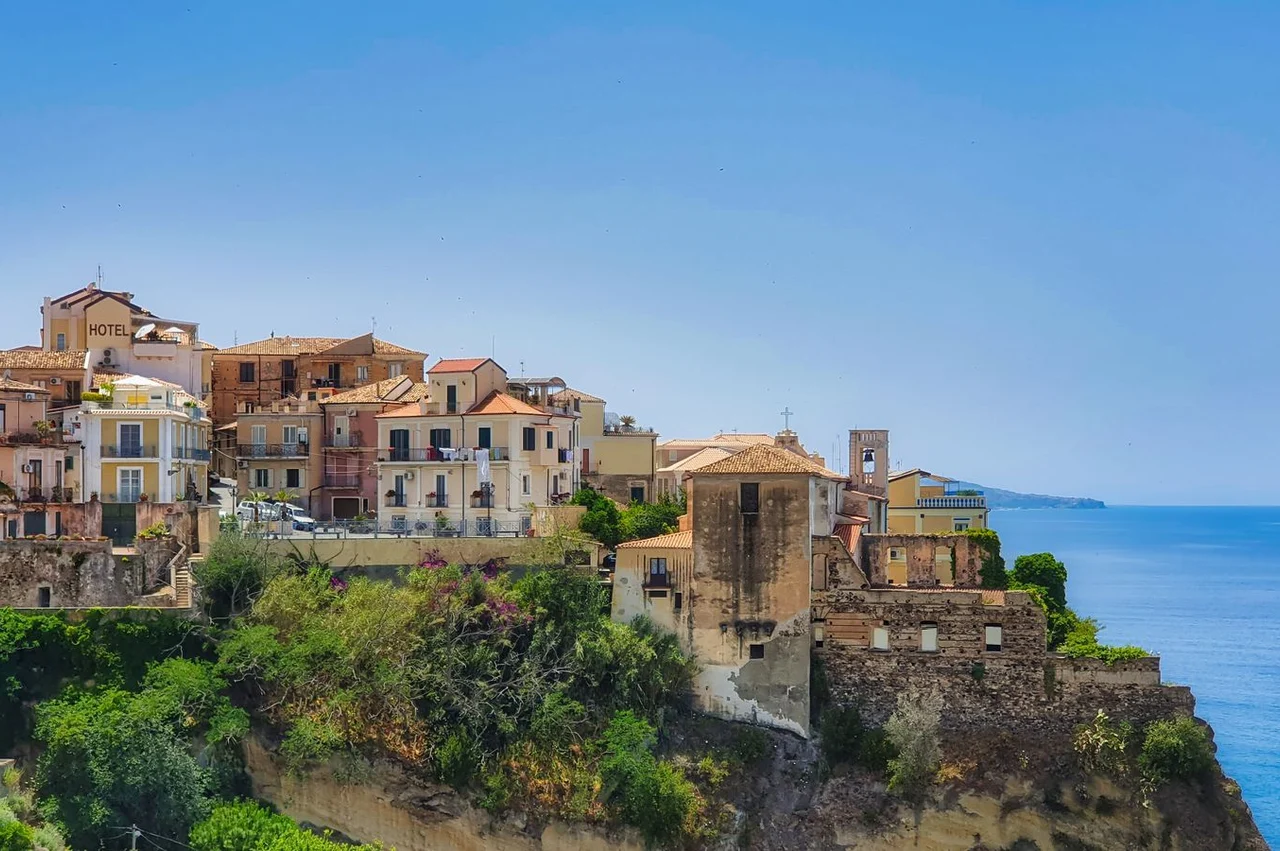
Calabria: Italy's most affordable sea
If the budget is limited but a house by the sea in Italy is genuinely wanted - look at Calabria. This is the country's most affordable coast: the average square meter holds at about 1,050 €, and whole seaside houses can genuinely be found in the 50,000-130,000 € range.
The resort town of Tropea, with its famous cliffs and beaches, is the region's showcase, and the town of Scalea has long become a magnet for budget buyers: apartments here start roughly from 30,000 €. For this money you couldn't even buy a closet in the North.
The pros are obvious: low entry threshold, clean sea, authentic southern Italy with no crowds. The cons are also : infrastructure is weaker in places, liquidity is lower (selling fast and expensive is harder), part of the housing stock needs repair, and the summer tourist flow is short and uneven. Calabria is a choice for vacationing and an unhurried lifestyle, not for fast speculation. Read more about budget purchases in our article oncheap real estate in Italy.
Sicily: a big island with small prices
Sicily is a huge selection of seaside housing at prices below the national average. Coastal Sciacca, Gela, and small towns near Palermo offer small apartments roughly from 60,000 €, and houses - up to 150,000 €. The average price per square meter across the island held at about 1,200 € - roughly half of what's asked in Tuscany.
The island wins not just on price: Mount Etna, Greek temples, Baroque towns, its own cuisine and culture. The famous 1-euro house program in depopulating villages (borghi) also operates here - but it's not a gift, but an obligation to renovate the property within a set term under a deposit. The romance quickly runs into the renovation budget.
Sicily suits a buyer looking for authenticity and a low budget, ready to dig into local procedures, and not counting on instant liquidity. For permanent living it's important to assess the infrastructure of the specific town in advance - the difference between the tourist coast and quiet hinterland is large.
Apulia, Abruzzo, and Marche: the golden mean
Between luxury and the very budget South there's a comfortable middle ground.Apulia- the heel of the Italian boot - is trendy thanks to Salento (Otranto, Gallipoli), where prices hold roughly in the 1,800-2,400 € per sqm range. A bit away from the hyped spots, closer to Brindisi, Lecce, and Taranto, properties often come in at 100,000 € and even lower, giving access to both white sandy beaches and rocky coves.
On the Adriatic, good options areAbruzzoand Marche. In Abruzzo, seaside towns like Pineto offer houses roughly from 70,000 to 140,000 € - sandy beaches framed by pine groves, calm family vacations, the Gran Sasso mountains nearby. Marche to the north is a quiet, green, underrated Adriatic with reasonable prices and good ecology.
This belt is a reasonable compromise: decent-quality sea, humane prices, infrastructure that's already not bad, and summer rentals that work. This is exactly where those for whom Liguria is too expensive and Calabria seems too out of the way often look. A review helps compare price levels across the country:real estate prices in Italy.
“The most common buyer mistake is looking only at the property's price and the beauty of the view, forgetting about two things: the real cost of ownership and the legal status of the beachfront. A house by the sea in Calabria for 60 thousand can turn out more advantageous than a studio in Liguria not because it's cheaper, but because it fits your goal - seasonal vacations - perfectly, and liquidity isn't as important to you. And vice versa: if you plan to live in Italy year-round, saving on the Adriatic will turn into off-season boredom. I separately warn about properties right by the water: a dock, a terrace over the sea, beach access - all of this can belong to the state maritime fund, and without a valid concession the deal will either fall through, or you'll buy a beautiful picture with no rights to it. And remember the main thing - in Italy buying square meters doesn't give a residence permit. Housing and legal status are two different tasks, and they need to be solved in parallel, not by hoping one will automatically give the other.”
Table: Italy's coasts, features, and price level
To keep the whole map in view, let's put the key regions into one table. Prices are approximate, the spread within a region is large - the specific town and sea view decide a lot.
| Coastal region | Feature | Price level |
|---|---|---|
| Liguria (Riviera) | Prestige, mild climate, high liquidity | High (from ~2,700 €/sqm, premium 4,500+) |
| Tuscany (Versilia) | Forte dei Marmi, a status-conscious crowd | Very high (8,000-12,000 €/sqm) |
| Amalfi (Campania) | Postcard views, a supply shortage | Very high (~7,200 €/sqm) |
| Sardinia (north) | Costa Smeralda, strong summer rentals | From medium to luxury (2,700 €, premium 7,000+) |
| Calabria | The most affordable sea, authenticity | Low (~1,050 €/sqm, houses from 50,000 €) |
| Sicily | A wide selection, 1-euro houses (borghi) | Low (~1,200 €/sqm) |
| Apulia (Salento) | A trendy destination, white beaches | Medium (1,800-2,400 €/sqm) |
| Abruzzo / Marche | A calm Adriatic, family vacations | Affordable (houses from 70,000 €) |
This breakdown is a starting point. From there, the specific property decides everything: floor, condition, distance to the water, parking availability, and legal cleanliness.
Nuances of resort real estate: seasonality and fees
Resort housing lives by its own rules, and it's better to know them before the deal. The first factor -seasonality. In the South and the islands life bustles for three to four summer months, while in winter resort towns empty out: cafés close, rental demand falls, every trip gets pricier due to weak transport links. For a vacation this is fine, for permanent living - a reason to choose places with year-round infrastructure.
The second factor -condominium fees(spese condominiali). These are mandatory payments for maintaining the building's common areas: cleaning, elevator, concierge, lighting, sometimes a pool and garden. They depend on the set of services and the owner's share, expressed in thousandths (millesimi), and roughly amount to 40 to 250 € a month. In premium complexes with service, the amount can be higher - budget it into the cost of ownership in advance.
The third factor -distance from airportsand transport. A beautiful bay three hours' drive from the nearest airport is both an inconvenience for yourself and a minus for rental yield: guests choose logistically simple destinations. Before buying, check the real travel time from the airport and whether there's winter transport.
Coastal restrictions: what demanio marittimo is
A separate and important topic for housing right by the water -the state maritime fund(demanio marittimo). Under Italian law, the coastal strip, beaches, and everything that opens directly onto the water belong to the state. If a house has its own dock, water access, boathouse, or terrace over the sea, a state concession (concessione demaniale) is required for them.
This isn't a formality. In 2025 the number of refused seaside deals grew roughly by 34%, and the main reason is exactly the absence or improper arrangement of the concession. A buyer risks discovering that the beautiful terrace over the waves isn't legally theirs, and dock rights can't be freely transferred with the house.
The conclusion is simple: any beachfront property needs a thorough legal check - who owns the plot down to the water, whether there's a valid concession, whether it transfers to the new owner and on what terms. This is the check you can't save on: a mistake here costs not percentage points, but the deal itself.
Renting out: what to realistically expect
Many buy seaside apartments in Italy so they pay for themselves through tourists. The logic works, but the figures should be understood soberly. In premium seaside locations net yield is modest - roughly 2-4% due to the high entry price: even strong revenue gives a small percentage against the expensive cost per meter.
Short-term rental gives large gross revenue, but it's eaten up by expenses. A rough calculation: 120 € a night, 22 nights a month, twelve months - that's about 31,700 € gross, but net after management company commissions (about 20%), cleaning, taxes, and vacancy periods, roughly 10-15% remains. In the South and the islands the summer season is short, and winter months don't bring in revenue.
Where the math works out best is affordable regions with a low entry price and stable summer flow: the return percentage is higher there than in luxury. And separately keep in mind short-term rental rules - they're tightening in Italy, registration and compliance with local norms are needed. Renting is a nice bonus on top of ownership, but building your main financial calculation on it is risky.
Vacation or permanent residency: how to choose for your goal
The main question before buying is why you need the housing. Different properties and regions suit these two goals.
For seasonal vacationsaffordable regions make sense - Calabria, Sicily, Abruzzo, Apulia. Low entry threshold, clean sea, authenticity. Seasonality isn't a problem here: you come in summer anyway, and small fees and rare winter life aren't critical. You can also afford a more remote location for beauty and price.
For permanent living or long winteringpriorities change: year-round infrastructure, healthcare, transport, and an airport within reasonable reach matter. Here Liguria, the Tuscan coast, the outskirts of large cities, or developed Adriatic spots are more often chosen - pricier, but with real life out of season. And the key point:buying real estate on its own doesn't give a residence permit in Italy- there's no golden visa for square meters here. Housing is comfort and an asset, while legal status is arranged separately through a suitable visa program.
The cost of ownership and purchase expenses
The property price is just the beginning. One-off transaction expenses and annual upkeep are added to it, and it's important to calculate them in advance.
When buyingbudget the registration tax (registro) or VAT (IVA) for new builds, notary expenses, agency and lawyer services. In total, accompanying costs often add a noticeable percentage to the price - especially if the property is bought as a second home, not the main one.
Annuallythe owner pays property tax (IMU) - it's not charged on a single main residence, but a resort house almost always counts as a second one, so IMU will apply. Add to this - condominium fees (40-250 € a month and up), utility payments, insurance, maintenance. For foreigners from CIS countries, purchase is possible on the reciprocity principle, and Russia has such reciprocity - the deal is conducted strictly within the legal field.
To avoid surprises, it makes sense to put together the full budget in advance: price plus transaction taxes plus annual upkeep. The BRIDGES GLOBAL team helps calculate the real cost of ownership for a specific region and property -leave a request for a consultation, and we'll lay out the figures piece by piece.
Property and status checks: where not to save money
The most expensive mistakes in the seaside market aren't in choosing the region, but in legal details. Before signing the preliminary contract, the property undergoes a full check: clean title, no debts or encumbrances, legality of all buildings and extensions, cadastre matching reality.
For housing right by the water, checking the state maritime fund (demanio) and concessions is added - exactly these caused the number of collapsed deals to grow in 2025. For 1-euro houses it's critical to assess the renovation budget and mandatory renovation deadlines, as well as the deposit. And if housing is needed not just for vacations but for legal residence in the country, status is arranged through a separate program -through the investor visaor another suitable route.
The tax side also needs attention: rates, benefits for a primary residence, the regime for new residents - all this is better calculated before the purchase. Details are collected in our review ofreal estate taxes in Italyand in the general guide tobuying real estate in Italy. BRIDGES GLOBAL helps connect buying a house by the sea with legal resident statusthe relocation program to Italyfrom BRIDGES GLOBAL.
Frequently asked
Questions people ask before deciding
01Does buying real estate in Italy give a residence permit?
No. Italy has no golden visa for real estate - buying an apartment or house on its own doesn't give a residence permit. Foreigners can buy housing, but legal status is arranged separately through a suitable visa program: the investor visa, the visa for the financially independent, and other routes.
02Where is the sea most affordable in Italy?
The most affordable coast is Calabria, where a square meter costs roughly about 1,050 €, and whole seaside houses can be found in the 50,000-130,000 € range. Close in affordability are Sicily (~1,200 €/sqm), Abruzzo, and part of Apulia outside trendy tourist spots.
03How much does a seaside apartment in Liguria cost?
In Liguria the average level holds at about 2,700 € per square meter, but in the province of Savona seaside housing starts from ~3,800 €/sqm, and premium properties with a sea view exceed 4,500 €/sqm. Resort spots like Portofino and San Remo cost several times more.
04Can Russians and CIS citizens buy real estate in Italy?
Yes, on the reciprocity principle, and Russia has such reciprocity. The deal is conducted strictly within the EU legal field, with enhanced compliance and no circumvention of sanctions. A Schengen visa is needed to enter. Buying housing doesn't mean automatically getting a residence permit or tax residency.
05What is demanio marittimo, and why does it matter?
Demanio marittimo is the state maritime fund: the coastal strip, beaches, and everything opening onto the water belong to the state. If a house has a dock, water access, or a terrace over the sea, a state concession is needed for them. In 2025 refusals of such deals grew roughly by 34% exactly due to the absence of concessions.
06What are the maintenance costs of seaside housing in Italy?
The main lines are condominium fees (spese condominiali) roughly 40-250 € a month, property tax IMU (a resort house is usually treated as a second home, so IMU applies), utility payments, insurance, and maintenance. In premium complexes with service, fees are higher.
07Is it realistic to buy a house in Italy for 1 euro?
1-euro houses in depopulating villages (borghi), including in Sicily, really exist. But it's not a gift: the buyer takes on an obligation to renovate the property within a set term and pays a deposit. The renovation budget usually far exceeds the symbolic price, so the whole budget needs to be calculated.
08What's the yield from renting out seaside real estate?
In premium locations, net yield is modest - roughly 2-4% due to the high entry price. Short-term rental gives large gross revenue, but after management company commissions (about 20%), taxes, and vacancy periods, roughly 10-15% remains net. The math works best in affordable regions with a low entry threshold.
09What to choose - the pricey North or the affordable South?
Depends on the goal. For seasonal vacations, affordable regions are advantageous - Calabria, Sicily, Abruzzo: low price, clean sea, seasonality isn't critical. For permanent living, year-round infrastructure, healthcare, and a nearby airport matter more - here Liguria, the Tuscan coast, or developed Adriatic spots are more often chosen.
10How much does real estate on Sardinia cost?
The average price across the island holds at about 2,700 € per square meter. In the north, in the Costa Smeralda area (Porto Cervo, Porto Rotondo), premium villas go for 7,000-15,000 €/sqm. The south and less hyped towns - Pula, Villasimius, San Teodoro - give a noticeably more affordable entry at the same sea quality.
11What's good about Apulia, Abruzzo, and Marche?
This is the golden mean between luxury and the very budget South. Apulia (Salento) is a trendy destination with prices roughly 1,800-2,400 €/sqm. Abruzzo offers seaside houses from 70,000 to 140,000 € with sandy beaches. Marche is a quiet, green, underrated Adriatic with reasonable prices and good ecology.
12What checks are needed before buying a house by the sea?
Checking clean title, no debts or encumbrances, legality of all buildings, and cadastre matching reality are mandatory. For beachfront property, checking the state maritime fund and concessions is added. For 1-euro houses it's critical to assess the renovation budget and mandatory renovation deadlines. The tax side is also better calculated before the deal.
Transparency
How this material was prepared
- Author
- Igor Venc, real Estate Managing Director, BRIDGES
- Terms and costs last verified
- June 2026
- Sources
- official government authorities of the relevant country and state publications
- Methodology
- government minimum requirements are stated separately from due diligence charges, state fees, legal and banking costs
Sources and methodology
Figures, terms and timelines are checked against official sources as of June 2026. Link availability verified in August 2026. Third-party blogs and agent websites are not used as a source of programme terms.
- [1]Investor Visa for ItalyConditions of the investor visainvestorvisa.mise.gov.it
- [2]Ministry of Foreign Affairs of ItalyConsular services and visaswww.esteri.it/en/servizi-consolari-e-visti
Methodology: tables and charts state government minimum investment requirements; due diligence charges, state fees, legal, banking and other costs are calculated separately and are not included in the minimum thresholds.
About the author
Related materials
What to read next
 ArticleItalian citizenship by birth in 2026: children, jus soli and reality
 ComparisonAntigua and Barbuda or Grenada: Family Passport for Large Families in 2026
 AnalysisWhat is due diligence and why the Caribbean is rejecting applications
Personal programme selection is conducted by Anna Kovalevskaya, Head of Legal, BRIDGES.
Buying property in Italy: what to check
Title, encumbrances, outstanding debts and what to look for in the contract.