Residency · Greece
Tourism in Greece 2026: what to see - Athens, the islands, Meteora and the best season

Updated: June 2026·13 min read·Expert reviewed
Terms and costs verified: June 2026
Contents
Greece isn't one country, but several at once: ancient Athens with the Acropolis, snow-white islands of the Aegean Sea, the monasteries of Meteora floating above the ground, and the green shores of the Ionian. Planning a trip around Greece so as not to waste the vacation on transfers and not get caught in the August heat is a separate art. In this practical guide we break down what to see in Greece, which islands to choose for a vacation, when to go, and what a Russian tourist needs. And at the end - a answer to the question almost everyone asks sooner or later: what to do if you like the country so much you want to stay.
Why Greece is a country people come back to
Greece holds a spot in the top ten most visited countries in Europe not because of one postcard, but because of a rare combination of everything at once. In one trip you can climb to an ancient temple two and a half thousand years old, swim in turquoise-colored water, have dinner with fresh fish at a pier-side taverna, and catch a sunset people fly in from the other side of the world for. No other European country packs history, sea, and gastronomy so tightly.
The second reason is the scale of choice. Greece has about six thousand islands and islets, of which just over two hundred are inhabited. This means a trip around Greece can be assembled for any character: some want parties and design hotels, others want silence, olive groves, and an empty beach. Greece's sights aren't just the Acropolis and Santorini, but dozens of places not written about in standard roundups.
The third reason is that it's a country easy to fall in love with enough to want to stay longer than a vacation. A mild climate, safety, an unhurried pace of life, and EU membership make Greece a popular destination not just for a vacation, but for relocation. We cover the weather by month in detail in a separate article onthe climate and weather in Greece, and here we'll focus on the dream itinerary.
Athens: the Acropolis, the Parthenon, and the old town of Plaka
Almost any trip around Greece starts with Athens - most international flights arrive here, ferries and domestic flights to the islands radiate from here. But Athens isn't just a transport hub, it's a full-fledged city for two or three days of packed program.
The heart of the city and Greece's main attraction is the Acropolis, a rocky hill with temples from the 5th century BC. What to definitely see at the Acropolis:
- The Parthenon- the temple of the goddess Athena, a symbol of all ancient architecture and Greece's most recognizable building.
- The Erechtheionwith its famous Porch of the Caryatids - columns in the shape of female figures.
- The Temple of Athena Nike- an elegant small temple at the entrance to the rock.
- The Odeon of Herodes Atticusand the Theater of Dionysus - ancient amphitheaters at the foot of the hill, where concerts are still held today.
Below the Acropolis lies Plaka - Athens's oldest residential quarter, with narrow streets, neoclassical houses, shops, and tavernas. Nearby is the Monastiraki district with a flea market and the Anafiotika quarter, which looks like a piece of a Cycladic island in the middle of the capital. It's worth going up Lycabettus Hill or to one of the rooftop terraces at sunset: the Acropolis lit by the evening sun is a sight people come here for.
Practical advice: in summer the Acropolis is open roughly from 8:00 to 20:00, in winter until 17:00. Come at opening or after five in the evening - fewer people and soft light for photos. On the hottest days of July and August the site is sometimes closed during midday hours due to the heat.
The best Greek islands for a vacation: a short guide
The islands are what people go to Greece for in summer. They're conditionally divided into groups: the Cyclades in the Aegean Sea (postcard white-and-blue villages), the Ionian islands in the west (greenery and Italian flavor), the Dodecanese off the coast of Turkey (medieval fortresses), and huge Crete as a world of its own. The choice depends on exactly what you're looking for.
| Island | Who it suits and what to see |
|---|---|
| Santorini | Romance and sunsets: the white villages of Oia and Fira above the volcanic caldera, wineries, black beaches |
| Mykonos | Parties and design hotels, windmills, Little Venice, quiet northern beaches |
| Crete | The largest island - Greece in miniature: the Palace of Knossos, Samaria Gorge, Elafonisi beach, mountains and towns |
| Rhodes | History: one of Europe's best medieval old towns, Lindos, the Valley of the Butterflies, beaches for every taste |
| Corfu | Greenery and the Ionian: Venetian architecture, olive groves, a soft green landscape, a calm vacation |
| Zakynthos | Navagio Bay (Shipwreck) with turquoise water, sea turtles, dramatic cliffs |
The main planning rule: don't try to embrace the unembraceable. In one trip you can realistically see one or two islands well, not five. Hopping from ferry to ferry every other day eats up the vacation and your energy. Below we break down the key destinations in more detail.
Santorini and Mykonos: postcard Greece of the Cyclades
Santorini is Greece's most recognizable island and one of the most photographed spots on the planet. It's half of a flooded volcano: the villages of Oia and Fira cling to the edge of the caldera cliff, white houses with blue domes hang above the sea at a height of three hundred meters. Sunset in Oia is almost a ritual, gathering hundreds of people. Besides the views, on the island it's worth visiting the wineries (local wine from assyrtiko grapes is famous worldwide), swimming at the red and black volcanic beaches, and seeing the excavations of ancient Akrotiri - a Minoan city buried under ash, Greece's Pompeii.
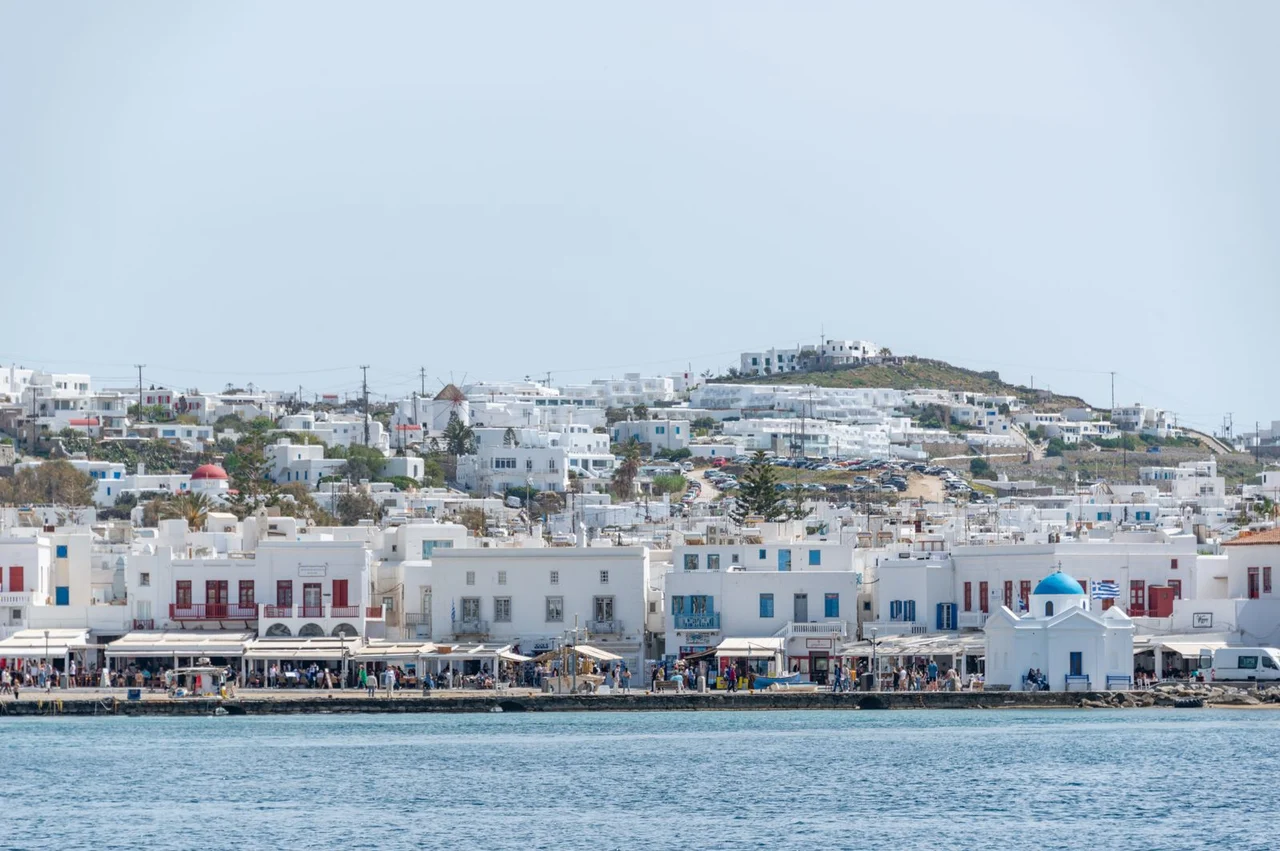
Mykonos is Santorini's neighbor in the Cyclades, but with a different character. It's an island of parties, beach clubs, and design boutique hotels. Its calling card is a row of old windmills and the Little Venice quarter, where houses stand right in the water. At the same time Mykonos has long outgrown its reputation as just a party island: on the north coast there are quiet, almost deserted beaches and excellent gastronomy.
An important seasonal nuance: both Santorini and Mykonos are islands that reveal themselves best in spring and autumn. In July and August it's the peak of prices, heat, and crowds here, the Santorini caldera is literally packed with cruise ship tourists. In May, June, September, and early October the same views, the same sea, but twice as calm and cheap.
Crete and Rhodes: history, nature, and beaches with no rush
If you only have a week and want the feeling of seeing all of Greece at once, choose Crete. The largest Greek island is, in essence, a separate country: mountain ranges with gorges, palm beaches, old Venetian ports in the towns of Chania and Rethymno, and the Palace of Knossos - the center of the oldest civilization in Europe, Minoan, with the legend of the Minotaur. In the south is the famous pink beach of Elafonisi and Balos lagoon, in the west the dramatic Samaria Gorge for hiking enthusiasts. Crete is enough for a beach holiday, active routes, and a gastronomic tour: Cretan cuisine is considered one of the healthiest in the world.
Rhodes is the main island of the Dodecanese, right off the coast of Turkey. Its gem is the medieval Old Town, one of the best preserved in Europe: mighty fortress walls, the Palace of the Grand Master, the cobbled Street of the Knights. This is the legacy of the Knights Hospitaller, who ruled the island in the Middle Ages. Outside the town is ancient Lindos with an acropolis on a cliff above the sea, the Valley of the Butterflies, and dozens of beaches for every taste, from windy surf spots to calm coves.
Both islands are good in that they don't require rushing. Their large size means tourists are spread out, and even in high season you can find an empty shore. This is a great choice for a family vacation and for those wanting to combine the beach with sightseeing without daily overload.
Corfu and Zakynthos: the green Ionian and Navagio Bay
The Ionian islands in western Greece are a completely different Greece, unlike the arid Cyclades. There's more greenery here, winter rain, olive groves, and cypresses, and Italian influence is felt in the architecture - these islands were under Venice for centuries and never knew Ottoman rule.
Corfu (Kerkyra) is the most famous of them. Corfu's old town, with its Venetian fortresses, arcades, and a square in the style of French Paris, is on the World Heritage list. The island is drowning in greenery, with a soft landscape, cozy bays, and a calm, almost aristocratic vacation pace. Corfu is loved because it suits both families with children and those tired of noisy Cycladic parties.
Zakynthos further south is first and foremost Navagio Bay, also known as Shipwreck Beach. A narrow strip of white sand squeezed between sheer cliffs, a rusted hull of a wrecked ship in the center, and water around it glowing an incredible turquoise. It's one of the most photographed bays in the world, reachable only by boat from the sea. In addition, rare Caretta caretta sea turtles live off the shores of Zakynthos, for which a marine reserve was created.
The Ionian islands are a good choice if you want sea and beaches but don't like sun-scorched landscapes and prefer greenery, shade, and an unhurried pace.
Meteora: monasteries floating above the ground
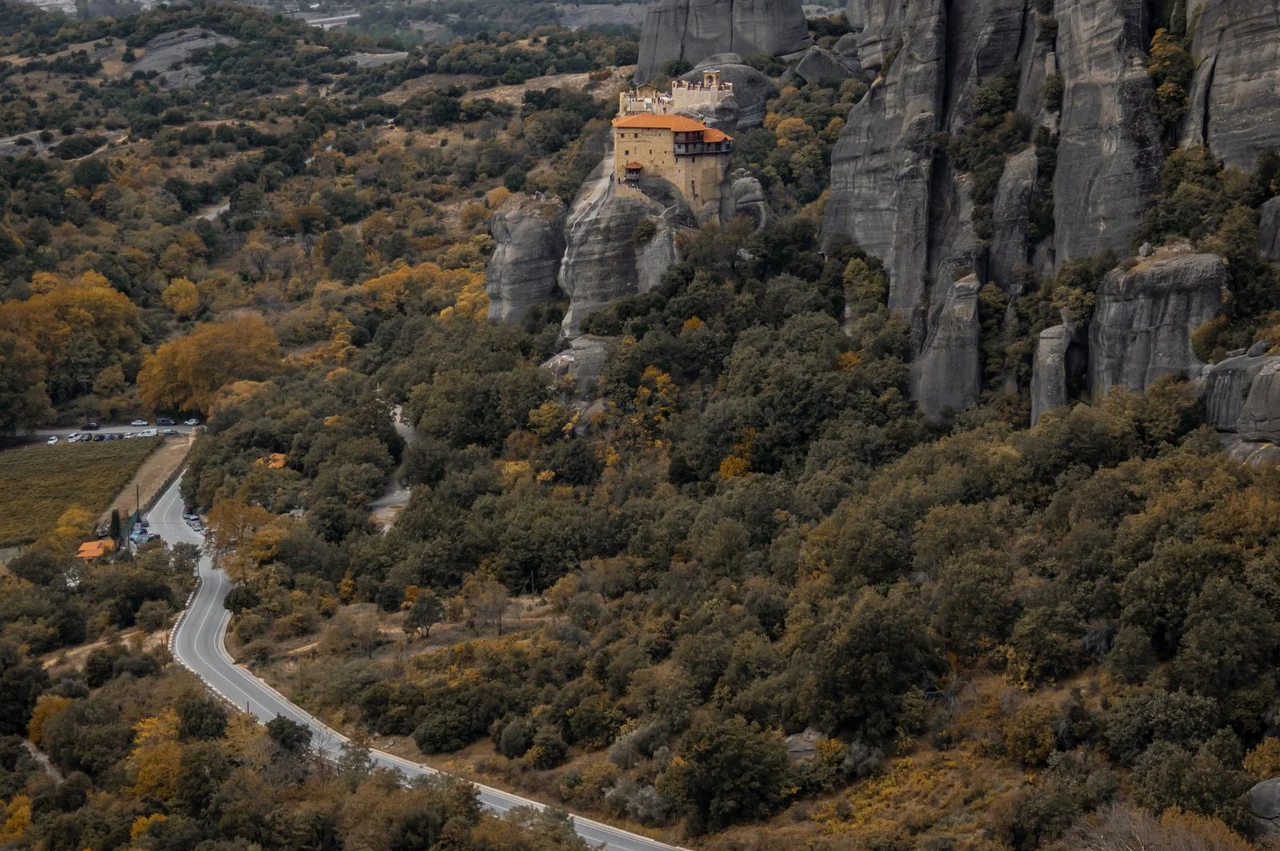
The most unusual place on mainland Greece is Meteora. The word itself translates from Greek as “suspended in the air”, and that's an exact description: on top of giant stone pillars rising up to 400 meters above the plain stand Orthodox monasteries. From a distance they really do seem suspended in the sky.
At its peak there were 24 monasteries here, today six are active and open to visitors. Monks used to climb up on rope ladders and in nets hauled up by winches - that's how they escaped worldly bustle and raids. Now steps and roads carved into the rock lead to the monasteries, accessible on foot or by car.
What's important for a tourist to know:
- The dress code is strict.These are active monasteries. Women need a long skirt (a wrap-around one is usually given out at the entrance) and covered shoulders, men can't wear shorts.
- When to come.Early morning at opening - fewer tour groups, and at 15:00-17:00 the best light on the rocks for photos.
- How to get there.The base town is Kalambaka (and the village of Kastraki right at the cliffs). From Athens it's convenient to go by train or on a two-day tour, often paired with Delphi.
Meteora is a UNESCO World Heritage site under two criteria at once, natural and cultural. This place makes a strong impression even on those far from religion: the combination of sheer cliffs, ancient frescoes, and silence stays with you for a long time.
Delphi and the Peloponnese: antiquity beyond Athens
If you want to see real ancient Greece, not just the Acropolis, the mainland has at least two more destinations worth a separate trip.
Delphi- in antiquity a famous oracle stood here, which kings and generals from all over Greece consulted for prophecies. The sanctuary is on the slope of Mount Parnassus in a stunningly beautiful spot: the ruins of the Temple of Apollo, an ancient theater, and a stadium descend the mountain in terraces, with a valley of olive groves stretching below all the way to the sea. The ancient Greeks considered Delphi the “navel of the earth”, the center of the world. The museum at the excavations holds unique finds, including the bronze Charioteer statue. Delphi is convenient to visit as a day trip from Athens or combine with a trip to Meteora.
The Peloponnese- a large peninsula in the south that many tourists unjustly skip. And wrongly so: a huge part of the ancient and medieval heritage is concentrated here. What to see:
- Ancient Olympia- the birthplace of the Olympic Games, a stadium and temples.
- Epidaurus- an ancient theater with perfect acoustics, where a whisper can be heard from the last row.
- Mycenae- the fortress of the legendary King Agamemnon with the Lion Gate.
- Monemvasia and Nafplio- fairy-tale medieval fortress towns by the sea.
The Peloponnese is ideal for a road trip: distances are short, roads are good, and there are noticeably fewer tourists than on the islands. This is Greece for those who want to dig deeper than the standard route.
Greek cuisine: what to definitely try
A trip around Greece without the gastronomy is half a wasted trip. The local cuisine is the standard of the Mediterranean diet: lots of vegetables, olive oil, fresh fish, herbs, and cheeses. The main virtue of Greek food is the simplicity and quality of ingredients, not complex sauces.
What's worth definitely trying:
- Greek salad (horiatiki)- tomatoes, cucumbers, onion, olives, and a whole block of feta on top, drizzled with olive oil. Back home it's nothing like what most restaurants around the world serve.
- Souvlaki and gyros- meat on a skewer and in flatbread, Greece's main street food.
- Moussaka - a casserole of eggplant, ground meat, and béchamel sauce.
- Fresh fish and seafood- on the islands they're served in tavernas right by the pier, grilled octopus is a must.
- Cheeses- not just feta, but smoked metsovone, soft graviera, and Cretan xynomyzithra.
For drinks, try the local wine (especially assyrtiko from Santorini), ouzo anise spirit, which turns cloudy with water, and Cretan rakomelo. The meal is usually finished off with a glass of clean water and a serving of yogurt with honey and nuts. A separate ritual is Greek coffee and hours-long sitting at a kafenio: rushing isn't welcome here.
“I always tell clients: to understand Greece, it's not enough to see it in July from a cruise ship in a crowd of tourists. Come in May or September, get a car, drive through the Peloponnese, go up to Meteora, live a week on one island rather than jumping across five. This is exactly how people really fall in love with this country - with its unhurried pace, its light, its food, its sea. And that's when many end up with a natural question: can you not just vacation here, but live here. You can. Greece is an EU member, the climate is mild, real estate is liquid, and buying a home opens a residence permit for the whole family. I've seen dozens of stories that started with an ordinary vacation and ended with their own house by the sea and a residence permit in Europe. The main thing is not to confuse a tourist visa with the right to live in the country, and to sort out the legal paths in advance.”
When to go to Greece: the best season by month
The question “when to go to Greece” matters more than it seems: the same island in May and in August is two completely different experiences in price, weather, and crowd size. The tourist season in Greece runs roughly from April to October.
| Period | What to expect | Who it suits |
|---|---|---|
| April-May | Warm (18-25 C), everything blooms, few tourists, the sea still cool | Sightseeing, Athens, Meteora, the mainland |
| June | Summer, warm sea, not yet peak crowds and prices | The optimal balance for beaches and islands |
| July-August | Heat up to 38 C and above, peak prices and crowds, the warmest sea | A beach holiday, if the heat and prices don't scare you off |
| September | The sea is warmed up from summer, the heat and tourist flow are subsiding | The best month for most: beach plus comfort |
| October | Warm during the day, mild, quiet, part of the infrastructure closes toward the end | A calm vacation, cities, cultural routes |
The experts' universal answer: the best months to travel to Greece are April-June and September-October. In spring and early autumn you get warm weather without exhausting heat, calm beaches with no crowding, and prices noticeably lower than July-August. July and August are good only for those going specifically for the sea and ready to put up with heat and crowds. A detailed breakdown of temperatures by month and region - in our article onthe climate and weather in Greece.
A Greece visa for Russians: what a tourist needs
Greece is an EU and Schengen member, so Russian citizens need a Schengen visa for a tourist trip. There's no visa-free entry for Russian passports.
What's important to know in 2026:
- Visa type.For tourism a type C Schengen visa is arranged (short-term, up to 90 days per six months).
- The consular fee- 80 euros, plus the visa center's service fee.
- Insurance.Medical insurance with coverage of at least 30,000 euros, including repatriation, is mandatory.
- Finances.You need to confirm sufficient funds for the trip - roughly from 50 euros per day of stay.
- Documents.Application form, international passport, photo, accommodation and ticket bookings, trip itinerary.
- Timelines.It's worth filing the application in advance - review realistically takes two to six weeks.
After 2022 the rules for Russians tightened: issuance became stricter, long-term multiple-entry visas are given less often. Nevertheless, Greek visas continue to be issued to tourists. We've put together a full step-by-step breakdown - who files, which documents, and how to avoid refusal - in a separate article onthe Greece visa for Russians. Current requirements should always be checked on Greece's official government services portal toogov.gr.
How to plan an itinerary: from one week to two
Tourists' main mistake in Greece is trying to see everything at once. The country is large, ferries between islands take hours, and chasing checkmarks easily turns a vacation into a race with suitcases. It's better to choose one region and get to know it properly.
A few proven schemes for different durations:
- A week, first time in Greece.2 days in Athens (the Acropolis, Plaka, museums) plus one nearby island - for example Santorini or the neighboring Cyclades. Minimum travel, maximum impressions.
- A week, for history lovers.The mainland circuit: Athens - Delphi - Meteora. This is the best cultural route in mainland Greece, doable in 5-6 days.
- A week, a beach holiday.One large island in full - Crete or Rhodes. They're enough for both the beach and sightseeing without rushing.
- Two weeks.Athens plus a combination of islands from one group (for example the Cyclades: Santorini, Naxos, Paros) or Athens plus the mainland plus one island.
Ferries run between islands (slow and high-speed ones), and domestic flights operate - for distant islands like Rhodes or Crete it's often faster and no more expensive to fly. On the mainland it's most convenient to get around by rental car, especially in the Peloponnese. Budget time for travel and don't plan to switch islands more than once every three or four days.
An expert's view: how not to ruin your trip to Greece
Over years of working with clients who travel to Greece both as tourists and as future residents, we've seen the same mistakes. Let's collect them into a short checklist so you don't step on the same rakes.
- Don't try to visit five islands in a week.Ferries eat up time and energy, and impressions get blurred. One or two places explored deeply give more than a whirlwind tour of the highlights.
- Avoid July-August if you can.Peak heat near 40 degrees, packed beaches, and double prices. May, June, September - the same beauty twice as comfortable.
- Book ferries and hotels in advance.In season, popular destinations sell out weeks in advance, and housing prices rise visibly.
- Budget time for the visa.It's worth filing documents a month and a half to two months before the trip, not at the last minute.
- Respect the dress code.You won't be let into the Meteora monasteries or churches in shorts or with bare shoulders - bring something more covered.
And the main observation: almost everyone who comes to Greece in spring or autumn returns. Some again as tourists, others already with a thought of their own house by the sea. If that second thought has crept in for you too, it's better to sort out the legal paths in advance, not put it off for later.
Want not just to visit, but to stay in Greece
A very common scenario: a person comes to Greece for two weeks, falls in love with the sea, the climate, and the unhurried pace - and starts thinking about how to stay here long-term, not just 90 days on a tourist visa. The good news: there's a legal path, and it doesn't require giving up your usual life.
The clearest option is getting a residence permit through a property purchase (the Golden Visa program). This gives the right to live in Greece, move freely across Schengen, and have your own house by the sea here, not a rented apartment for a couple of weeks a year. We handle getting a residence permit and selecting property in Greece turnkey - from choosing the property to arranging status for the whole family.
Discuss relocating and a Greece residence permit with a BRIDGES GLOBAL expert- we'll tell you which budget and which region suit you specifically.
How to stay in Greece legally: a residence permit and the Golden Visa
If the vacation has grown into a desire to relocate, it's important to understand the difference between tourist entry and a residence permit. The tourist Schengen visa gives a maximum of 90 days per six months - not enough for living there. Long-term residence requires a residence permit, and the most direct path to it for an investor is the Golden Visa program.
How this works in 2026 (approximate, thresholds should be confirmed before the deal):
| The Golden Visa option | Condition |
|---|---|
| Real estate, base threshold | from 250,000 euros - only for landmark restoration or converting a commercial property to residential |
| Real estate, standard | from 400,000 euros in most regions |
| Real estate, premium zones | from 800,000 euros (Athens, Thessaloniki, Mykonos, Santorini, and popular islands) |
| The property's minimum area | from 120 m², one deal |
| Residence permit term | 5 years, renewable, for the whole family |
Key advantages: physical presence in the country is barely required, the status covers the spouse and children, and after years of legal residence the path opens to permanent residence and EU citizenship. An important caveat: short-term rental of such housing (through Airbnb and similar services) is prohibited for Golden Visa properties - it risks residence permit revocation and a fine. A full breakdown of the program - in the article onthe Greece Golden Visa. And if you're specifically interested in living in the capital, read the guide onlife in Athens.
Bottom line: how to put together the perfect trip around Greece
Greece gives rare freedom of choice. In one trip you can stand by the Parthenon, older than most world capitals, sail a boat to Navagio Bay, climb to the floating monasteries of Meteora, and end the day with fish at a seaside taverna under a Santorini sunset. Greece's sights aren't exhausted by postcards - there's always a second and third layer behind the standard routes.
To boil it down to simple rules: choose April-June or September-October, don't chase the number of islands, be sure to add at least one cultural destination to the beach - Athens, Delphi, or Meteora - and sort out the visa question in advance. Then the trip will go smoothly with no rush or disappointment.
And if you like Greece so much you want more than a vacation, remember: the country is open to those who want to live here. The legal path starts with a residence permit, and it's built most simply throughthe Golden Visa and buying property. Many of our clients started exactly with a tourist trip - and ended up with the keys to a house by the Aegean Sea.
Frequently asked
Questions people ask before deciding
01What must you see in Greece on a first trip?
The minimal program is Athens with the Acropolis and Parthenon, one island (most often Santorini or Crete), and, if there's time, Meteora or Delphi. This is enough to see three facets of Greece: antiquity, the islands, and nature. Chasing a large number of places the first time isn't worth it - it's better to get to know a few deeply.
02Which Greek islands are best for a vacation?
Depends on what you're after. Santorini - for the views and sunsets, Mykonos - for parties and design hotels, Crete - for diversity (Greece in miniature), Rhodes - for history and the medieval town, Corfu - for greenery and calm, Zakynthos - for Navagio bay. For a first trip, Crete or Santorini is often chosen.
03When is the best time to go to Greece?
April-June and September-October are optimal: warm but without exhausting heat, calmer with tourists, and noticeably cheaper. September is especially good - the sea is warmed up from summer, and the crowds have already thinned. July and August are the peak of heat (up to 38 C and above), prices, and crowds, suited only for a beach holiday.
04What is Meteora and is it worth going there?
Meteora is a complex of Orthodox monasteries atop rock pillars up to 400 meters high in central Greece, a UNESCO World Heritage site. Today six monasteries are active and open to visitors. The place makes a strong impression even on non-religious people. It's convenient to go from Athens, often paired with Delphi.
05How many days do you need for Athens?
For most tourists 2 full days is optimal. In this time you can manage the Acropolis and the Acropolis Museum, the old town of Plaka, Monastiraki, the ancient Agora, and a couple of rooftop terraces with a view. Athens is usually used as a starting point before a flight or ferry to the islands.
06Do Russians need a visa for Greece in 2026?
Yes, you need one. Greece is an EU and Schengen member, there's no visa-free entry for Russian passports. For tourism a type C Schengen visa is arranged for up to 90 days. The consular fee is 80 euros, insurance from 30,000 euros is mandatory. It's better to file documents a month and a half to two months before the trip.
07Which bay in Greece is the most beautiful?
The most famous is Navagio Bay (Shipwreck) on the island of Zakynthos: a strip of white sand between sheer cliffs, a rusted ship's hull, and water of an incredible turquoise color. You can only get there by boat from the sea. It's one of the most photographed bays in the world.
08What should you try in Greek food?
Definitely a Greek salad with feta, souvlaki and gyros (meat street food), moussaka, fresh fish and grilled octopus at island tavernas, local cheeses. For drinks - assyrtiko wine from Santorini, ouzo anise spirit, and Greek coffee. And yogurt with honey for dessert.
09What's the best way to travel between islands?
Ferries run between islands - regular and high-speed. For distant islands (Crete, Rhodes) it's often faster and no more expensive to fly a domestic route. On the mainland, especially the Peloponnese, it's most convenient to rent a car. Don't plan to switch islands more than once every three or four days - transfers eat into the vacation.
10Which route should you choose for your first trip to Greece?
For a week, three schemes work: Athens plus one island (a classic for beginners); the mainland cultural circuit Athens-Delphi-Meteora (for history lovers); one large island in full - Crete or Rhodes (for an unhurried beach holiday). For two weeks you can combine Athens, the mainland, and the islands.
11Can you stay to live in Greece after a tourist trip?
A tourist visa gives a maximum of 90 days per six months. Living there requires a residence permit. The most direct path for an investor is the Golden Visa program: buying property (thresholds from 250,000 to 800,000 euros depending on the region) gives a 5-year residence permit for the whole family and a path to permanent residence and EU citizenship.
12Can you rent out an apartment bought under Greece's Golden Visa?
Long-term rental (a year or more) is allowed, but short-term daily rental (through Airbnb and similar services) is prohibited for properties bought under the Golden Visa. A violation risks residence permit revocation and a fine. This is important to consider if you're viewing property as a source of income.
Transparency
How this material was prepared
- Author
- Anna Kovalevskaya, head of Legal, BRIDGES
- Terms and costs last verified
- June 2026
- Sources
- official government authorities of the relevant country and state publications
- Methodology
- government minimum requirements are stated separately from due diligence charges, state fees, legal and banking costs
Sources and methodology
Figures, terms and timelines are checked against official sources as of June 2026. Link availability verified in August 2026. Third-party blogs and agent websites are not used as a source of programme terms.
- [1]Ministry of Migration and Asylum of GreeceResidence permits, including the investor permitmigration.gov.gr/en
- [2]Enterprise GreeceConditions of the investor programmewww.enterprisegreece.gov.gr/en
Methodology: tables and charts state government minimum investment requirements; due diligence charges, state fees, legal, banking and other costs are calculated separately and are not included in the minimum thresholds.
About the author
Related materials
What to read next
 ArticleGreek citizenship by descent in 2026: by roots, parents, grandparents
 ComparisonGolden Visa of Greece or Caribbean citizenship 2026: EU residence permit versus second passport
 AnalysisWhat is due diligence and why the Caribbean is rejecting applications
Residency in Greece: timelines and requirements
Grounds, document list, presence requirements and what is needed for renewal.