Living abroad · Greece
Cost of living in Greece in 2026: real numbers

Updated: June 2026·9 min read·Expert reviewed
Terms and costs verified: June 2026

Contents
Greece has long ceased to be just a tourist destination. Families from Russia, Kazakhstan, Ukraine and other CIS countries move here for the climate, sea and European quality of life. But how much does it actually cost? We have collected current prices for 2026: rental housing in different cities, food, transport, medicine, school. No tourist brochures - just what people who live here permanently pay. Athens is more expensive than many people think. Thessaloniki is cheaper and more comfortable. The islands are beautiful, but expensive all year round. In this article we will analyze each option with specific amounts so that you can calculate your budget before moving.
Why Greece attracts people moving from the CIS
Greece is part of the European Union - this means a European passport, freedom of movement and access to the EU banking system. The cost of living is lower than in Germany or France.
The climate is mild: winters are short and warm, summers are long. Greek cuisine, a leisurely pace of life and the friendliness of the locals are common reasons why people stay here forever.
To obtain an investor residence permit in Greece, the Golden Visa program is available. Read more about it on the page Greece residence permit through investment.
Three types of locations: Athens, Thessaloniki, islands
Greece is heterogeneous in terms of prices. The choice of city directly affects your budget.
Athens - capital and business center. Prices have been rising for the last three years. The center (Kolonaki, Glyfada, Marousi) is expensive. The suburbs are 30-40% cheaper.
Thessaloniki - the second largest city. More intimate, youth, student. Prices are noticeably lower for a comparable quality of life.
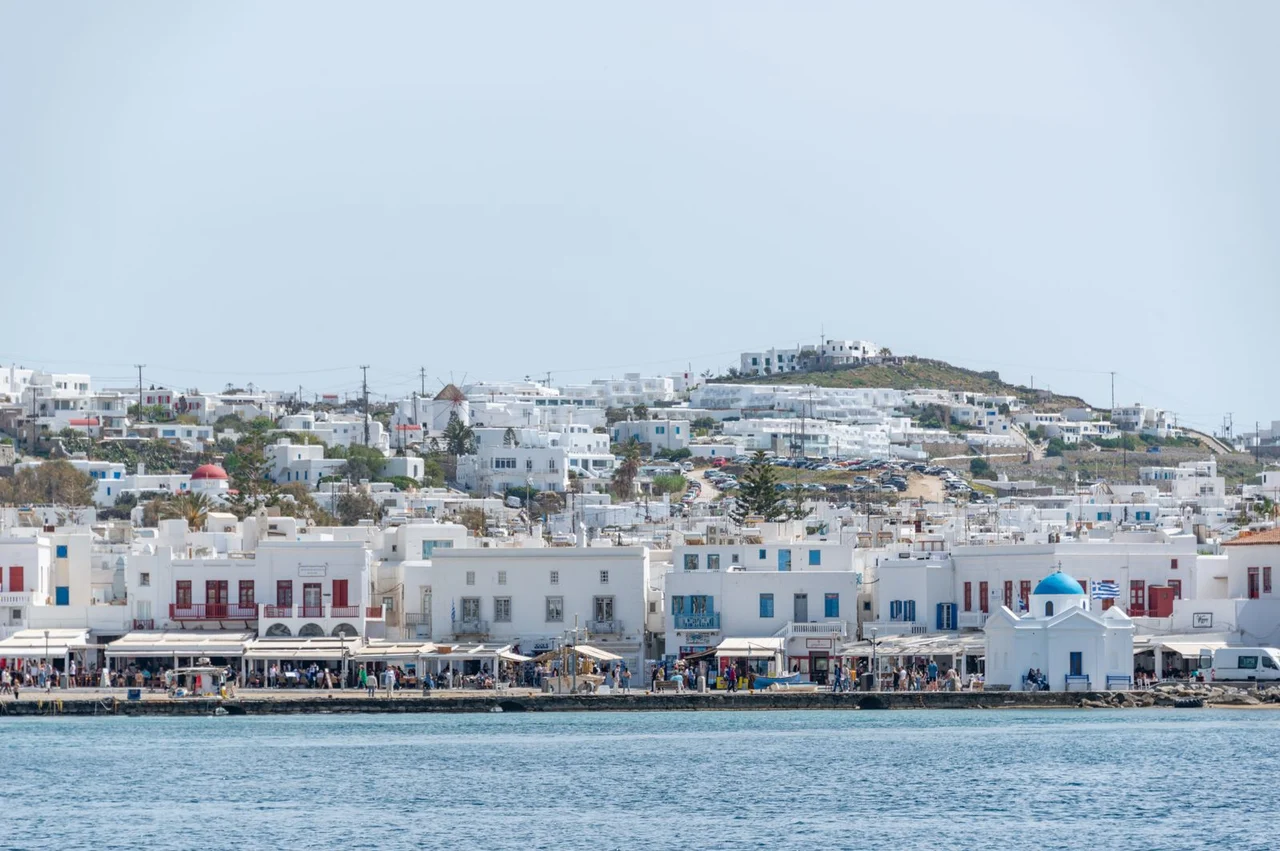
Islands - Santorini, Mykonos, Crete, Rhodes. Tourist islands are expensive all year round: rent is high, the choice of goods is limited. Crete is an exception: a large island with normal infrastructure and prices close to Thessaloniki.
Cost of living in Greece 2026: table by item
Below are the actual prices paid by permanent residents. Not tourist, not average for the country.
| Expense item | Athens (center) | Thessaloniki | Islands (Santorini/Mykonos) |
|---|---|---|---|
| Rent 1BR | €900-1400 | €550-800 | €1200+ |
| Rent 2BR | €1300-2000 | €800-1200 | €1800+ |
| Rent 3BR | €1800-3000 | €1100-1700 | €2500+ |
| Housing and utility services (electricity, water, gas) | €80-130 | €70-110 | €100-160 |
| Internet (optics) | €25-35 | €25-35 | €30-45 |
| Products (family of 3 people) | €450-650 | €380-550 | €500-750 |
| Cafe/tavern for two | €30-50 | €25-40 | €50-90 |
| Monthly pass | €30 | €25 | no (auto) |
| Gasoline (1 l) | €1.80 | €1.80 | €1.90-2.00 |
| Medical insurance | €80-200 | €80-180 | €100-200 |
| Private school (months) | €400-800 | €300-600 | €400-700 |
| Fitness club | €30-60 | €25-45 | €40-70 |
Total: comfortable life for a family of three in Athens - from €3500-5000 per month. In Thessaloniki - from €2500-3500. On tourist islands - from €4000+.
Do you want to move to Greece? We will analyze your case for free.
Get a free consultationRenting a home in Greece: what you can rent and for how much
The rental market in Athens is overheated. The reason is the growth of tourism and short-term rental platforms. A good option in the center goes away in a day or two.
The suburbs of Athens (Glyfada, Voula, Chalandri) are 30-40% cheaper than the center. At the same time, the infrastructure is good, and the metro will reach the center in 20-30 minutes. Rent 1BR here - €600-900 per month.
In Thessaloniki the offer is wider and the competition is lower. You can find a spacious 2BR apartment for €900-1100 in a good area.
Utilities are usually not included in the rent. In winter in Athens, heating, electricity and water costs €80-130 per month. In summer it’s lower: the air conditioner eats up €50-80 per month on electricity.
Food and food: prices in stores and taverns
Greece is a country with rich cuisine and affordable local products. Olive oil, vegetables, fish, cheeses - all this is cheaper than in Western Europe.
Prices in supermarkets (AB Vassilopoulos, Sklavenitis, Lidl):
- Milk 1 l - €1.1
- Bread (loaf 500 g) - €1.2
- Olive oil 1 l - €7-12 (depending on the brand)
- Chicken fillet 1 kg - €5
- Eggs 10 pcs. - €2.5
- Tomatoes 1 kg - €1.5-2.5
- Local feta cheese 200 g - €2
- Coffee beans 250 g - €4-7
Trip to a tavern: lunch of a meat dish, salad and a glass of wine - €15-25 per person. This is not a tourist place, but a regular tavern for locals.
Food delivery (Wolt, efood) in Athens and Thessaloniki is well developed. The average order for two is €20-35 with delivery.
Transport: metro, buses and whether you need a car
Athens has a metro, tram, buses and commuter trains. The system is convenient for a European city. Monthly pass for all types of transport - €30. This is very cheap by EU standards.
Thessaloniki metro will open in 2023. There is only one line for now, but it covers the main areas. The bus network is wide.
It’s difficult on the islands without a car. Public transport is minimal, the distances between villages are large. Car rental - €30-60 per day depending on the season.
Taxi: Bolt and Uber operate in Athens. Travel from the center to the airport - €35-50 fixed rate. Between city districts - €8-15.
Gasoline costs about €1.80 per liter. Insurance for a small car is €300-600 per year. OSAGO is required, CASCO is optional.
Medicine and insurance for foreigners
Greece has a public health care system (ESHS). Foreigners with a residence permit have access to it, but the quality of public hospitals is uneven. Queues are the norm.
Most expats choose private healthcare. A visit to a private therapist - €50-80. Appointment with a specialist - €80-150. The private clinic Hygeia in Athens and Papageorgiou in Thessaloniki are among the best in the country.
Medical insurance for a foreigner with a residence permit is a mandatory condition when preparing documents. Cost - €80-200 per month per adult, depending on age, coverage and insurance company (Allianz, Eurolife, Interlife).
Childbirth in a private clinic - €3000-6000. Planned surgery - from €2000. Ambulance in the state system is free.
Schools and education: options for expat children
Public schools in Greece are free. Training in Greek. A foreign child can enroll, but adaptation will take time - the language barrier is real.
Private Greek schools cost €400-800 per month. Education is bilingual (Greek and English), the level is higher than the state level.
International schools (American Community Schools, Athens College) - €8000-18000 per year. IB and British Standard programs. The best option for families who are planning to move further or return.
Kindergarten (private) - €350-600 per month. State nurseries are cheaper, but there are few places.
The best cities for families with children are Athens (suburbs of Glyfada, Kifissia) and Crete (Heraklion, Chania). Good infrastructure, international schools, safe areas.
Comparison with Moscow and other CIS cities
For people from Russia and the CIS, Greece looks different depending on the city you are moving from.
| Article | Moscow | Athens | Thessaloniki |
|---|---|---|---|
| Rent 1BR (center) | ₽80 000-120 000 | €900-1400 | €550-800 |
| Products (family of 3 people) | ₽40 000-60 000 | €450-650 | €380-550 |
| Public transport | ₽3 000-4 000 | €30 | €25 |
| Internet | ₽700-1000 | €25-35 | €25-35 |
| Restaurant for two | ₽3 000-5 000 | €30-50 | €25-40 |
In terms of purchasing power parity, Greece is comparable to Moscow. At the same time, you get a European residence permit, a warm climate and a much calmer pace of life.
Compared to Almaty or Kyiv, Greece is noticeably more expensive. But the difference in quality of life and legal security outweighs the difference in prices for many.
“Greece is one of the few EU countries where the cost of living has not yet reached the level of Western Europe. Athens is becoming more expensive every year as rising tourism and short-term rental platforms put pressure on the housing market. But Thessaloniki, Crete, mainland cities - you can still live well there for €2000-3000 per month per family. The main thing that clients understand after moving is that there is no need to spend a lot here to live a quality life. Food is fresh and inexpensive, the climate reduces clothing and heating costs, and medical care works well if you have insurance. Those who come expecting a “cheap country” are a little disappointed in the first months. Those who expect European quality at a reasonable price are satisfied.”
Buying real estate in Greece: price guidelines
Buying an apartment in Greece makes sense if you plan to stay for a long time. Renting in the long term is not more profitable than buying.
Housing prices in Athens (2026):
- Center (Kolonaki, Pangrati) - €3500-6000 per sq. m
- Suburbs (Glyfada, Voula) - €2500-4000 per sq. m. m
- Working quarters (Piraeus, Peristeri) - €1500-2500 per sq.m. m
In Thessaloniki - €1800-3500 per sq.m. m depending on the area.
Important: Greece has a Golden Visa program. Purchasing real estate from €250,000 (in some zones from €400,000 and €800,000) entitles you to a residence permit. Details - on the page Greece residence permit for investors.
Taxes and expenses when moving to Greece
When moving, you need to consider not only monthly expenses, but also one-time expenses.
Tax on the purchase of real estate (transfer tax) - 3.09% of the cadastral value. Notary - €1500-3000. Real estate agent - 2-3% of the transaction amount.
Income tax for tax residents of Greece: progressive scale from 9% to 44%. There is a special regime for new tax residents (non-dom) - a flat tax of €100,000 per year on foreign income.
VAT in Greece is 24% (standard rate). For food and books - 13%. For medicines - 6%.
When importing personal belongings during a move, there is a customs benefit for EU residents - furniture and household appliances can be transported duty-free if the conditions are met.
Quality of life: what makes Greece attractive
Greeks live slowly. This is not a flaw, but a feature. No one is in a hurry, business meetings start later than the stated time, queues in government offices are the norm.
But the climate compensates for a lot. Winter in Athens is mild: +10-15°C, sometimes rainy. Summer is long and hot: from May to October the temperature is +25-35°C. The sea is nearby - for residents of Athens it is a 20-40 minute drive.
Security is one of the advantages of Greece. According to Numbeo, crime rates are low. Pickpocketing does occur in tourist areas, but serious crimes are rare.
Greeks are friendly towards foreigners, especially from Russia and the CIS. There is almost no language barrier in Athens: English is widely spoken in the business environment and the service sector.
cons: what you should know in advance
Bureaucracy is the main pain. Opening a bank account, obtaining a residence permit, registering a company - all this takes longer than you expect. Greek civil servants work according to their own schedule.
Greek is difficult. The alphabet is different, the grammar is complex. Without knowledge of the language in government institutions it is almost impossible. You need either a lawyer or an assistant translator.
The economy is historically unstable. Everyone remembers the crisis of 2010-2015. Now the situation has improved, but the debt burden remains high.
In summer it is hot in Athens - up to +38-42°C. Air conditioning is a must. July and August in the city center are difficult to endure: many citizens leave for the islands.
Conditions for a comfortable life in Greece
Greece is suitable for those who value climate, European quality of life and a relaxed pace. This is not a metropolis with a frantic rhythm - this is a place where you can exhale.
For families with children, the best options are the suburbs of Athens (Glyfada, Kifissia, Chalandri) and Crete. Good schools, safe areas, convenient infrastructure.
For those who work remotely - Thessaloniki. Inexpensive, youthful atmosphere, good internet, the sea is an hour's drive away.
For investors and those considering a residence permit - Athens. Business infrastructure, international connections, airport with direct flights to most European cities.
Do you want to move to Greece? We will analyze your case for free.
Get a free consultationResidence permit in Greece: how to legally stay and live
Non-EU citizens without a European passport cannot live in Greece without status. Residence permit required.
The most common way for investors is Golden Visa. Purchasing real estate from €250,000 (in some zones from €400,000 or €800,000) gives a residence permit for the whole family. It is not necessary to live in Greece - you can simply have status.
For those who move to work or run a business, a work visa or a self-employed visa. The process is bureaucratically complex, it is better with legal support.
A student visa is an option for those enrolled in a Greek university. Gives the right to residence for the entire duration of study.
Final budget: how much do you need to live in Greece
Let's summarize the costs under three scenarios:
| Scenario | Compound | Budget/month |
|---|---|---|
| One person, modestly (Thessaloniki) | 1BR + food + transport + insurance | €1400-1900 |
| Couple, comfortable (Athens suburb) | 2BR + food + auto + insurance | €2800-3800 |
| Family with a child, good (Athens) | 3BR + food + auto + private school + insurance | €4500-6500 |
These are realistic figures without luxury, but with comfort. If you are used to a high standard of living in Moscow, a budget of €5,000-7,000 per month per family will ensure good quality in Athens.
By the standards of Western Europe, Greece is still an affordable country. By CIS standards, it is more expensive, but it pays off with its European status and quality of life.
Frequently asked
Questions people ask before deciding
01How much does it cost to rent an apartment in Athens?
One-room apartment in the center of Athens - €900-1400 per month. In the suburbs (Glyfada, Chalandri) - €600-900. Two-room apartment in the center - €1300-2000.
02Is it expensive to live in Greece compared to Russia?
In absolute numbers, it is comparable to Moscow. Rent and products are similar in value when converted. But in Greece you get a European residence permit and a fundamentally different quality of life.
03How much do groceries cost in a Greek supermarket?
Milk - €1.1, bread - €1.2, olive oil - €7-12/l, chicken fillet - €5/kg, eggs 10 pcs. - €2.5. A family of three spends €400-600 per month on groceries.
04Do you need a car in Greece?
In Athens and Thessaloniki you can do without a car - the metro and buses are convenient and cheap (pass €30/month). On the islands and in the provinces it is difficult without a car.
05How much does health insurance cost in Greece?
For an adult foreigner with a residence permit - €80-200 per month. Depends on age, insurance company and amount of coverage. Insurance is required when applying for a residence permit.
06Are there international schools in Greece?
Yes. American Community Schools and Athens College operate in Athens. Cost - €8000-18000 per year. Private bilingual Greek-English schools cost €400-800 per month.
07How to get a residence permit in Greece?
The most popular route for investors is purchasing real estate under the Golden Visa program from €250,000 (in some zones from €400,000 or €800,000). The whole family receives a residence permit. More details at brgsglobal.com/residency/investment/greece/
08What budget does a family of three need to live in Greece?
Comfortable life in Athens - €4500-6500 per month (3BR rent + food + car + private school + insurance). In Thessaloniki - €2800-4000. Without a private school - much cheaper.
09Is it cheaper to live in Thessaloniki than in Athens?
Yes, noticeably cheaper. Rent 1BR - €550-800 versus €900-1400 in Athens. Cafes and restaurants are also 15-25% cheaper. At the same time, the quality of life is high - warm climate, close to the sea, good infrastructure.
10What is included in utility bills in Greece?
Electricity, water, gas or central heating. In winter in Athens - €80-130 per month. Less in summer, but air conditioning adds €50-80 to your electricity bill. Internet is paid separately: €25-35/month.
11Is it possible for a foreigner to buy real estate in Greece?
Yes, without restrictions. Non-EU citizens can buy housing in most areas. The exception is border zones, where permission is required. Purchases of €250,000 or more in a number of zones entitle you to a Golden Visa.
12Is it safe to live in Greece?
Yes. According to Numbeo, crime rates in Greece are low. The suburbs of Athens and provincial towns are especially safe. Pickpocketing does occur in tourist areas, but serious crimes are rare.
About the author
Related materials
What to read next
 ArticleGreek citizenship by descent in 2026: by roots, parents, grandparents
 ComparisonGolden Visa of Greece or Caribbean citizenship 2026: EU residence permit versus second passport
 AnalysisWhat is due diligence and why the Caribbean is rejecting applications
Moving to Greece: what to settle first
Housing, schooling, healthcare, accounts and taxes - the order and what takes longest.