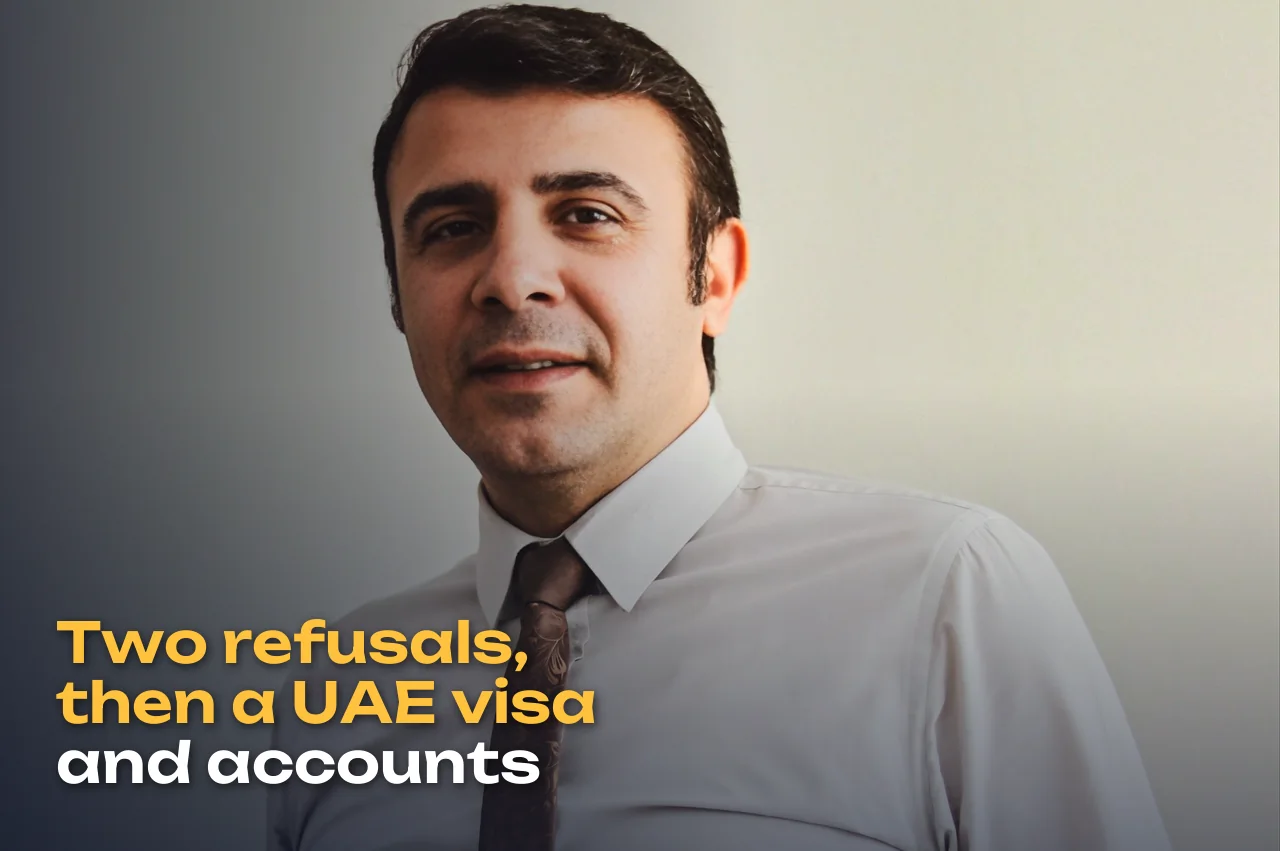
Timur is 38, from Tashkent, and runs an IT team of twenty people spread across several countries. Clients are in Europe and Asia, payments in dollars and euros. In the spring he decided to move contracts to a company in a UAE free zone: clear taxes, a convenient jurisdiction for international clients, the option to move to Dubai himself.
The company got its licence in a week. That was the end of the easy part. A large European client was ready to make the first payment, but there was nowhere to pay: the company had no account.
Two banks refused without giving reasons. Later it became clear how the application looked to them: a fresh licence, zero turnover, an owner without a residence visa, and documents dropped at the branch by an intermediary who could explain nothing about the business. For a review that is an empty shell, even if behind it there is a real team with real contracts.
While the refusals came in, the business lived awkwardly. The European client postponed the contract start twice: its lawyers refused to pay to personal cards and third-party services. Timur paid his team from old personal accounts, while the licence and office rent cost money every month. The company was spending without being able to earn.
We stopped new applications and rebuilt the project in the right order: first a residence visa and Emirates ID for the owner, in parallel a banking file for the company, and only then banks whose requirements matched its facts. Seven weeks later Timur had a visa, a personal account with a card and a corporate account for the company. Here is how it went.
Case at a glance
This story in seven lines
Client
Timur, 38, IT company owner from Tashkent (name changed)
Goal
A UAE free zone company, personal and corporate accounts, a visa for the owner
What happened
A licence in a week, then two bank refusals for the new company
Real cause
The wrong order: a company, but no visa or Emirates ID for the owner and no file
What was at stake
A client postponing the contract, salaries from old personal accounts, costs without income
What we did
Stopped applications, visa and Emirates ID, a company file, banks matched to requirements
Result
Visa, personal and corporate accounts in 7 weeks
Client story
A company but no way to pay salaries
A licence in a week
Timur chose a free zone that works with IT companies and registered the company through a local agent. The licence came in a week, and he rented an office in a business centre for a year. The agent said the bank was a formality and offered to take the documents to a couple of banks himself.
Two refusals in a row
Two banks refused without giving reasons. Later it became clear the application looked to a review like an empty shell: a fresh licence, zero turnover, an owner without residency, filed by an intermediary who could say nothing about the business. UAE banks do not refuse forever, but each unprepared application makes the next one harder.
Life without an account
The European client postponed the contract start twice: its lawyers refused to pay to personal cards or third-party services. Timur paid the team from old personal accounts and knew each such payment would stain the company's future banking history: turnover outside the corporate account is read by a review as a red flag. Meanwhile the licence and rent cost money every month.
A mistake in the order of steps
The review showed a typical sequencing error: the company was registered before the banking side was thought through. Without a residence visa the owner cannot get a personal account or proper signatory status. Without a clear description of the business and contracts the bank cannot see the company's economics. Without Emirates ID digital onboarding is unavailable, and for new companies it often works faster than the classic route.
The cost of every week
Every week without an account cost money: rent, the licence, salaries from personal funds and, above all, a contract the client could give to another contractor. Timur came to us after the second refusal, when the agent suggested trying a third bank with the same set of documents.
Why not a third bank straight away
A third application with the same set would almost certainly have ended the same way, and banks see refusals in a row. We proposed applying nowhere until the owner had a visa and Emirates ID and the company had a file explaining its business. It looked like a delay but was the shortest route to working accounts.
Where it could all have stopped
Where it could all have stopped
A new company with no turnover and an owner without a visa is the worst combination for UAE banks. There were seven difficult points.
a third refusal in a row: UAE banks see application history, and another unprepared application would have closed part of the market to the company for months;
01the client contract: two postponements of the start, and a third could have been a cancellation;
02salaries from personal accounts: turnover outside the corporate account spoils the company's future history;
03the owner's visa: without it there is neither a personal account nor signatory status;
04Emirates ID: without it digital onboarding and some banking products are unavailable;
05the company file: the bank needs to see contracts, money flows and source of funds, not just a licence;
06choice of banks: some banks require six months of turnover history, and applying there would mean another refusal;
07costs without income: rent and the licence were paid from Timur's personal money.
The order of the project
The right sequence: from visa to two accounts
The chart is built from the facts of this matter and shows the logic of the work without decorative or unverified data.
01
Stage 1
We stopped new applications and rebuilt the sequence.
02
Stage 2
The owner’s residence visa and Emirates ID came first.
03
Stage 3
In parallel we assembled the company’s banking file with contracts and flows.
04
Stage 4
We matched each bank basket’s requirements against the company’s facts.
05
Stage 5
We filed only where the fit was real - and both accounts opened first time.
Takeaway. The account is not an add-on to the licence: resident status, clear economics and a documented source of funds are what a bank actually reads.
How it went
How it went
Seven weeks step by step: what we did in what order and why in that order.
01
A stop to applications
First we asked the agent not to send documents to a third bank. Then we went through both refusals: what had been filed, by whom, what questions the bank had asked. It became clear the banks had refused not Timur's business but a set of documents that said nothing about it.
02
Visa and Emirates ID
In parallel we started a residence visa for Timur through his own company. Medical test, biometrics, Emirates ID. It took about three weeks. This was the main key: with a visa and Emirates ID Timur became a resident, and therefore a normal client for a retail bank and a signatory for a corporate one.
03
The company file
While the visa was in progress we built the company's banking file. Contracts with European and Asian clients, a plain-language description of the business, a map of money flows: who pays, in which currency, where money goes for salaries and contractors. Separately we confirmed the source of the funds Timur used to finance the company at the start, with documents on his previous business in Tashkent.
04
Three baskets of banks
We split the market into three baskets. The first: large retail banks for the personal account, where the procedure takes days once you have Emirates ID. The second: banks that work systematically with new free zone companies and do not require six months of turnover history - this is where the corporate account was planned. The third: a digital bank with app-based onboarding as a backup if a classic bank was slow.
05
Matching requirements before applying
Before applying we matched each bank's requirements against the company's facts: licence type, activity, counterparties' countries, expected turnover. One bank in the second basket did not accept companies with half their clients in one of the countries Timur worked with, so we struck it off. Applications went only where the bank's requirements matched the company's facts.
06
The personal account
A few days after receiving Emirates ID Timur opened a personal account at a retail bank. A card, online banking, a local phone number. From then on his personal spending in Dubai went through a local account rather than cards from other countries.
07
The corporate account
The corporate application went to a bank from the second basket. Timur came to the meeting with the manager as a resident and signatory, with a file containing contracts and the money-flow map. The bank asked a few questions about clients and how salaries would be paid to a distributed team. A few weeks later the account was activated.
08
The first invoice
The company issued its first invoice to the European client in the same week the corporate account was activated. The payment arrived without questions. Salaries now went out from the corporate account, and Timur stopped using his old personal accounts for business operations.
Expert comment
The classic mistake of new companies in the UAE is treating the account as an add-on to the licence. To a bank, a new freezone company with a non-resident owner and no turnover is the highest risk level, and no connections change that. Preparation does: resident status, clear economics and a documented source of funds. After that, Timur had no question left for which we did not have a ready document.
Outcome
What the client received
Visa and Emirates ID
Issued in 3 weeks
Personal account
Retail bank, card
Corporate account
A bank with practice in new free zone companies
Whole setup
7 weeks
First invoice
In the week the account was activated
What happened: an IT company owner registered a UAE free zone company before thinking through the banking side, received two refusals and paid salaries from old personal accounts while a client postponed the contract start. What we did: stopped applications, arranged a residence visa and Emirates ID, built a company file with contracts and a money-flow map, split banks into three baskets and applied only where requirements matched the facts. What the client got: a visa, a personal account with a card and a corporate account in seven weeks, and the first invoice in the week the account was activated.
Plan the banking side before registering the company, not after.
Without a residence visa and Emirates ID the owner can get neither a personal account nor proper signatory status.
A fresh licence without contracts and a money-flow map looks like an empty shell to a bank.
After a refusal, do not send the same set to the next bank: banks see refusals in a row.
Choose banks by their requirements for new companies, not by their fame.
Do not pay salaries or take company payments through personal accounts longer than necessary.
Keep a digital bank as a backup in case a classic bank is slow to review.
Share this article
FAQ
Questions people ask in a similar situation
01Why do UAE banks refuse new free zone companies?
A fresh licence, zero turnover and an owner without a visa look like an empty shell to a review. The bank needs to see contracts, money flows and the person responsible for the company.
02Does the owner need a residence visa for a corporate account?
In practice, almost always. With a visa and Emirates ID the owner becomes a resident and a full signatory; without them most banks treat the company far more cautiously.
03How long does the whole setup take?
In this case seven weeks: about three for the visa and Emirates ID, the file in parallel, then the personal and corporate accounts.
04Which documents are needed for a corporate account?
Licence and constitutional documents, client contracts, a description of the business, a money-flow map, the owner's source of funds and his visa with Emirates ID.
05Can I open an account at a digital bank?
Yes, often faster, but it is better kept as a backup or for specific operations. The main corporate account is better held at a bank that works with new companies.
06What should I do after two refusals?
Stop applying, work out the reasons, close them with documents and the owner's status, and only then apply to banks whose requirements match the company's facts.
07How much does support for such a setup cost?
A corporate account from EUR 5,000, a personal account from EUR 3,500; together with the visa the setup is priced individually by scope. The price is fixed before payment; bank fees and government charges are always separate.
08Can salaries be paid from the owner's personal account?
Temporarily, yes, but it spoils the company's future banking history. Turnover outside the corporate account is read by a review as a risk.
I lead the international tax practice at BRIDGES and work at the intersection of tax residence, cross-border reporting and banking compliance. I assess how citizenship, residence, relocation or a new ownership structure may affect the client's tax obligations, banking profile and capital.
My work covers tax residence, CRS and FATCA requirements, source of funds and the questions a bank may raise. These elements should be considered together, because inconsistencies between documents, declarations and the underlying circumstances can create risks after a status has been obtained or an account has been opened.
During the consultation, you will receive an assessment of the tax and banking implications of the proposed decision. Where further work is required, I determine the financial documentation and personally oversee the tax and compliance aspects of the BRIDGES project.
Prepared on the basis of BRIDGES practice and reviewed by a subject-matter expert.
We will explain the requirements, amounts and timelines that apply now, and what is checked in a situation similar to yours.
We will review your situation and propose a solution
Describe your task in a few words. We will study your situation, assess the legal and practical options and propose the next step based on your goals, documents and country.
Confidential · no obligations · answered by the relevant specialist
Names and certain details have been changed to protect client confidentiality. The result described reflects one specific situation and is neither a public offer nor a guarantee of a similar outcome. Programme terms are stated as of 2026 and may change - please confirm current parameters with a BRIDGES consultant.