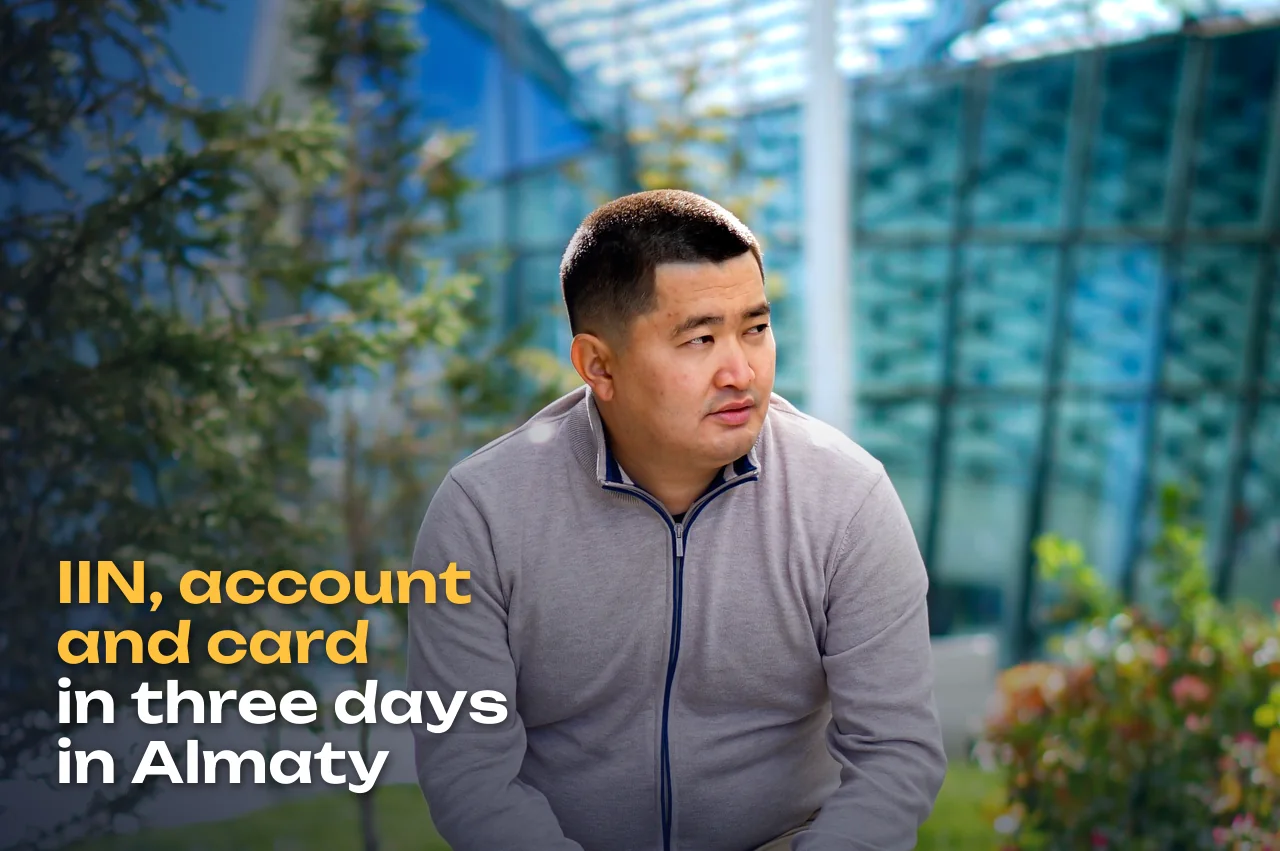
Yerzhan landed in Almaty on a Tuesday morning. He is 44, co-owner of a logistics company in Bishkek, and almost half of his contractors work in Kazakhstan: carriers, warehouses, customs brokers. He had six partner meetings over three days and planned to drop into a bank in between to open a personal account. The account was meant to end paying intermediaries for every transfer in tenge.
At the branch the conversation ended on the first question. The officer asked for his IIN, the individual identification number, and Yerzhan did not have one. He was sure an account could be opened on a passport, as at home. Without the number a bank will not even take an application from a non-resident. The second piece of news was that in 2025 Kazakh banks moved foreigners to in-person visits and enhanced checks, and the "through a friend" options he had heard about in Bishkek had already closed.
By the evening of day one Yerzhan had two days left, six meetings and not one document ready. A second trip would mean new flights, a hotel and another month or two of payments through intermediaries. That evening he called us.
What followed were two days planned by the hour. In the morning the public service centre (TsON) and the IIN, during the day a file built for the chosen branch, in the evening a local SIM card, and on day three a bank visit at an agreed time. We moved his meetings to early mornings and evenings so the working hours stayed free for the procedures.
On day three Yerzhan flew home with a card, an account in tenge, dollars and euros, and a working banking app. Below is how we fitted it all into one trip and where it could all have stopped.
Case at a glance
This story in seven lines
Client
Yerzhan, 44, co-owner of a logistics company in Bishkek (name changed)
Goal
A personal account and card at a Kazakh bank to pay contractors
What happened
At the very first branch: no IIN, and without it a non-resident cannot open an account
Constraint
Three days in the country, six business meetings, new bank rules for foreigners
Why he could not do it alone
He did not know the order: TsON issues the IIN, and the bank expects a file and a local phone number
What we did
Rebuilt the trip around the procedures, obtained the IIN, built the file, agreed the bank visit
Result
KZT, USD and EUR account, card and app before departure, no second trip
Client story
A business in two countries and an account in one
Logistics across the border
Yerzhan's company moves freight between Kyrgyzstan and Kazakhstan. Carriers, warehouses and brokers on the Kazakh side work in tenge, and every month several dozen payments go to them. For years the money went through intermediaries: the company paid them in som or dollars, and they paid the contractors in tenge. Every transfer cost a fee, an exchange margin and an extra day, and contractors increasingly asked to be paid directly.
An account "between meetings"
Yerzhan decided to start with a personal account in Almaty and open a corporate one later, once the bank knew him. He planned the trip around negotiations: six meetings in three days, the bank in a gap between them. Experience told him an hour would be enough: at home accounts are opened on a passport in one visit. In Kazakhstan the procedure for a non-resident works differently, and he found that out at the branch.
A number he did not have
The first thing the officer asked for was the IIN. The individual identification number is mandatory for a non-resident: without it the bank will not open an account or accept documents. It is issued not by the bank but by a public service centre, TsON, and only after identification in person. It usually takes one working day, but that day has to be built into the trip in advance. Yerzhan had not built it in.
Rules that had changed
The second piece of news was more serious. In 2025 Kazakh banks moved non-residents to in-person visits and enhanced compliance checks. Powers of attorney and remote routes that acquaintances in Bishkek had mentioned stopped working. The bank now wants to understand why a foreigner needs an account here, and the answer has to be in documents, not words.
The detail nobody mentioned
There was a third problem Yerzhan had not known about at all. Without a Kazakh phone number confirmation codes do not arrive, so the banking app does not work. An account opened without a local SIM card exists, but it cannot be managed from Bishkek: every payment would have to be confirmed at a branch. For someone living in another country such an account is almost useless.
Why he called us that evening
By the evening of day one Yerzhan understood he could not do it alone in two days: get to TsON, assemble documents for a specific bank, sort out a number and make the visit without cancelling meetings. A second trip would cost new flights, a hotel and another month or two of payments through intermediaries. Business partners who had opened accounts in the region through BRIDGES had recommended us.
Where it could all have stopped
Where it could all have stopped
Today a non-resident can open an account in Kazakhstan only during a trip. Anything not done during the days in the country moves to the next visit. Yerzhan had seven such points.
one day for the IIN: without the number the bank will not accept documents, and TsON issues it only after identification in person, so the morning of day two was the only window;
01a file for a specific bank: each bank has its own document list for non-residents, and a generic set would not have worked;
02an economic link: the bank had to see why a Kyrgyz citizen needs an account in Kazakhstan, otherwise it is an account "just in case" that checks do not pass;
03source of funds: income from a stake in the company had to be confirmed by company documents, not the owner's word;
04a local phone number: without a Kazakh SIM the account would have opened but would not work remotely;
05the branch queue: in high season a walk-in visit takes half a day, and Yerzhan had no spare hour;
06a failed application: a refusal stays in the client's history and the next bank sees it;
07the meetings: six negotiations could not be cancelled, they were the reason for the trip.
Three days by the hour
How we fitted it into one trip
Five points of the trip, from the refusal at the branch to the card in hand.
Days in the country3
Trips1
Refusals0
0102030405
Day 1, morning
The branch asks for an IIN. No number, no account.
Day 1, evening
Call to BRIDGES: a new trip plan, TsON appointment for the morning.
Day 2
IIN issued, file built for the branch, local SIM card bought.
Day 3, morning
Bank visit at the agreed time: filing and identification.
Day 3, afternoon
Three-currency account, card and app before departure.
Takeaway. In Kazakhstan the trip is planned around the procedures, not the other way round: the IIN and the bank visit are fixed points, and everything else is built around them.
How it went
How it went
Two days step by step: what had to be done, what got in the way and what we did so that Yerzhan only had to be in the right place at the right time.
01
The evening review
On the evening of day one we went through the situation by phone: why the account was needed, which payments would run through it, which documents Yerzhan had with him and which his Bishkek office could send. It was immediately clear that opening an account "wherever possible" would not work. He needed a bank that works with non-residents from neighbouring countries and a branch where the procedure is well run. By midnight Yerzhan had a new two-day schedule and a list of what the office should send in the morning.
02
Morning at TsON
On day two, at the start of the working day, Yerzhan was at TsON with his passport. We had explained in advance which counter to go to, what to declare and how identification would go. The number was assigned the same day. This was the first and main milestone: with an IIN in hand, the bank can accept documents. Without it, the rest of the plan made no sense.
03
Choosing the bank
In parallel we chose the bank. We looked at three of the country's systemic banks. The first worked with non-residents only with local registration at the time; the second required proof of employment ties to Kazakhstan, which Yerzhan does not have, as an entrepreneur from a neighbouring country rather than an employee of a local company. The third accepted non-residents with a clear economic link and had a well-run procedure at a central branch. We chose the third.
04
A file in one day
The bank's main question to a non-resident is simple: why do you need an account here. We put the answer into a file. Contracts with Kazakh carriers and warehouses, statements showing how much and how often the company pays into Kazakhstan, documents on Yerzhan's stake in the company as the source of funds, and the company's accounts for the previous year. Separately we wrote a note on planned operations: currencies, approximate payment frequency, range of amounts. The documents from Bishkek arrived by lunchtime, and by evening the file was ready and checked.
05
A SIM card in the evening
On the evening of day two Yerzhan got a local phone number. It sounds minor, but without a Kazakh SIM confirmation codes do not arrive, and without them the banking app does not work. We had warned him to get the number before the bank visit: it goes into the application form when the account is opened, and changing it later from Bishkek would be harder.
06
A visit at an agreed time
We agreed the bank visit for the morning of day three, at a set hour. This was the key decision of the trip: in high season the branch queue easily eats half a day. Yerzhan arrived at the appointed time, and the officer already knew which client and which set of documents to expect. Identification, the form, compliance questions on the file: every question had an answer in the folder.
07
Account, card, app
The account was opened the same day in three currencies: tenge, dollars and euros. The card was issued at the branch, the app was set up before he left the bank, and confirmation codes arrived on the new number. Yerzhan made a first test payment right at the branch and made it to the last meeting of the day. That evening he flew back to Bishkek.
08
What came next
Within a month Yerzhan moved payments to Kazakh contractors onto the new account and stopped paying intermediaries. The next step is a corporate account for the company. It will be opened with a client history the bank already knows: the personal account works and operations run as declared in the file, which is the best basis for the next application.
Expert comment
Kazakhstan has become stricter over the past two years: personal presence and enhanced review are now mandatory, and there are practically no remote workarounds left. For a client that means one thing - the trip has to be planned around the procedures. The IIN, the documents, a local number, a scheduled visit: if even one element is missing, the trip is wasted. We work with exactly that logistics, not only with paperwork.
Outcome
What the client received
IIN
Issued at TsON on the morning of day two
Account
KZT, USD and EUR in one account
Card and app
Issued and set up before departure
Trips
One, three days
Next step
Corporate account for the company
What happened: an entrepreneur from Bishkek flew into Almaty for three days to open an account between meetings and learned at the branch that without an IIN, a file and a local number a non-resident cannot open one. What we did: rebuilt the trip around the procedures, obtained the IIN at TsON, chose a bank with suitable practice, built a file for a specific branch and agreed a visit at a set time. What the client got: a three-currency account, a card and a working app before departure, without a second trip. Next comes the company's corporate account with a history the bank already knows.
In Kazakhstan the IIN is not a formality but an entry ticket: without the number the bank will not accept a non-resident's documents.
The IIN is issued by TsON after identification in person, usually within one working day. Build that day into the trip in advance.
Since 2025 non-residents can open accounts only in person and after enhanced checks, so the trip is planned around the procedures.
The bank asks why you need an account here. The answer must be in contracts, statements and income documents.
A local SIM card is needed not for calls but for confirmation codes: without it you cannot manage the account from home.
Agree the branch visit for a set time: in high season the queue eats half a day.
Start with a personal account: a corporate one opens faster later because the bank already knows the client.
Share this article
FAQ
Questions people ask in a similar situation
01Can you open an account in Kazakhstan without an IIN?
No, for a non-resident it is mandatory. The IIN is obtained separately from the bank, at TsON after identification in person, usually within one working day. We build it into the trip plan.
02Is it realistic to open a Kazakh account remotely?
Since 2025 banks open accounts for non-residents only in person and after enhanced compliance checks. The remote routes and powers of attorney that used to work are effectively closed.
03How many days should you allow for the trip?
A practical guide is three full working days: IIN, document preparation, SIM card and bank visit. If you already have an IIN, two are usually enough.
04Which documents go into the file?
Passport and IIN, and for a clear economic link: contracts with Kazakh counterparties, payment statements, documents on income or a stake in a company, and a note on planned operations. The exact list depends on the bank, so the file is built for a specific branch.
05Do you need a Kazakh phone number?
Yes, for confirmation codes and the app. Get it on arrival, before the bank visit: the number goes into the application form when the account is opened.
06Is an employment contract with a local employer required?
Not at every bank. Some banks require it in practice; others accept a clear economic link: contracts with local counterparties, a business, property. The bank is chosen to fit the client's situation.
07How much does the support cost?
From EUR 2,500: IIN, file preparation, visit coordination and support until the bank's decision. The price is fixed before payment; bank fees are paid separately.
08What if the bank refuses?
Do not reapply straight away. We analyse the reason, strengthen the file and choose a bank with suitable practice: refusals in a row damage the client's history.
I lead the international tax practice at BRIDGES and work at the intersection of tax residence, cross-border reporting and banking compliance. I assess how citizenship, residence, relocation or a new ownership structure may affect the client's tax obligations, banking profile and capital.
My work covers tax residence, CRS and FATCA requirements, source of funds and the questions a bank may raise. These elements should be considered together, because inconsistencies between documents, declarations and the underlying circumstances can create risks after a status has been obtained or an account has been opened.
During the consultation, you will receive an assessment of the tax and banking implications of the proposed decision. Where further work is required, I determine the financial documentation and personally oversee the tax and compliance aspects of the BRIDGES project.
Prepared on the basis of BRIDGES practice and reviewed by a subject-matter expert.
We will explain the requirements, amounts and timelines that apply now, and what is checked in a situation similar to yours.
We will review your situation and propose a solution
Describe your task in a few words. We will study your situation, assess the legal and practical options and propose the next step based on your goals, documents and country.
Confidential · no obligations · answered by the relevant specialist
Names and certain details have been changed to protect client confidentiality. The result described reflects one specific situation and is neither a public offer nor a guarantee of a similar outcome. Programme terms are stated as of 2026 and may change - please confirm current parameters with a BRIDGES consultant.