Tax · Russia
Second citizenship and residence permits in Russian deals: which documents to confirm

Updated: November 2026·13 min read·Expert reviewed
Terms and costs verified: November 2026
Contents
Since 5 November 2026, a person's status in a deal involving Russian assets is decided by a document. Decree No. 816 wrote one rule into six decrees on deals and payments: anyone who has not shown a passport or residence permit of Russia or a friendly country counts as a person from an unfriendly state. For owners of apartments, company stakes, shares and loans in Russia, this is a question of time and money. Below I explain which document works in your situation, how to prepare it and where questions remain open.
Key points
- Status is confirmed by one of four documents: a Russian passport, a passport of a friendly country, a Russian residence permit, or a residence permit or other permanent residence document of a friendly country.
- Without a document, payments to you go to a type C account, and real estate and stake deals require a government commission permit.
- For a Russian citizen a Russian passport is enough. A second passport or foreign residence permit does not need to be shown for status.
- Documents of EU countries, the UK, the US and other countries on the unfriendly list do not remove the status.
- The decree does not expressly cover dual citizenship with an unfriendly country or temporary statuses. Check these cases with the bank before the deal.
Why the question arose now
Russia has applied a special regime to persons from unfriendly countries since spring 2022. It rests on several presidential decrees. Decree No. 81 requires a permit from the government commission on foreign investment control for real estate and securities deals. Decree No. 95 routes payments to foreign creditors on loans and bonds to rouble type C accounts. Decree No. 254 does the same for profit distributions by Russian companies. Decree No. 618 and the related No. 737 cover deals with LLC stakes, and Decree No. 198 covers obligations on certain securities.
All these rules apply to "persons of foreign states taking unfriendly actions". The list of those states was approved by Government Order No. 430-r of 5 March 2022. Who exactly counts as such a person, however, was long defined by explanations from the Bank of Russia and the Ministry of Finance: citizenship, place of residence, place of main business. Banks had to draw conclusions from the client file, and in disputed cases clients waited months for a decision.
Decree No. 816 of 5 November 2026 moved the check into the language of documents. Banks, brokers and registrars now have a simple rule: if the client has not presented one of four documents, the client counts as a person from an unfriendly state. The decree came into force on the day of publication and has no transitional provisions. So the check already applies to all new transactions, including payments under old contracts.
In practice this is two pieces of news. The bad one: a person without the right document, even with no link to unfriendly countries, gets an inconvenient status. The good one: there is now a clear way to confirm status and lift the restrictions if you hold a suitable passport or residence permit.
The four documents and their requirements
Russian passport. Both the internal and the international passport qualify. The decree does not require the person to live in Russia: a citizen who moved abroad long ago confirms status with the same passport. The main risk is expiry. If the bank file holds a copy of an expired international passport, the bank may consider that there is no document.
Passport of a friendly country. This is the passport of any state not on the unfriendly list. The list includes the EU countries, the UK, the US, Canada, Switzerland, Norway, Japan, South Korea, Australia, New Zealand, Singapore and several others. Turkey, the UAE, Israel, Serbia, Kazakhstan, Armenia, Georgia and most countries in Asia, Africa and Latin America are not on it. The list is extended from time to time, so check it as of the deal date.
Russian residence permit. It works for a foreigner and for a stateless person. Citizenship does not matter for this rule: a Russian residence permit confirms status on its own.
Residence permit or other permanent residence document of a friendly country. Two words matter here. The first is "friendly": a Greek golden visa or a residence permit of Portugal, Cyprus or Malta does not qualify. The second is "permanent": the decree names a residence permit and a document confirming the right of permanent residence. A temporary permit or a study or work visa is not expressly on that list. Suitable options include a UAE residence visa, a Turkish residence permit, a Serbian residence permit and similar documents from countries not on the list.
The filing format depends on the bank. A Russian translation certified by a notary or sworn translator is usually needed. Documents from Hague Convention countries such as Turkey, Serbia or Kazakhstan get an apostille. UAE documents go through consular legalisation, because the Emirates are not party to the convention. We arrange sworn translation and certification so that both the bank and the notary accept the document.
What this means for you. If you hold both a Russian passport and a foreign document, the Russian passport is enough for the bank. There is no need to show your second passport or residence permit for status, so the bank will not receive extra information about you.

Which transactions depend on status
The consequence of a missing document depends on which decree applies to the transaction. Below are the main cases that owners of Russian assets bring to us.
| Transaction | Which decree | What happens without a document |
|---|---|---|
| Sale or purchase of real estate in Russia | No. 81 | deal only with a government commission permit |
| Buying or selling securities through a broker | No. 81 and No. 198 | deal restrictions and a special settlement procedure |
| Loan repayment or bond payments | No. 95 | money credited in roubles to a type C account |
| LLC profit distribution, payout on leaving the company | No. 254 | payout to a type C account |
| Sale or purchase of an LLC stake | No. 618 and No. 737 | deal only with a government commission permit |
A type C account is a rouble account from which money cannot be freely transferred abroad or moved to an ordinary account. It can be used to pay taxes and some expenses in Russia, but it does not solve the problem of an owner who wants to receive money abroad. A government commission permit is a separate procedure with its own document package, timing and conditions that the commission may impose.
So the status document should reach the bank or broker before the transaction, not after. Once a payment has gone to a type C account, getting it back to an ordinary account is difficult. If a real estate deal is filed for registration without a commission permit, it may stall at the review stage.
Dmitry NagyInternational Tax Consultant, BRIDGES
Selling an apartment or stake, or expecting a payment in Russia? We will check the documents before the deal
We will tell you which document the bank will accept, prepare the translation, apostille or legalisation and handle the deal.
Six typical situations
Below are the situations our clients encounter most often. The list is not exhaustive, but it makes the logic of the decree easy to follow.
| Who you are | Which document to show | Comment |
|---|---|---|
| Russian citizen living in the UAE or Turkey | Russian passport | no need to show the residence permit, check the passport expiry |
| Citizen of Russia and Israel | Russian passport | the Israeli passport is not needed for status |
| Citizen of Kazakhstan, Armenia or Serbia | your own passport | these countries are not on the unfriendly list |
| German citizen with a UAE residence visa | UAE residence visa | status under the German passport has not been clarified |
| Stateless person living in Russia | Russian residence permit | qualifies regardless of citizenship |
| Heir with a French passport and no other documents | no qualifying document | transactions follow the rules for unfriendly persons |
A Russian citizen abroad. The most common case. Someone lives in Dubai or Istanbul, holds a residence permit there and is selling an apartment in Moscow. A Russian passport is enough for status. Something else matters more: if the person is no longer a Russian tax resident, the tax rate on the sale proceeds will differ. Tax residence and status under the decree are different things. We explained how tax residence is determined in our article on what tax residence is and in our breakdown of the 183-day rule.
A citizen of Russia and a second country. For holders of dual Russian and Israeli citizenship or Russian and Turkish citizenship nothing changes: the Russian passport confirms status. A bank may not demand the second passport to lift unfriendly status.
A foreigner from an unfriendly country with a second document. For example, a German citizen who lives in the UAE on a residence visa and owns a stake in a Russian LLC. Under the wording of the new rule, the UAE visa keeps them out of the new criterion. But the German passport remains, and the earlier criteria from the Bank of Russia's explanations may still cover them. The decree did not resolve this conflict. Until explanations appear, we prepare both sets of documents for such clients and agree the position with the bank or registrar in advance.
An heir from an unfriendly country. An heir with a French passport and no other documents accepts the inheritance under the usual rules, but further transactions with the property will follow the unfriendly-person regime. Families whose heirs live in different countries should think about the ownership structure in advance. We described the options in our articles on inheritance tax with a second citizenship and on an inheritance fund.
What to put in the contract
The decree changes not only dealings with the bank but also how the deal itself is prepared. If one of the parties may turn out to be a person from an unfriendly state, this should be addressed in the contract in advance rather than discovered at settlement.
Status representation. Each party states which category it belongs to and attaches the document confirming it. If the status changes before settlement, for example a passport or residence permit expires, the party must report it and provide a new document.
Permit condition. If a real estate or stake deal may require a government commission permit, the contract should tie the transfer of title and the payment to obtaining that permit. Otherwise the buyer risks paying for an asset whose title will not pass.
Payment procedure. The contract should name the account for payment and set out what happens if the bank credits the money to a type C account. For a seller abroad this is the key clause: it decides where the money ends up.
Timing. Document checks, translation, apostille or legalisation take from a few days to several weeks. Plan the deal timeline with a margin, especially if the documents were issued in another country. We build these steps into the schedule when we run a deal end to end.
A second passport, the bank and notifying the authorities
Many ask whether the decree will expose information about a second citizenship. The answer depends on which document you show. A Russian citizen shows a Russian passport, and the bank learns nothing about a second citizenship from this check. A foreign document appears in the file only if you choose to hand it over.
The decree does not change the duty to report a second citizenship. A Russian citizen who lives permanently in Russia and acquires another citizenship or a residence permit must notify the Ministry of Internal Affairs within 60 days. Late notification carries a fine, and concealment carries more serious liability. Russians who live permanently abroad are exempt. We wrote in detail about when and how to notify in our article "Notify or not", and about the difference between the terms in "Dual and second citizenship".
Banks and the tax authority share data more and more actively. In autumn 2026 the Federal Tax Service began mass requests for information on foreign accounts. So any document you hand to a Russian bank should be treated as information that may reach the state. This is not an argument against a second passport but for careful preparation.
How to prepare the document
Identify the transaction and the decree
A property sale, a profit payout, a deal with a stake or securities. This decides who checks the document: a bank, broker, registrar or notary.
Choose one document
If you are a Russian citizen, it is your Russian passport. If not, a passport or residence permit of a country not on the unfriendly list.
Check validity and format
The document must be valid on the transaction date. Ask the bank whether a notarised copy, apostille or legalisation is required.
Get a translation
A foreign document is translated into Russian with certification. Names and dates must match the contract and statements.
Hand the document over early
Send it before the payment date or the filing of the deal for registration, and keep proof of delivery.
Keep your file current
When you renew your passport or residence permit, provide the new copy, or the next transaction may follow the unfriendly regime.
If you have no suitable document
Sometimes the owner of a Russian asset holds only a passport of a listed country. There are two options. The first is to work within the unfriendly-person regime: receive payments to a type C account and apply to the commission for deal permits. This is possible, but slow and without a guaranteed result.
The second is to obtain a document of a friendly country. This does not require changing citizenship. A UAE residence visa is available through property, a company or employment and can also give tax residence in the Emirates if the conditions are met. A Turkish residence permit is available through property, and Turkish citizenship through investment. Serbia attracts with modest requirements and a clear tax system. You can compare programmes in our residency and citizenship sections.
When choosing a document, look beyond Decree No. 816. What matters is how the passport or residence permit works for travel, banking and taxes, and whether it creates new obligations. An overview of options for different goals is in our second citizenship overview, and the general rules are in "Russian dual citizenship with other countries".
What remains open
- Dual citizenship with an unfriendly country. The decree does not say whether a friendly passport lifts the earlier criteria.
- Temporary statuses. A temporary residence permit and work and study visas are not expressly named.
- Document format. Each bank currently sets its own requirements for translation, apostille and legalisation.
- Ongoing transactions. Payments under contracts signed before 5 November are checked under the new rules, with no separate procedure for them.
Official explanations on clause 6.1 of Decree No. 618 may be given by the Bank of Russia, and on all other questions by the Ministry of Finance. We follow their position and will update this article once it is published. Until then, the best way to avoid delays is to prepare the document in advance and agree it with the bank before the deal.
Our team supports deals with Russian and foreign assets, prepares documents and opens accounts in friendly jurisdictions. You can review your situation at an online consultation.
Share this article
Still have questions? We'll answer for your case
Tell us what you want to solve, and an expert on the topic will contact you.


Frequently asked
Questions people ask before deciding
01Which document confirms I am not a person from an unfriendly state?
A Russian passport, a passport of a friendly country, a Russian residence permit or a residence permit of a friendly country. One is enough.
02Do I need to show the bank my second passport?
Not if you are a Russian citizen: the Russian passport is enough. For a foreigner from an unfriendly country, a friendly passport or residence permit may help.
03Will a Greek golden visa work?
No. Greece is on the list of unfriendly states, so its residence permit does not remove the status.
04Will a UAE residence visa work?
Yes, the UAE is not on the list. The document usually needs consular legalisation and a Russian translation.
05What happens to a payment if no document is presented?
A loan, bond or LLC profit payment goes in roubles to a type C account, from which money cannot be freely withdrawn.
06Does the decree change the duty to notify the authorities?
No. A Russian citizen living permanently in Russia must still notify the Ministry of Internal Affairs of a second citizenship or residence permit within 60 days.
About the author
Related materials
What to read next
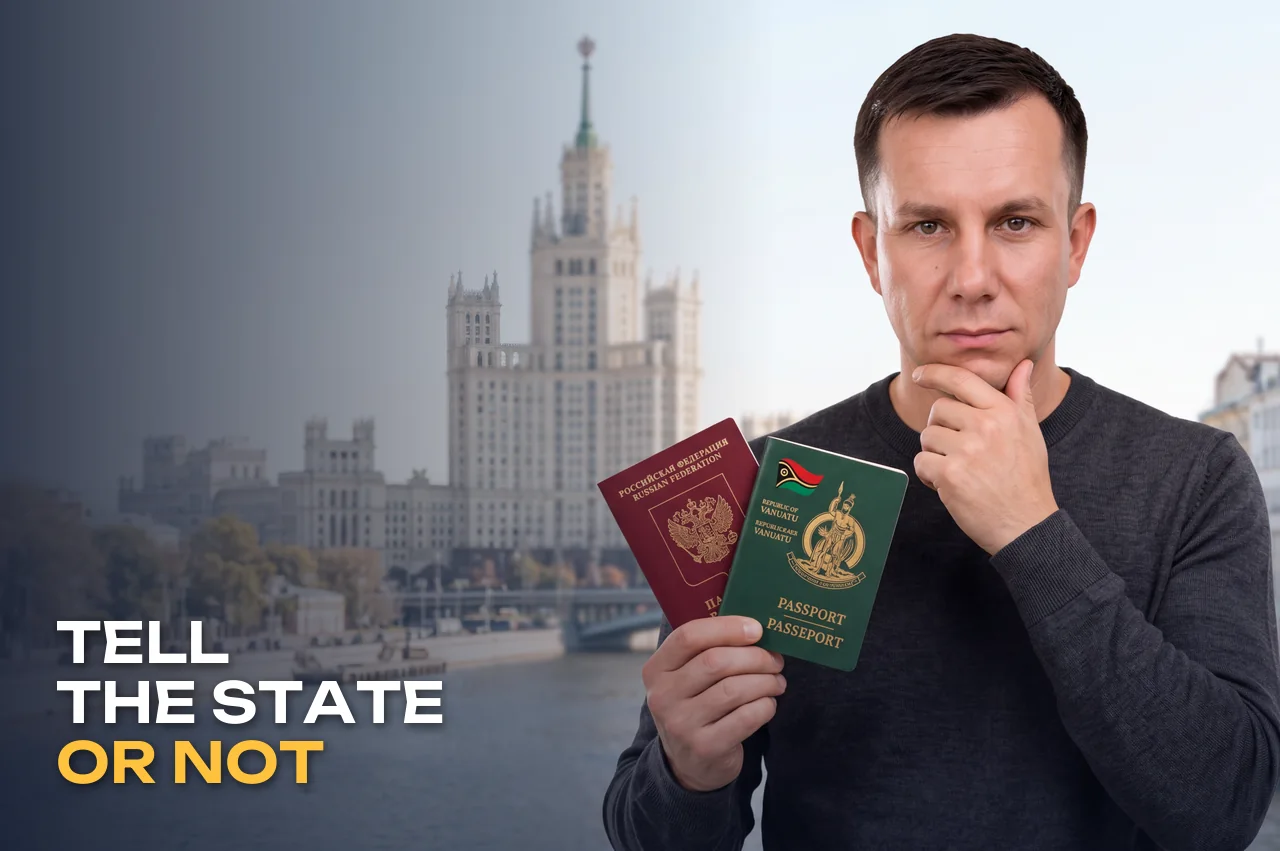 AnalysisTelling the state about a second passport and a foreign account: the decision stays with you
 ArticleTax Residency: What It Is and Why It Matters to Every Expatriate
News+1 story on 19 November
Related news
 Russia · 18 NovRussia: individuals without a friendly passport or residence permit now count as unfriendly
 Russia · 29 OctRussia: the Bank of Russia brings crypto payments under foreign trade contracts into currency control
 Russia · 29 OctRussia: CFC profit to be taxed without the RUB 10 million threshold from 2027
Personal programme selection is conducted by Anna Kovalevskaya, Head of Legal, BRIDGES.
Need a residence permit or passport of a friendly country? We will choose and arrange it
We will compare the UAE, Turkey, Serbia and other countries off the list for your assets, taxes and family.
