BRIDGES Insights · European Union
The five-year passport is obsolete: 15 Schengen states already refuse it

Updated: October 2026·9 min read·Expert reviewed
Terms and costs verified: October 2026
Contents
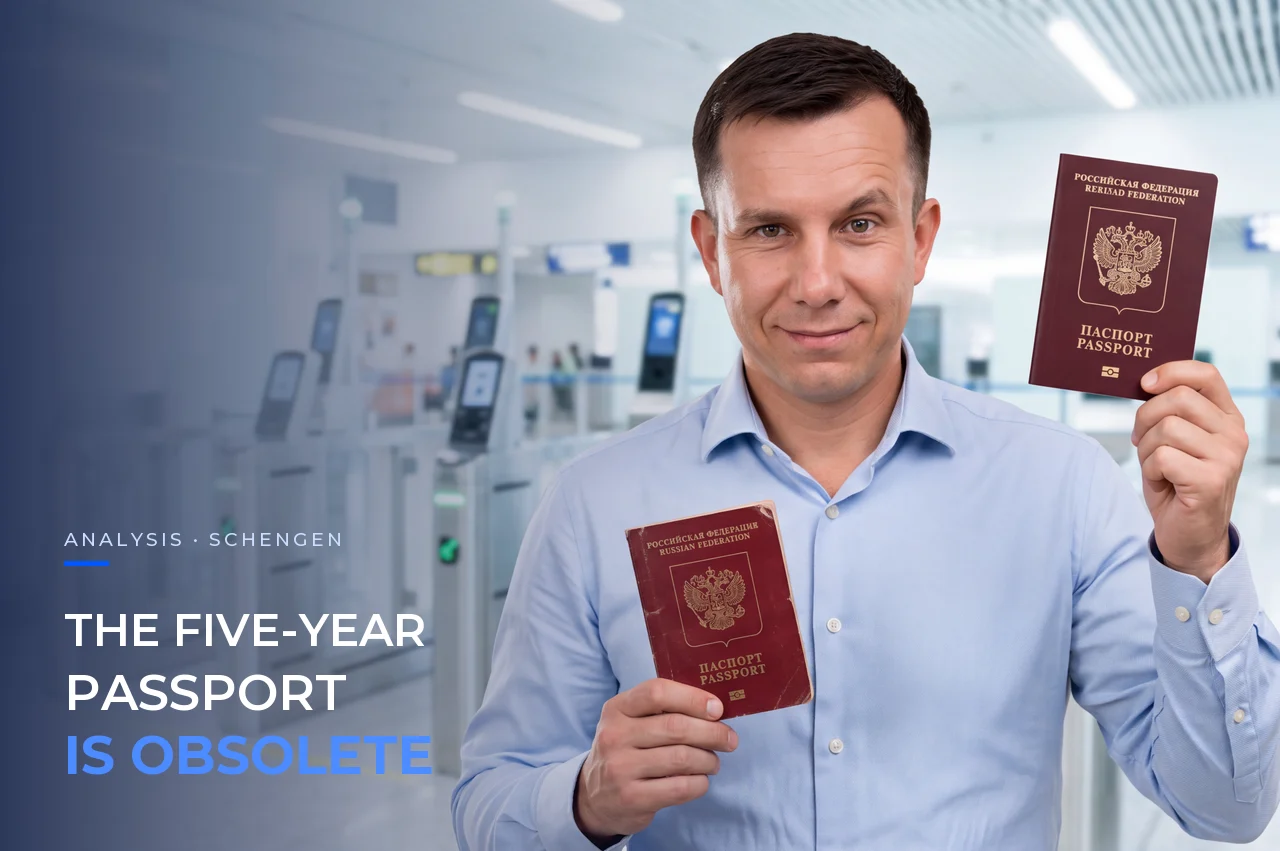
The five-year Russian passport today is like a push-button phone. You can still make calls, and it even works. But half the places no longer let you in with it, and the other half let you in with a look that says you have arrived from 2009. 15 of 29 Schengen states refuse a Russian passport without a chip. In two years their number grew from one to fifteen, and it has never once gone back. My advice here is single and free: get a ten-year biometric passport and forget about the problem.
In brief
- From 1 October 2026 Belgium, the Netherlands, Luxembourg and Sweden refuse the five-year passport. There are now 15 such Schengen states.
- A Schengen visa in the old passport does not help: a state that does not recognise the passport will not admit you on it.
- Transit through such a state is also a risk.
- 14 states still accept it, including Italy, Spain, Greece and Hungary. The list only shrinks.
- A ten-year biometric passport solves the issue entirely.
A scene at the check-in desk
How this looks in real life is easiest to show with an example. Morning, a transit airport, a flight to Frankfurt. The visa is fine, the hotel booking is printed, the suitcase is checked in. At the desk the airline agent leafs through the passport, looks at the cover and asks: "Do you have another passport?" The traveller does not understand. It is explained: Germany does not recognise this passport, and the carrier will not board the passenger because the airline pays for the return itself.
The options from here are bad. Cancel the ticket, reroute through a country that recognises the passport and hope there is no connection with a border check. Or fly home. The hotel, the tours, a business meeting in Munich - all gone in ten minutes.
The most frustrating part is that the warning had been in the official European Commission list since the start of the year. Nobody reads it until it applies to them personally. That is why we check clients' passports before they buy tickets, not after.
What this means for you. The airline checks documents before the border guard does. Refusal can happen at the departure airport, and then there is nobody to argue with.

Where the five-year passport no longer works
In short: 15 Schengen states, some with exceptions for children, earlier visas and residence permits.
The European Commission keeps an official list of which travel documents each Schengen state recognises. In the version of 2 October 2026, an ordinary Russian passport without biometrics is refused by 15 states. Some have exceptions for children, residence permit holders and earlier visas, but the rule is general.
Still accept it: Austria, Bulgaria, Croatia, Greece, Hungary, Italy, Liechtenstein, Malta, Norway, Portugal, Slovakia, Slovenia, Spain and Switzerland.
European Commission list of travel documents, version of 2 October 2026
| Country | From | Exceptions |
|---|---|---|
| Estonia | 31 March 2025 | none |
| Denmark, Latvia, Lithuania | already in force | none |
| France | already in force | children under 15; a French visa issued before 1 June 2025 or a French residence permit until it expires |
| Czechia | already in force | children under 15; visas and residence permits issued in the interest of Czechia |
| Iceland | already in force | children under 15 |
| Germany, Romania | 1 January 2026 | Germany: a German residence permit issued before 1 January 2026, until it expires |
| Poland | 1 April 2026 | none |
| Finland | 1 June 2026 | children under 18 and Finnish residence permits; until 31 December 2026 valid visas and permits issued before 1 June 2026 |
| Belgium, Netherlands, Luxembourg | 1 October 2026 | visas in such passports lose validity by 31 December 2026 at the latest |
| Sweden | 1 October 2026 | until 31 December 2026 valid EU and Schengen visas and permits issued before 1 October 2026 |
What this means for you. If your route includes even one country from this table, the five-year passport will not do for the trip. Even with a visa in it.
Why a visa in the old passport does not help
In short: the visa grants entry, but the passport must be recognised by the country you enter. Without that the visa does not work.
The most common mistake: "I have a Schengen visa, so they will let me in." The visa grants entry, but the passport must be recognised by the country you enter. If Germany does not recognise the five-year passport, a German border guard will not admit you on it, even with an Italian visa. Belgium, the Netherlands and Luxembourg went further: visas in such passports lose validity by 31 December 2026 at the latest.
The second trap is transit. You fly to Spain, which recognises the passport, but change planes in Frankfurt. A connection with a border check makes Germany the country of entry. The result is predictable.
What this means for you. Look not only at the destination but at every point on the route where you pass passport control.
How the five-year passport survived to 2026
To understand why the five-year passport still exists, it helps to remember where it came from. Russia has issued ten-year biometric passports for a long time, but the old model was never abolished: it is simpler, issued at any office, given to children, chosen out of habit or because it is "quicker".
For years there was hardly any difference. Both booklets were accepted everywhere, visas went into both, border guards treated them alike. The difference was in validity and price, and many chose the short passport, seeing no point in paying more for a chip.
Everything changed when European countries began, one by one, to remove the non-biometric Russian passport from their lists of recognised documents. In summer 2024 it was one country. Two years later there are fifteen. Each decision was taken separately, without a common date, so people still carry the old picture: "the passport is valid, so it works".
What this means for you. A passport can be valid for Russia and still useless for entering half of Schengen. These are two different questions.
Why the five-year passport loses
In short: a passport without a chip is less secure and unreadable for border automation. The EU is gradually dropping it.
The EU logic is simple. A passport without a chip is less protected against forgery, and its data cannot be checked automatically. Since 10 April 2026 the Entry/Exit System has run at all external Schengen borders. With a five-year passport you can formally cross the border, but not through the automated gates: they read only the chip.
Russia still issues both types, and the five-year passport remains valid. It is just valid in fewer and fewer places. Like a train ticket that cancels a couple of stations every quarter.
Every week one of our clients learns about this at the airport. The frustrating part is not the refusal of entry but that the problem could have been solved with one visit to a passport office. A chipped passport is the cheapest document in the whole second citizenship story, and also the most common reason a trip falls apart.
What to do
In short: one ten-year biometric passport solves the issue entirely.
- Get a biometric passport. It is valid for 10 years and accepted by every Schengen state.
- Check the passports of the whole family. Exceptions for children are not universal: France and Czechia make them up to 15, Finland up to 18, Poland and Germany not at all.
- Do not throw away an old passport with a valid visa. Russian rules allow two valid international passports. In states that recognise it, you can travel on it until the visa expires.
- Apply for visas only in the biometric passport. Putting a new visa into a five-year passport makes no sense today.
We will check the family's documents before the trip
We look at the passports, visas and route of every traveller and tell you where a border problem will arise.
What this means for you. One visit for a chipped passport removes the issue for ten years. There is no point waiting for the next country to drop the old model.
Five questions we are asked
- "I have a Schengen visa until 2027 in the old passport. Will it be cancelled?" The visa itself stays valid, but you can only enter a country that recognises the passport. In Belgium, the Netherlands and Luxembourg visas in such passports lose validity by 31 December 2026 at the latest.
- "Can the visa be transferred to the new passport?" No. A visa is affixed to a specific document. If the old passport is not recognised, travel with the old passport and visa to a country that accepts it, or get a new visa in the biometric one.
- "My child is 12 and has a five-year passport." France, Czechia and Iceland accept such passports for children under 15, Finland under 18. Germany and Poland make no exceptions. Check every country on the route.
- "What if I fly to Italy directly?" Italy still recognises the five-year passport. But there are no direct flights from Russia to the EU, and a connection inside Schengen can make another state the country of entry.
- "How long does a new passport take?" It depends on where you apply. That is exactly why it is better to replace it in advance, not a week before the trip.
Where second citizenship comes in
In short: a new passport solves the technical problem, not the visa one.
Refusing five-year passports is part of the EU's general line on Russians: single-entry visas instead of multiple-entry ones, extra checks, a debate on binding visa measures. A biometric passport solves the technical problem, not the visa one. Those who need Europe often should also look at a second passport with visa-free Schengen access or a residence permit in an EU country.
One more detail. An application for a second citizenship or a residence permit almost everywhere requires a valid passport with at least a year to eighteen months left. A five-year passport that expires in six months can stop the process before filing.
I will tell you whether you need a second document
Write how often you travel to Europe and with whom. I will say honestly whether a new passport is enough or it is time to think about plan B.
Where people go wrong most often
In short: four mistakes ruin trips more often than others.
- Looking only at the destination. A connection with a border check makes another state the country of entry.
- Relying on a visa in the old passport. The visa does not cancel the requirement for the passport itself.
- Forgetting the children. Child exceptions are not everywhere, and where they exist the age limits differ.
- Putting a new visa into a five-year passport. Money and time go into a document that half of Schengen will not accept.
What to do now
- Open your passport and check the validity: if it is 5 years, it is the old model.
- Apply for a biometric passport before your next trip.
- Check the route, including connections.
- Keep the old passport if it holds a valid visa.
- If you plan a second citizenship, check the passports of the whole family.
How this material was prepared
Prepared by Sergey Evdokimov, Managing Partner at BRIDGES. Countries, dates and exceptions were checked against the European Commission list of travel documents, version of 2 October 2026, on 11 October 2026. Airport scenes and client questions are from our practice.
- Countries, dates and exceptions - the list of third-country travel documents kept by the European Commission, version of 2 October 2026.
- Entry/Exit System - official EU information on the system running at all external borders from 10 April 2026.
- Two international passports - Russian passport issuing rules.
- Clients' travel practice - our practice.
- All facts checked on 10 October 2026.
Related: Schengen for Russians in 2027, visa-free travel on Caribbean passports.
Frequently asked
Questions people ask before deciding
01Which states refuse the five-year Russian passport?
15 Schengen states: Belgium, the Netherlands, Luxembourg, Germany, Denmark, Estonia, France, Latvia, Lithuania, Poland, Romania, Finland, Sweden, Czechia and Iceland.
02Where is it still accepted?
In Austria, Bulgaria, Croatia, Greece, Hungary, Italy, Liechtenstein, Malta, Norway, Portugal, Slovakia, Slovenia, Spain and Switzerland.
03Will a visa in a five-year passport get me in?
Only into a state that recognises the passport. A state that does not recognise it will not admit you even with a visa.
04Are there exceptions for children?
France, Czechia and Iceland accept passports of children under 15, Finland under 18. Germany and Poland make no exceptions for children.
05Can I hold two passports?
Yes, Russian rules allow two valid international passports. An old one with a valid visa can be kept.
06Is transit risky?
Yes. If a connection with a border check runs through a state that does not recognise the passport, entry on it will fail.
07Can I enter Italy on a five-year passport?
Italy still recognises it. But check the route: a connection through Germany or France with a border check makes entry impossible.
08Do Norway and Malta recognise the five-year passport?
According to the European Commission list of 2 October 2026, yes, both do.
09What happens to a visa in an old passport in Belgium and the Netherlands?
Visas in non-biometric passports lose validity by 31 December 2026 at the latest.
10Do I need a biometric passport for a second citizenship?
Most programmes need a valid passport with at least a year to eighteen months left. A biometric one is more reliable for travel.
About the author
Related materials
What to read next
 ComparisonAntigua and Barbuda or Grenada: Family Passport for Large Families in 2026
 AnalysisWhat is due diligence and why the Caribbean is rejecting applications
 AnalysisHow to Choose a Program: Citizenship, Residence Permit or Permanent Residency through Investment
Personal programme selection is conducted by Anna Kovalevskaya, Head of Legal, BRIDGES.
We will check the family's documents before travel and before filing
Passports, visas, validity and route: we tell you where a problem will arise before you reach the border.