BRIDGES Insights · Caribbean
Visa-free Schengen for Caribbean passports: the EU gives five states until June 2028

Updated: October 2026·9 min read·Expert reviewed
Terms and costs verified: October 2026
Contents
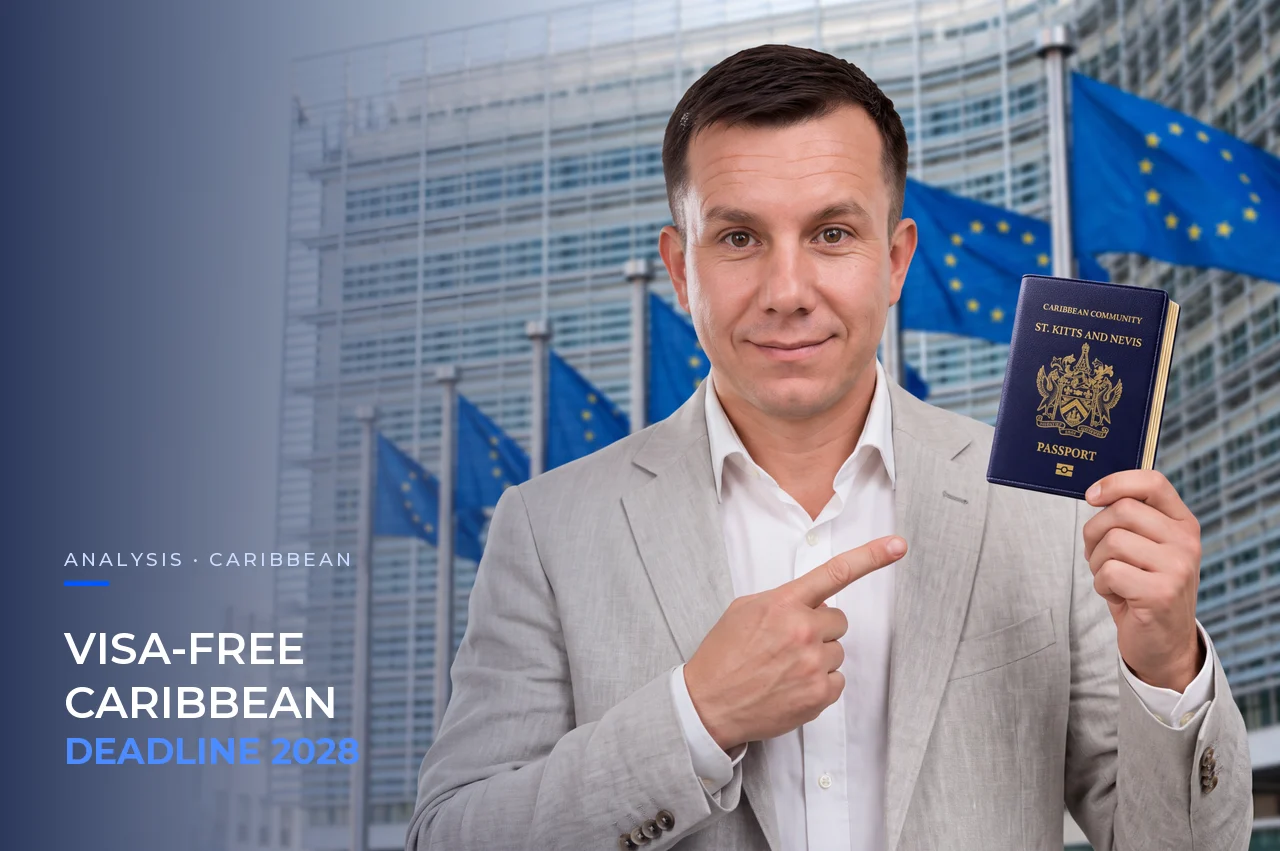
In November 2026 a technical mission of five Caribbean states travels to Brussels. The reason is serious: the EU wants their citizenship by investment programmes wound down by 1 June 2028, or it may suspend visa-free Schengen access for their citizens. It sounds like a verdict, but I look at it more calmly. While both sides are sitting down to negotiate, there is no decision. And in two years the Caribbean governments have done more than in the previous twenty: a common minimum price, a common regulator, stricter vetting. Let us see what they bring to Brussels and how it ends for passport holders.
In brief
- Antigua and Barbuda, Dominica, Grenada, Saint Kitts and Nevis and Saint Lucia keep visa-free Schengen access today.
- Since 30 December 2025 the EU can suspend visa-free travel simply because a state sells citizenship without a genuine link.
- In a letter of 25 June 2026 the European Commission asked the five states to wind down their programmes by 1 June 2028.
- In November 2026 a technical mission of these states discusses the process and a transition in Brussels.
- In December 2026 the Commission presents a report assessing the states' responses.
What visa-free access gives today
In short: a citizen of any of the five states enters Schengen without a visa for 90 days in any 180-day period. This is the main reason Russians buy a Caribbean passport.
To see what is at stake, picture an ordinary trip. A Saint Kitts passport holder flies to Milan for a business meeting. No visa centre, no employment letter, no booking for the whole route. At the border the Entry/Exit System registers them, takes fingerprints and a photo, and records the 90 days. That is all. For a Russian with one passport the same trip starts two or three weeks earlier with a visa appointment.
Entry prices have converged over five years. Since 1 July 2024 all five states hold a common minimum of $200,000 and do not undercut each other.
| Programme | Fund contribution from | Visa-free Schengen today |
|---|---|---|
| Saint Kitts and Nevis | $250,000 | yes |
| Saint Lucia | $240,000 | yes |
| Grenada | $235,000 | yes |
| Antigua and Barbuda | $230,000 | yes |
| Dominica | $200,000 | yes |
What this means for you. Today the difference between programmes is not visa-free access, which all five have, but price, timing and family composition. If the EU imposes visas, a difference may appear here too: decisions need not cover all states at once.
The new EU rule
In short: since 30 December 2025 the EU can suspend visa-free travel purely because a state sells citizenship. It is not automatic: the Commission assesses the case and follows a procedure.
The EU had a mechanism for suspending visa-free travel before, but it was triggered by rising irregular migration and asylum refusals. Regulation 2025/2441, applicable since 30 December 2025, added a separate ground: a state grants citizenship for a predetermined payment or investment to a person with no genuine link to it. The programme itself can now be the reason.
An important detail: suspension is not automatic. The Commission has to assess the situation, weigh proportionality and follow the procedure. That is why the talks matter.
- 07.2024Five states adopt a common $200,000 minimum
- 09.2025Agreement on the ECCIRA regional regulator signed
- 12.2025EU Regulation 2025/2441 takes effect
- 06.2026Commission letter: wind down programmes by 1 June 2028
- 09.2026Prime ministers meet the Commissioner in New York
- 11.2026OECS technical mission in Brussels
- 12.2026Commission report under the suspension mechanism
Regulation (EU) 2025/2441, statements by the governments of Antigua and Barbuda and Saint Lucia
What this means for you. The rule is in force, but there is no decision on visas for Caribbean passports. Every month of talks is a month in which the passport works as before.
What Brussels demands
In short: wind the programmes down by 1 June 2028, and from autumn 2026 refuse people under EU sanctions and vet all applicants more strictly.
On 25 June 2026 the Commissioner for Internal Affairs and Migration wrote to the five governments. According to the published response of Antigua and Barbuda, the EU asks for the programmes to be wound down by 1 June 2028. Interim measures were due by September 2026: no applications from persons under EU restrictive measures and stronger vetting of applicants of all nationalities. The Commission will assess the responses in its December report.
Antigua and Barbuda replied on 7 July 2026 and did not accept the demand to close its programme: it is an important source of revenue, and closing it requires a replacement. In September the prime ministers of Saint Lucia and Antigua and Barbuda, the governor of the Eastern Caribbean Central Bank and the OECS Director General met the Commissioner in New York. The outcome: continue the dialogue on a transition.
What this means for you. If you are under EU sanctions, the Caribbean route is already closed to you. For everyone else vetting is stricter, but the door is open.
The November talks
In short: in November 2026 the five states bring a common minimum price, a regional regulator and stricter vetting to Brussels. The goal is to agree a transition.
According to the prime minister of Saint Lucia, a technical mission of all five programme states goes to Brussels in November 2026. Saint Lucia will be represented by its deputy prime minister. The task is to agree on the process and on what happens after 2028.
The Caribbean does not arrive empty-handed. Since 1 July 2024 all five states have held a common minimum of $200,000 and no price war. In September 2025 an agreement on the ECCIRA regional regulator, headquartered in Grenada, was signed: common vetting standards for all five programmes. This is exactly what the EU asked for over the years.
I like that there is real bargaining here, not silence. Five small states against Brussels sounds unequal, but they hold good cards: a regulator, a single minimum price, the applicant vetting the EU asked for. I would not be surprised by a compromise with a transition period. Nor by a hard decision. So I tell clients honestly: a Caribbean passport works today, but buying it only for Schengen in 2026 is a risky bet.
Three scenarios
In short: a compromise, a transition period or a suspension. In none of them is the passport taken away.
| Scenario | What happens | What it means for the passport holder |
|---|---|---|
| Agreement | The EU accepts enhanced vetting and the regional regulator as sufficient | Visa-free access stays |
| Transition | Programmes wind down by 2028, visa-free access stays | The passport works, fewer new applications |
| Suspension | The EU imposes visas on nationals of one or more states | A Schengen visa is needed, citizenship remains |
In all three scenarios the person keeps the citizenship. A suspension of visa-free travel does not take the passport away or cancel its other benefits: travel outside the EU, banking, a second citizenship for the family. One thing changes: Schengen would require a visa obtained as a Caribbean national, not as a Russian one.
What this means for you. There is a precedent: visa-free EU travel on Vanuatu passports is suspended, yet demand for the programme has not disappeared. People buy more than Schengen.
We will compare the Caribbean with other passports
Five Caribbean programmes, Vanuatu and Argentina: price, timing, visa-free access today and the Schengen risk.
What the Vanuatu case showed
In short: the EU already has experience of suspending visa-free travel over passport sales, and it shows what happens to holders in practice.
Vanuatu was the first to fall under this mechanism. The EU first partly and then fully suspended visa-free entry for its citizens, and passport holders needed a Schengen visa. Nobody's citizenship was taken away, and the passports kept working for travel worldwide and for banking.
What is interesting is that demand for the programme did not disappear. We looked at this in detail in why demand for Vanuatu did not fall after the EU visa suspension. People were buying not only Schengen but a second passport as such: for banks, business, travel and family peace of mind.
For the Caribbean states this is an important argument in the talks, and an important hint for buyers. If visa-free Schengen is the only point of the passport for you, the risk is high. If the passport solves several problems, a suspension changes convenience but does not cancel the purchase.
What this means for you. Before buying, answer honestly why you need the passport beyond Schengen. If there is no answer, also look at options without this risk.
Who a Caribbean passport makes sense for now
In short: those who need a second passport for more than Schengen.
- Those who need a second passport for banking, business and world travel, with Schengen as a bonus.
- Families who want citizenship for everyone at once: Caribbean programmes include children and parents.
- Those prepared for a Schengen visa scenario and who find it acceptable.
- Those who need visa-free Schengen for the next ten years should also look at passports without this risk, such as Argentina.
I will tell you whether a Caribbean passport fits
Write why you need a second passport and who is in the family. I will answer directly whether the Caribbean is worth it in 2026.
Where buyers go wrong
In short: three mistakes recur more than others.
- Buying the passport for Schengen only. In 2026 that is a bet against a decision the EU is already discussing.
- Waiting for the outcome of the talks before applying. If a wind-down is agreed, the window for new applications will narrow and queues will grow.
- Getting a passport for one person rather than the whole family. Adding children and parents after a programme closes may be impossible.
What to check before applying
In short: five questions to answer before the first payment.
Before applying for a Caribbean passport
- Why you need the passport beyond Schengen
- Who will be in the application: spouse, children, parents
- Whether any applicant faces EU sanctions-related restrictions
- Programme timing and the dates of upcoming EU decisions
- Whether a fallback is ready if visa-free travel is suspended
What to do now
- Do not sell or cancel plans because of the news: there is no visa decision.
- If you apply now, choose a programme with clear vetting and include the whole family in the application.
- Do not count on Schengen as the main reason to buy.
- Watch the Commission's December report.
How this material was prepared
Prepared by Sergey Evdokimov, Managing Partner at BRIDGES. Facts were checked against Regulation (EU) 2025/2441 and official statements of the governments of Antigua and Barbuda and Saint Lucia on 11 October 2026; programme prices are from our programme pages.
- New ground for suspending visa-free travel - Regulation (EU) 2025/2441, applicable since 30 December 2025.
- The Commission's demands and deadlines - published response of the Government of Antigua and Barbuda of 7 July 2026.
- The New York meeting and the technical mission - statements of the Government of Saint Lucia, September and October 2026.
- Common $200,000 minimum and the ECCIRA regulator - OECS memorandum and agreement of 2024-2025.
- Assessment of scenarios - our practice.
- All facts checked on 10 October 2026.
Related: five Caribbean programmes, Vanuatu after the EU visa suspension, Argentine citizenship, Schengen for Russians in 2027.
Frequently asked
Questions people ask before deciding
01Do Caribbean passports have visa-free Schengen access now?
Yes. Antigua and Barbuda, Dominica, Grenada, Saint Kitts and Nevis and Saint Lucia keep visa-free access for 90 days in 180.
02Will visa-free access end in 2028?
There is no decision. The EU asks for the programmes to be wound down by 1 June 2028 and the states are negotiating. A compromise, a transition or a suspension are all possible.
03What happens to my passport if visa-free access is suspended?
Your citizenship and passport remain. Schengen would require a visa obtained as a Caribbean national.
04When are the talks?
A technical mission of the five states travels to Brussels in November 2026. The Commission presents its report in December 2026.
05Are applications accepted now?
Yes, the programmes operate. Applications from persons under EU sanctions are not accepted, and vetting has been strengthened.
06Which passport gives Schengen without this risk?
Among new programmes, Argentina: its citizens travel to Schengen visa-free, with applications from Q4 2026.
07How much does a Caribbean passport cost in 2026?
A fund contribution from $200,000 in Dominica, $230,000 in Antigua, $235,000 in Grenada, $240,000 in Saint Lucia and $250,000 in Saint Kitts, plus government fees and due diligence.
08Can a Russian get a Caribbean passport now?
The programmes accept applications, but persons under EU sanctions are excluded and vetting is stricter. The outcome depends on background and source of funds.
09If visa-free access is suspended, can I get a Schengen visa?
Yes, as a Caribbean national under the ordinary Visa Code rules.
10What if I have already applied?
Carry on. Citizenship obtained before any EU decision is not revoked, and visa-free access applies today.
About the author
Related materials
What to read next
 ComparisonAntigua and Barbuda or Grenada: Family Passport for Large Families in 2026
 AnalysisWhat is due diligence and why the Caribbean is rejecting applications
 AnalysisHow to Choose a Program: Citizenship, Residence Permit or Permanent Residency through Investment
Personal programme selection is conducted by Anna Kovalevskaya, Head of Legal, BRIDGES.
We will choose a second passport with the Schengen risk in mind
Caribbean, Vanuatu, Argentina: price, timing and what each passport gives your family.