Updated 09.10.2026
 Legal structures · Private foundations
An Austrian private foundation the Privatstiftung for capital in the EU
The Austrian Privatstiftung is the structure through which the country’s industrial families hold their capital. A legal person inside the European Union, with a full tax system and a high reputation: an instrument for preserving capital in Europe, not for saving tax.
- We check eligibility under the EU sanctions rules before the work begins
- We work with Austrian notaries and auditors directly
- We calculate the tax burden openly — in Austria it is real
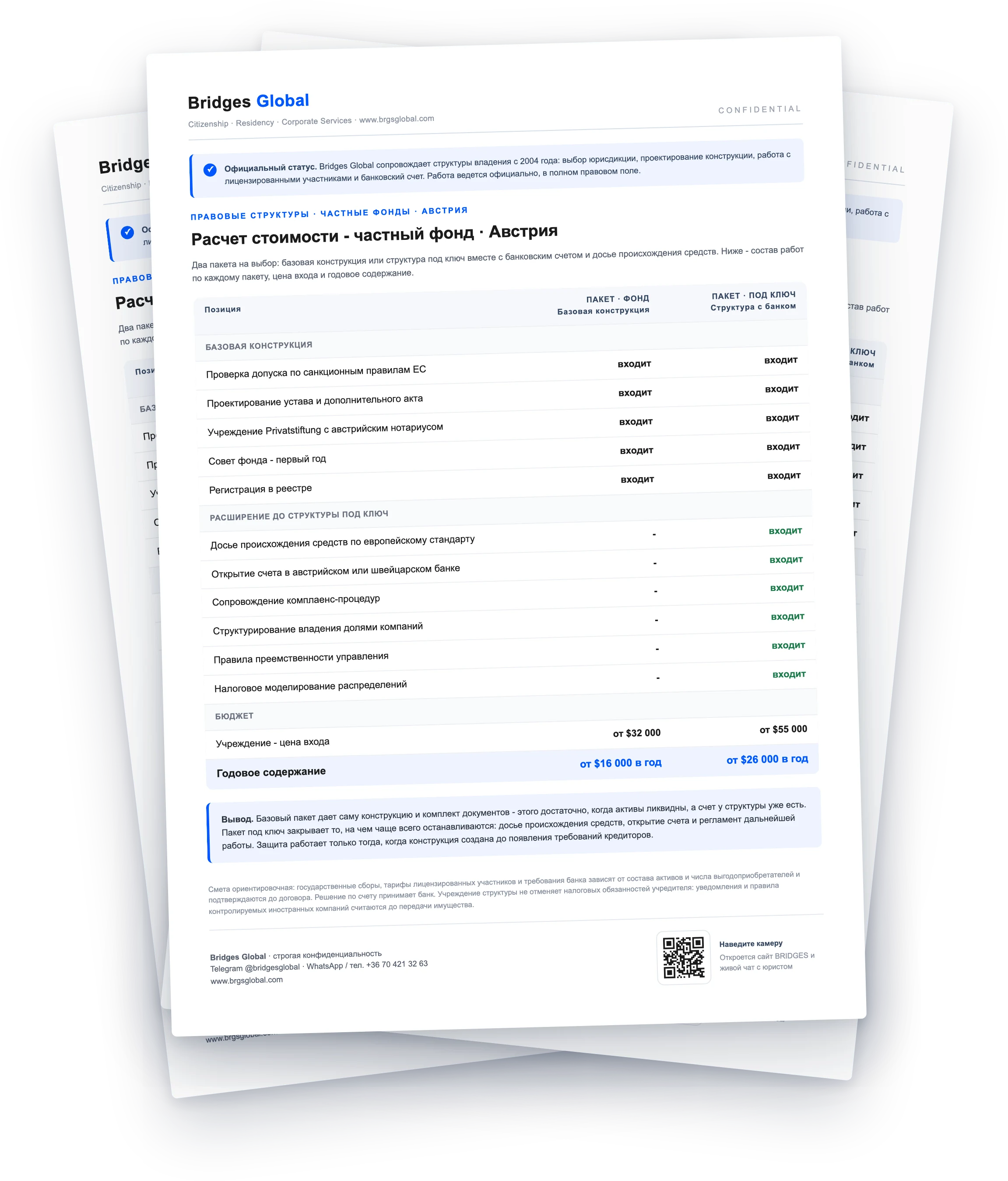
The guide figures depend on the composition of the assets, the number of beneficiaries and the bank’s requirements. The exact quotation for the set-up and the annual upkeep is fixed before the agreement.
Applicability
Is Austria the right structure for your task
01 Main purpose
02 Assets
03 Beneficiaries
04 Bank account needed
The selector does not give a legal opinion: applicability is confirmed after the analysis of assets, family and tax residence.
The structure
What a Privatstiftung is
The Austrian private foundation is a legal person without owners, created by the 1993 law. It owns assets and distributes income to the beneficiaries under its charter. In Austria such foundations have historically held stakes in industrial groups and family property.
The foundation is designed for significant assets: a minimum capital is set by law, and running it requires a notary and an auditor.
With the assets, the heirs and the banks in the EU, the structure works in the same legal environment, without cross-border conflicts.
The classic use is holding the shares of a family company with the rules of succession written into the charter.
Austria is not an offshore centre: the foundation pays tax under local rules. We calculate the burden in advance and openly — it is part of the decision, not a surprise.
Fit
Who an Austrian foundation suits — and who it does not
A plain filter, sanctions restrictions and tax included.
- Capital from $10m, predominantly in Europe
- You hold an EU passport, EU residence or a citizenship outside the sanctions perimeter
- A stake in a European business is held with a succession plan
- The priority is stability and reputation inside the EU
- You are ready for a real tax burden for the sake of European standing
- Russian or Belarusian citizenship without EU residence: corporate services are restricted by the EU regulation
- The aim is to minimise tax: Austria is not suited to that
- A budget below $30,000 for the set-up and $15,000 a year for the upkeep
- The assets are outside Europe: the point of a European structure is lost
Roles
The legal structure and the governing bodies
The civil-law model: the organs of a legal person instead of trust roles.
Transfers the assets and approves the charter. After the transfer they do not own them personally.
The governing body: decisions on the assets and the distributions strictly within the charter.
The controlling figure: approving key decisions, changing the composition of the council.
The family, the children, you yourself. They receive distributions under the charter; the names are not published.
Protection
The legal limits of using the structure
The strengths together with the limits.
The shares are not split between the heirs: the foundation owns them as a whole and the heirs receive distributions under the charter.
The foundation’s property does not form part of the founder’s estate and is not divided on divorce.
Austrian law is predictable, the courts are strong and the risk of arbitrary decisions is minimal.
The structure is accepted by any European bank or counterparty without explanation.
The limits we state plainly: the structure does not protect against claims that arose before the assets were transferred — such transfers can be set aside. It does not cancel the tax obligations of the founder and the beneficiaries and does not make assets invisible: the exchange of information and the duty to declare both operate. Criminal proceedings, sanctions regimes and maintenance lie beyond what any structure can do. Anyone who promises otherwise is misleading you. Separately: for citizens of Russia and Belarus without residence in the EU the provision of corporate and trust services is restricted by the European Union’s sanctions regulation — we check eligibility before the work begins and offer lawful alternatives outside the EU.
Prices
The options for the structure and the cost
The «from» prices cover the legal work on the establishment; taxes and notarial fees are calculated separately and in advance.
from $32,000
Annual upkeep: upkeep thereafter from $16,000 a year
Holding the family’s capital inside the EU
Included
- A check of eligibility under the EU sanctions rules
- Design of the charter and the supplementary deed
- Establishment of the Privatstiftung with an Austrian notary
- The foundation council — the first year
- Registration in the register
from $40,000
Annual upkeep: upkeep thereafter from $19,000 a year
A structure with a European bank already in place
Included
- Everything in the «Foundation» package
- A source-of-funds file to the European standard
- Opening an account with an Austrian or Swiss bank
- Support through the compliance procedures
from $55,000
Annual upkeep: upkeep thereafter from $26,000 a year
Business shareholdings and a succession plan across generations
Included
- Everything in the «Foundation + account» package
- Structuring the ownership of the company shareholdings
- The rules of management succession
- Tax modelling of the distributions
- Annual support and audit
The package does not include: the tax on the contribution of capital, the notary’s fees, the mandatory audit, or legal work in the countries of the assets.
What drives the quote
The factors that affect the cost of the project
The packages cover the standard tasks. Here is what moves the budget — and it is counted before the agreement, not after.
The tax on establishment is calculated on it — the largest item in the start-up budget.
Shareholdings in operating companies require valuation and structuring; portfolios are simpler.
Calculating the distributions with the double tax treaties in mind is a piece of work in itself.
The volume of mandatory reporting depends on the size and composition of the foundation’s assets.
In the quotation we separate our own fee, the notary’s and the auditor’s charges, and the taxes and government fees. The total is fixed by the agreement.
Cost of ownership
The cost of the structure over three years
A structure costs money not only when it is created: administration, reporting and bank compliance recur every year.
- Creating the structure and the documents
- Registration and government fees
- Opening the structure’s bank account
- The first year of administration
- Administration of the structure
- Reporting and mandatory notifications
- Bank compliance and the KYC refresh
- Support of distributions to beneficiaries
- Administration of the structure
- Reporting and mandatory notifications
- Bank compliance and the KYC refresh
- A review of the structure as circumstances change
What each year contains depends on the jurisdiction, the assets and the bank’s requirements. We prepare the three-year calculation together with the set-up quotation — before the agreement.
Tax
Taxation, reporting and disclosure
Austria is a country with full taxation. The foundation pays tax when capital is contributed, tax on profit and tax on distributions to beneficiaries. We calculate the burden before you decide.
The contribution of capital to the foundation is taxed at the rate set by law. That is the first significant item in the budget.
The foundation’s profit is subject to corporate tax; for certain types of income an interim regime applies with a later credit.
Payments to beneficiaries are subject to withholding tax. For non-residents the rate depends on the double tax treaty.
A foundation is a foreign structure: participation is declared, and where there is control the CFC rules apply.
We do not build arrangements to conceal income and we do not work with funds whose origin is not evidenced by documents.
Banking
The banking infrastructure of the foundation
An Austrian structure opens accounts in Europe without difficulty — that is part of its value.
Banks in Austria, Switzerland, Liechtenstein and Luxembourg.
Who the founder and the beneficiaries are, where the capital came from, the purpose of the foundation, the sanctions factors.
The European standard: a complete chain for every source.
For clients with Russian citizenship the bank separately checks for EU residence.
A refusal by a bank is not the end: we work out the reason and go to the next one with the file corrected. No one guarantees approval, and neither do we.
Documents
Documents and information for the establishment
We assemble the pack once — the same pack goes to the administrator and to the bank.
- 01Personal documents Passports and proof of address: the founder, the foundation council, the beneficiaries.
- 02The source of the capital Sale agreements, bank statements, dividend resolutions, tax returns.
- 03The list of assets What is going into the foundation: accounts, portfolios, real estate, shareholdings — with the title documents.
- 04Tax residence The countries and the taxpayer numbers of every party: the notifications and the reporting depend on them.
- 05The rules for distributions Who receives funds, when and on what conditions — these rules go into the foundation’s charter.
- 06Current obligations Claims, debts, guarantees and disputes: they determine whether the protection works at all.
No documents are needed at the first consultation — we work through the task in words.
Comparison
Compare Austria with other structures
| Austria | |
|---|---|
| Setup | from $32,000 |
| Annual | upkeep thereafter from $16,000 a year |
| Timing | 6-8 weeks |
| Typical use | Capital from $10m, predominantly in Europe |
Select up to two jurisdictions above. A detailed legal comparison is prepared for the specific task.
Process
The stages of establishing the structure
From the review of the task to a finished structure with an account.
What is being consolidated or protected, who the beneficiaries are, whether there are current disputes. We say plainly whether the structure is needed at all.
1-2 daysThe charter, the organs, the rules for distributions, the controller’s powers, the composition of the assets to be transferred.
3-5 daysIdentity documents and source-of-funds evidence for the administrator and the bank.
1-2 weeksThe constitutive documents, the appointment of the officers, registration.
6-8 weeksMoving the assets into the structure with correct formalities in the countries where they are held.
Opening the structure’s account and setting the rules for the work that follows.
Comparison
Austria against the alternatives
The main parameters side by side, so that the choice is an informed one.
| Austria | Liechtenstein | Luxembourg SPF | UAE · RAK | |
|---|---|---|---|---|
| Jurisdiction | EU | EEA | EU | The Gulf |
| Tax burden | Real | Low | A subscription tax | Nil outside commerce |
| Suitable for business shareholdings | Yes, the classic use | Yes | Limited | Yes |
| Establishment | 6-8 weeks | 4-6 weeks | 3-5 weeks | 2-3 weeks |
| Cost from | $32,000 | $28,000 | $18,500 | $9,500 |
The comparison is as at the date the page was updated; whether it applies to your case is confirmed once the profile has been reviewed.
FAQ
Questions and answers
Because Austria is an ordinary European country with a full tax system, not a preferential jurisdiction. A Privatstiftung is chosen not to save money but for stability, reputation and the ability to hold a European business. We calculate the burden before you decide.
Without residence in the EU — no: the provision of corporate services is restricted by the European Union’s sanctions regulation. With residence or a second passport outside the perimeter — yes. We check eligibility before the work begins.
The law sets a minimum capital for the foundation, but the structure only makes economic sense from several million upwards: the costs of establishment, audit and support are set for substantial capital.
Yes, that is the classic use: Austrian industrial families hold controlling stakes this way, with the rules of succession in the charter.
The data is held in a closed register, with no public access since the 2022 judgment of the Court of Justice of the EU. The competent authorities obtain the information on request.
From $16,000 a year: the foundation council, the administration, the reporting and the audit. Plus tax on the year’s results. The exact figure is in the quotation before the agreement.
Calculation
Structure and budget: Austria
Describe the assets, the family and the task. We will come back with the applicable structure, the setup budget and the annual upkeep.
A structure does not cancel existing creditor claims or the tax obligations of the settlor. Where the task cannot be solved lawfully, we say so before the engagement.