Updated 13.08.2026
 Legal structures · Trusts
A trust in South Dakota an Americanfortress for capital
South Dakota is the leading trust jurisdiction of the United States: perpetual dynasty trusts, no state tax on trust income, sealed court files. People come here for the stability of the US legal system, not for the exotica of small islands.
- We work with licensed trust companies of the state
- We speak plainly about US reporting and what it entails
- We prepare the source-of-funds file to US standards
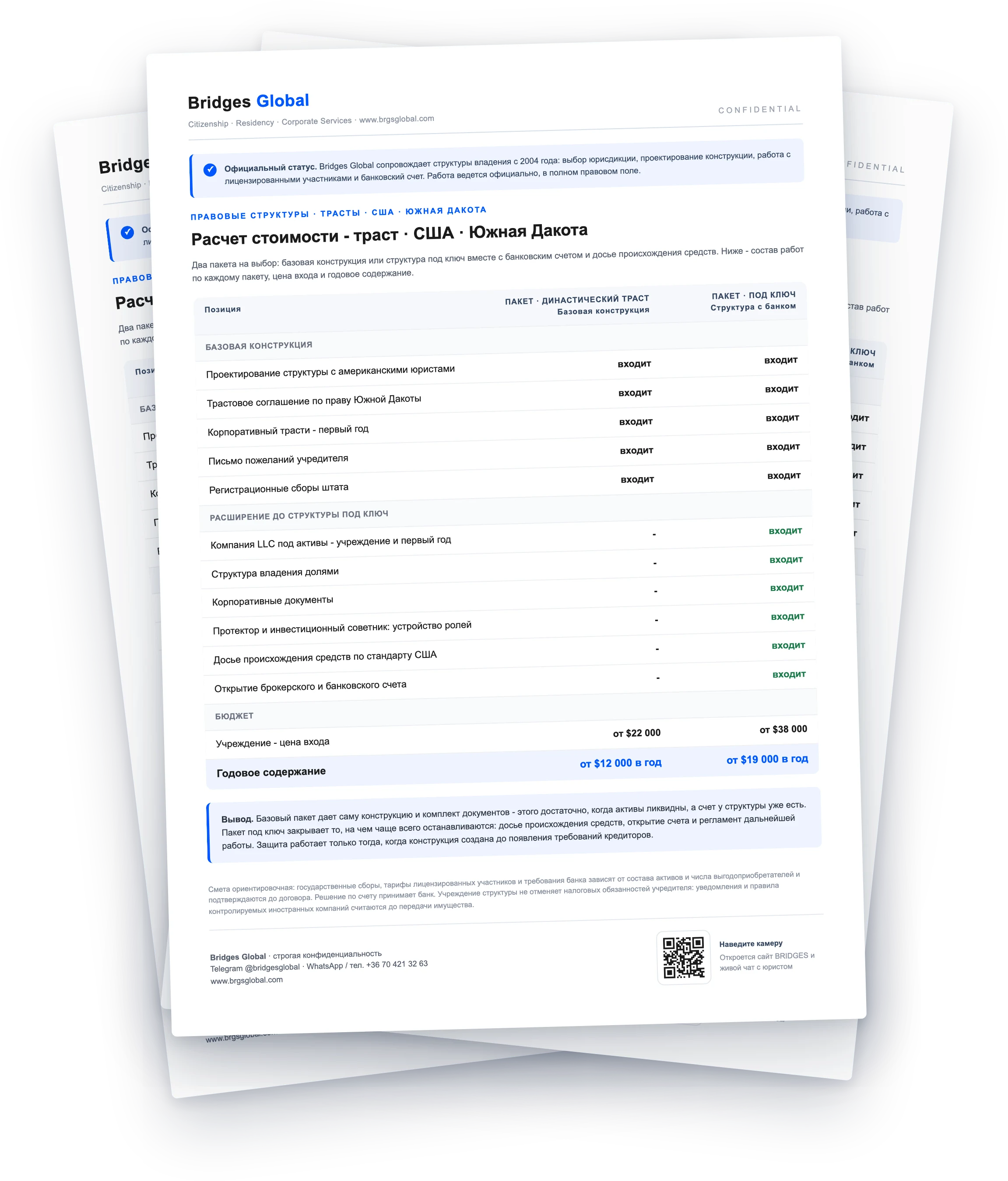
The guide figures depend on the composition of the assets, the number of beneficiaries and the bank’s requirements. The exact quotation for the set-up and the annual upkeep is fixed before the agreement.
Applicability
Is USA · South Dakota the right structure for your task
01 Main purpose
02 Assets
03 Beneficiaries
04 Bank account needed
The selector does not give a legal opinion: applicability is confirmed after the analysis of assets, family and tax residence.
The structure
What a South Dakota trust is
It is a trust under the law of the State of South Dakota — a jurisdiction that has consistently built the best trust legislation in the United States: it abolished the limit on a trust’s lifespan, removed the state tax on trust income and closed trust court files to public access.
Most jurisdictions limit how long a trust may last. South Dakota removed that limit: the structure can exist indefinitely, passing capital down the generations.
The state does not levy its own tax on the trust’s income. Federal US obligations remain and depend on the status of the trust and of the beneficiaries.
Trust disputes are heard in closed session and the materials do not reach the public record — a rarity in the United States.
The main argument for substantial capital: the stability and predictability of American courts instead of the risks of small jurisdictions.
Fit
Applying the structure: when it fits and when it does not
A plain filter: this is an expensive structure for substantial capital.
- Capital from $5m: portfolios, shareholdings, investment assets
- The task is planning for generations, a dynastic handover
- The priority is the stability of the legal system rather than a low price
- Part of the assets is already in the US, or a US portfolio is planned
- You need a structure the world’s largest banks will accept without questions
- A budget below $20,000 for the set-up: US trustees cost more than offshore ones
- The aim is to escape reporting: the American rules are strict and they work
- The settlor or the beneficiaries have US tax connections — the picture becomes far more complex and needs a separate review
- A dispute has already begun: a late transfer can be set aside
Roles
The legal structure and the parties
The American model adds professional participants to the classic roles.
Transfers the assets and sets the rules. After the transfer they do not own them personally.
A licensed South Dakota trust company supervised by the state. The legal owner of the assets.
The lever of control: replacing the trustee, vetoing distributions, amending particular terms.
A separate figure in the American model: responsible for investment decisions, leaving administration to the trustee.
Protection
The legal limits of using the structure
The strengths together with the limits.
The US legal system is predictable: court decisions are consistent and the risk of a «political» change of the rules is minimal.
A dynasty trust has no maximum lifespan — capital passes down the generations without re-establishing the structure.
Trust court files are not published — information about the structure and the family does not reach the public record.
An American trust with a corporate trustee is accepted by the world’s largest banks without further explanation.
The limits we state plainly: the structure does not protect against claims that arose before the assets were transferred — such transfers can be set aside. It does not cancel the tax obligations of the settlor and the beneficiaries and does not make assets invisible: the exchange of information and the duty to declare both operate. Criminal proceedings, sanctions regimes and maintenance lie beyond what any structure can do. Anyone who promises otherwise is misleading you.
Prices
The options for the structure and the cost
The «from» prices are for a standard structure with a confirmed source of funds. The exact quotation is fixed by the agreement.
from $22,000
Annual upkeep: upkeep thereafter from $12,000 a year
A portfolio and liquid assets held for generations
Included
- Design of the structure with US lawyers
- A trust deed under South Dakota law
- A corporate trustee — the first year
- The settlor’s letter of wishes
- The state registration fees
from $28,000
Annual upkeep: upkeep thereafter from $15,000 a year
Business shareholdings and real estate through an underlying structure
Included
- Everything in the «Dynasty trust» package
- An LLC to hold the assets — formation and the first year
- The structure for holding the shareholdings
- The corporate documents
from $38,000
Annual upkeep: upkeep thereafter from $19,000 a year
Substantial capital: the complete circuit with a bank and an adviser
Included
- Everything in the «Trust + company» package
- The protector and the investment adviser: how the roles are arranged
- A source-of-funds file to the US standard
- Opening the brokerage and bank accounts
- The rules of distributions across generations
The package does not include: US tax advice on the federal side, the charges of banks and brokers, or legal work in the countries of the assets.
What drives the quote
The factors that affect the cost of the project
The packages cover the standard tasks. Here is what moves the budget — and it is counted before the agreement, not after.
A foreign or a domestic US trust — the whole tax architecture and the volume of advisers’ work follow from it.
US persons among the beneficiaries make the structure sharply more complex and raise the cost of the support.
Portfolios are simple. Real estate and an operating business require additional structures.
The American standard for documenting the source of funds is above average.
In the quotation we separate our own fee, the US trustee’s fees, the work of the US tax advisers and the state charges.
Cost of ownership
The cost of the structure over three years
A structure costs money not only when it is created: administration, reporting and bank compliance recur every year.
- Creating the structure and the documents
- Registration and government fees
- Opening the structure’s bank account
- The first year of administration
- Administration of the structure
- Reporting and mandatory notifications
- Bank compliance and the KYC refresh
- Support of distributions to beneficiaries
- Administration of the structure
- Reporting and mandatory notifications
- Bank compliance and the KYC refresh
- A review of the structure as circumstances change
What each year contains depends on the jurisdiction, the assets and the bank’s requirements. We prepare the three-year calculation together with the set-up quotation — before the agreement.
Tax
Taxation, reporting and disclosure
The state does not tax trust income, but the United States has one of the strictest reporting systems in the world. We say it plainly: saving tax is not the main motive here.
The tax treatment depends on the status of the trust (foreign or domestic) and on whether any of the beneficiaries are US persons. It is worked through case by case with a US tax adviser.
The United States does not take part in the automatic CRS exchange but applies its own FATCA regime. That is not «invisibility»: American institutions collect and pass on data under their own rules.
A trust is a foreign structure: its establishment is declared, and where there is control the CFC rules apply. The Russian reporting remains in full.
The structure sits under American and Russian rules at the same time — we design it so that the obligations are workable in both systems.
We do not build arrangements to conceal income and we do not work with funds whose origin is not evidenced by documents.
Banking
The banking infrastructure of the structure
An American trust opens accounts more easily than many: the institutions know this form.
Banks in the US, Switzerland and Singapore — depending on the profile of the assets and the beneficiaries’ residence.
Who the settlor and the beneficiaries are, where the capital came from, the status of the trust for tax purposes, who takes the investment decisions.
The American documentation standard is above average: a complete chain is required for every source.
Often what is opened is a brokerage account rather than a current account — the structure is designed for a portfolio, not for operating payments.
A refusal by a bank is not the end: we work out the reason and go to the next one with the file corrected. No one guarantees approval, and neither do we.
Documents
Documents and information for the establishment
We assemble the pack once — the same pack goes to the administrator and to the bank.
- 01Personal documents Passports and proof of address: the settlor, the protector, the beneficiaries.
- 02The source of the capital Sale agreements, bank statements, dividend resolutions, tax returns.
- 03The list of assets What is going into the trust: accounts, portfolios, real estate, shareholdings — with the title documents.
- 04Tax residence The countries and the taxpayer numbers of every party: the notifications and the reporting depend on them.
- 05The rules for distributions Who receives funds, when and on what conditions — these rules go into the settlor’s letter of wishes.
- 06Current obligations Claims, debts, guarantees and disputes: they determine whether the protection works at all.
No documents are needed at the first consultation — we work through the task in words.
Comparison
Compare USA · South Dakota with other structures
| USA · South Dakota | |
|---|---|
| Setup | from $22,000 |
| Annual | upkeep thereafter from $12,000 a year |
| Timing | 4-8 weeks |
| Typical use | Capital from $5m: portfolios, shareholdings, investment assets |
Select up to two jurisdictions above. A detailed legal comparison is prepared for the specific task.
Process
The stages of establishing the structure
From the review of the task to a finished structure with an account.
What is being protected or consolidated, who the beneficiaries are, whether there are current disputes. We say plainly whether the structure is needed at all.
1-2 daysThe roles, the rules for distributions, the controller’s powers, exactly what is transferred and how.
3-5 daysIdentity documents and source-of-funds evidence for the administrator and the bank.
1-2 weeksThe constitutive documents, the appointment of the officers, registration.
4-8 weeksMoving the assets into the structure with correct formalities in the countries where they are held.
Opening the structure’s account and setting the rules for the work that follows.
Comparison
South Dakota against the alternatives
The main parameters side by side, so that the choice is an informed one.
| South Dakota | Cook Islands | Nevis | Liechtenstein | |
|---|---|---|---|---|
| Legal system | USA | Pacific | Caribbean | EEA |
| The lifespan of the structure | Perpetual | Long | Long | Perpetual |
| Participation in CRS | No, the FATCA regime | Yes | Yes | Yes |
| Establishment | 4-8 weeks | 3-5 weeks | 2-4 weeks | 4-6 weeks |
| Cost from | $22,000 | $14,500 | $12,500 | $28,000 |
The comparison is as at the date the page was updated; whether it applies to your case is confirmed once the profile has been reviewed.
FAQ
Questions and answers
No, and we warn plainly against that way of thinking. The United States does not take part in CRS but applies its own FATCA regime, and your duty to declare in your country of tax residence remains in full. We build only transparent structures and do not take on the task of concealment.
American corporate trustees charge at the rates of the US financial industry, and a US lawyer is a compulsory part of the project. That is the price of the stability of the legal system and of the structure being recognised by the largest banks.
A trust with no maximum lifespan. In most jurisdictions a trust has to come to an end after a set period; South Dakota abolished that limit, so the structure passes capital down the generations without being re-established.
As a rule no: the establishment is handled remotely through US lawyers and the trust company. Opening particular accounts may require a visit.
Yes. Establishing a foreign structure is not prohibited; the obligations are to declare it and to apply the CFC rules. We check the sanctions profile separately: American institutions are particularly strict on that point.
Yes, that procedure exists and is called a transfer or a change of the governing law. Whether it is possible depends on the terms of the current deed — we review the documents before starting.
Calculation
Structure and budget: USA · South Dakota
Describe the assets, the family and the task. We will come back with the applicable structure, the setup budget and the annual upkeep.
A structure does not cancel existing creditor claims or the tax obligations of the settlor. Where the task cannot be solved lawfully, we say so before the engagement.