Updated
SRV-CR-JC
Company registration
Choosing a jurisdiction for a companya decision made once
The country of registration settles the tax, the requirements as to presence, the cost of running the company and — above all — whether banks and counterparties are ready to work with you. Moving the company later costs more than choosing carefully now.
- We compare two or three options on your own task rather than handing over a general list
- We check the company will pass with banks before it is registered
- We show the annual running costs for each option
01 / The service
What actually settles the choice
A jurisdiction is rarely chosen on the tax rate — and almost never correctly when it is. Four things turn out to decide it, and most of them only emerge on a particular task.
Who your counterparties and banks are
The company has to be acceptable to those you will be working with. A jurisdiction on a grey list brings a check on every payment, however lawful everything formally is.
Tax is counted along the whole chain
What matters is not only the rate in the country of registration but the withholding tax, the double taxation treaties and the rules of your own residency.
The requirements as to presence
An office, a director, staff, evidence of economic substance. Where those requirements are real, running the company costs several times more than registering it.
Restrictions by the owner’s citizenship
Some European jurisdictions are restricted for citizens of Russia and Belarus. That is checked first of all — before every other comparison.
02 / Situations
When a separate review is needed
Situations where the price of a mistake is markedly higher than the cost of the advice.
A first company abroad
There is no experience, and the advice on the internet contradicts itself and is usually several years out of date.
A working bank account is needed
The task is not to register but to settle payments. Then the choice runs from the bank back to the jurisdiction.
A company inside a structure
The entity fits into a holding, a trust or a foundation — the choice depends on the whole chain, not on the company alone.
The previous jurisdiction has stopped working
The company exists but the account has been closed or counterparties refuse. A review and a move to another country are needed.
Real activity on the ground
An office, staff, licences — here a jurisdiction is chosen on quite different criteria from a holding company.
Several owners
Partners with different citizenships and residencies narrow the list of countries available.
03 / Honest limits
What we do not do
A position that saves clients money.
We do not sell the jurisdiction we earn most on
The recommendation depends on the task, not on what a particular registrar pays us.
We do not register where no account can be opened
A company with no bank is money spent for nothing. If there is no working banking option, we say so before the registration.
We do not build tax avoidance schemes
Choosing a jurisdiction is lawful planning. We do not propose constructs whose only purpose is to conceal income.
We do not promise anonymity
Registers of beneficial owners, the exchange of information and banks’ requirements make complete privacy impossible. Anyone promising otherwise is misleading you.
04 / Scope of work
What the review covers
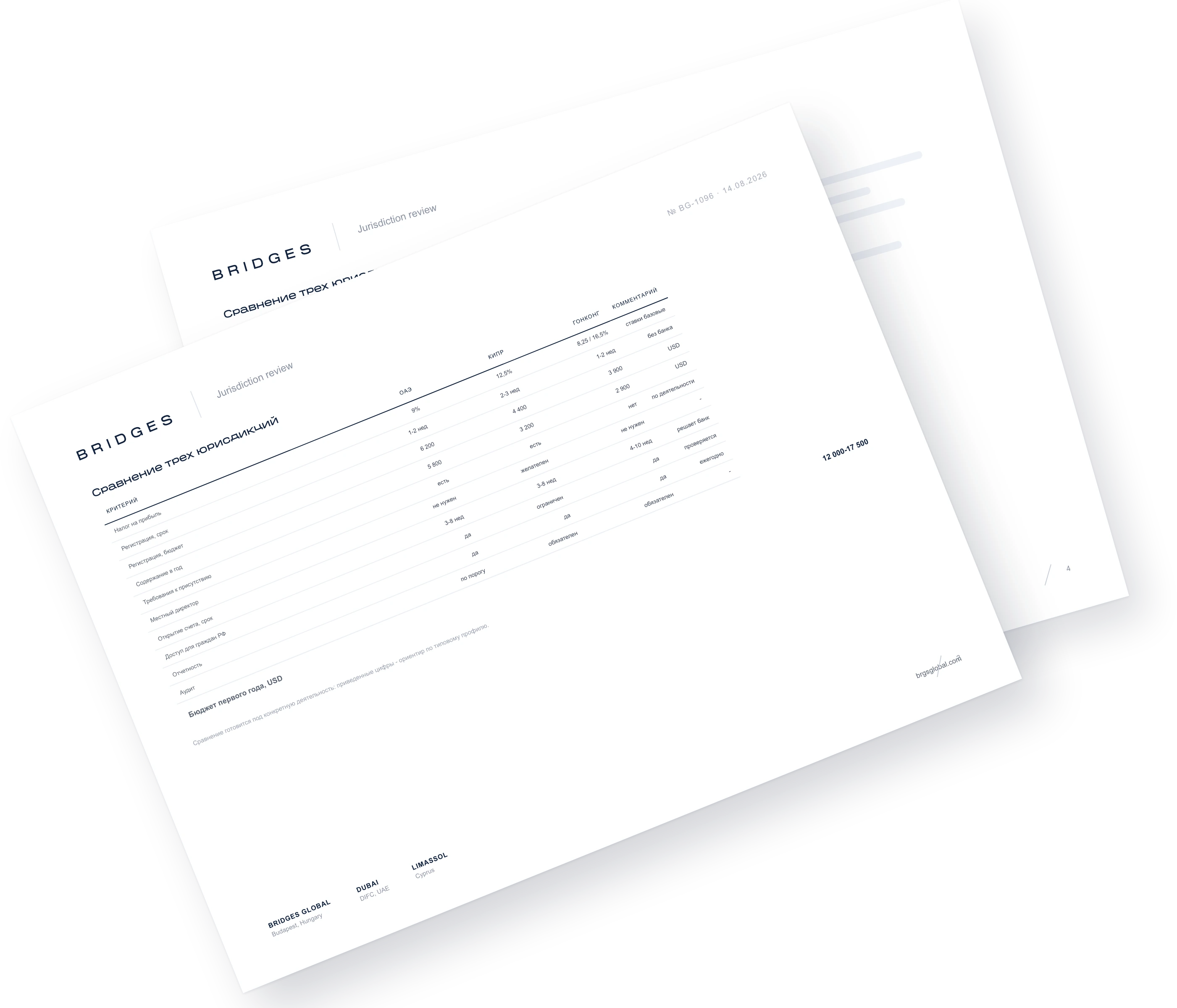
The result is a document with the comparison and a reasoned recommendation.
Checking the restrictions
Which jurisdictions are available with your citizenship and line of business. We cut out what will not work at once.
A comparison of the options
Two or three options on tax, presence, timing, the cost of registration and the cost of running it.
The banking map
Which banks really work with companies from this jurisdiction on your profile and what they will ask.
The tax consequences
How the choice will show in your own tax picture: the CFC rules, the notifications, the tax on distributions.
A three-year budget
Registration plus upkeep: renewals, reporting, the agent, presence where it is required.
The recommendation
One option with the reasoning and a fallback — with an explanation of the conditions in which to choose it.
The review is a result in itself: even if you register elsewhere, the document stays with you.
05 / Cost
What the cost depends on
The review is quoted by the complexity of the task, not by the number of pages in the report.
The number of jurisdictions compared
Two options are simpler than five: each calls for a tax and a banking check.
The type of activity
Trade, services and holding assets are checked quickly. Financial services, cryptocurrency and licensed activity are work of their own.
The number of owners
Every participant with their own citizenship and residency adds restrictions.
The link to a structure
If the company fits into an existing holding or trust, the whole chain has to be analysed.
The cost of the review is set against the cost of the registration if you go on to work with us.
06 / How it works
How we work
A short cycle: usually a week passes from the question to the recommendation.
A conversation about the task
What the company will do, who owns it, where the money comes from and where it goes.
1 day
Filtering by the restrictions
We check the owners’ citizenship, the type of activity and the sanctions profile.
1–2 days
The comparison
Tax, presence, banks, timing, budget — for each option.
3–5 days
The discussion
We go through the document together, answer the questions and adjust it on new information.
1 day
Moving to registration
Once the decision is taken we start the registration on the chosen option straight away.
07 / Preparation
What we will need from you
At this stage documents are hardly needed — facts are.
A description of the business
What the company will do, whom it will work with, in which currencies and at what volumes.
The owners
Who the participants are and their citizenships and tax residencies.
The current structure
Which companies and assets there already are — the new one has to fit into them.
The priorities
What matters more: the running cost, the speed, the reputation of the jurisdiction or the tax burden.
08 / Team
Who runs the review
A lawyer and a tax adviser prepare the comparison together.
 Sergey EvdokimovManaging PartnerThe legal requirements of the jurisdictions and the registration
 Hanna BergerTrusts and Succession AdvisorThe tax side and the requirements as to presence
 Tomas LinderCompliance and AML OfficerThe banking map: who actually opens accounts
 Irena SokolovskaHead of Europe OfficeThe offices and the partner network
10 / Questions
Answers to common questions
There is no such thing — there is one that suits a particular task. A company for settlements with European clients, a company for holding property and a company for IT services are chosen on different criteria, and the best answers for them differ.
Registering a company in another country is lawful in itself. What is unlawful is concealing the participation where it has to be notified and not paying tax where it arises. We work only in the first field.
They work, but narrowly: for holding assets and intra-group settlements. For an operating business with bank payments they have become inconvenient — the requirements as to presence and banks’ wariness have made running them cost more than the benefit.
It can: some jurisdictions allow redomiciliation with the legal person preserved; in the other cases a new company is created and the assets moved. Both cost more than choosing correctly the first time.
The spread runs from a thousand and a half dollars for a simple jurisdiction with no presence requirements to several tens of thousands where an office and staff are needed. That is exactly why we show the running budget before the registration rather than after.
The UAE, Hong Kong, Singapore, Panama, the Seychelles, Mauritius, Nevis and a number of others. In the European Union corporate services are restricted by the sanctions rules for persons with no EU residence permit. We check availability first of all, before every other comparison.
They are lists of jurisdictions the regulators watch closely. A company from such a country is formally lawful, but each of its payments goes through a heightened check and some banks refuse outright. We warn about that before the registration.
Not always, but saving on the registration often turns into spending on the bank. If the company is needed for settlements, the choice runs from the bank back to the country. If it is only for holding assets, a cheap jurisdiction works perfectly well.
Two or three. More makes no sense: after filtering by citizenship, type of activity and whether banks will take it, a handful of genuinely workable options almost always remain, and we go through those in detail rather than listing thirty countries.
Go through the cause: whether it lies in the country, the structure or the owner’s profile. Sometimes changing the bank is enough; sometimes the company has to be moved. We work out both options with a budget before anything is changed.
INITIAL ASSESSMENT
Tell us what outcome your family needs
We will design a solution for your case, choose the country and the right status, and take the whole process through to the result.