



Updated

ES-DN

The digital nomad visa

Residency in Spainthe nomad visa

A status for those who work remotely for foreign companies. The decision is taken in 20 days, the card is issued for three years at once and extended for two. The family comes with the applicant and an income of €2,442 a month is evidenced.

  • The conditions are checked against law 28/2022 and the Spanish Foreign Ministry
  • Working since 2004
  • We run the visa, the TIE card and the renewal
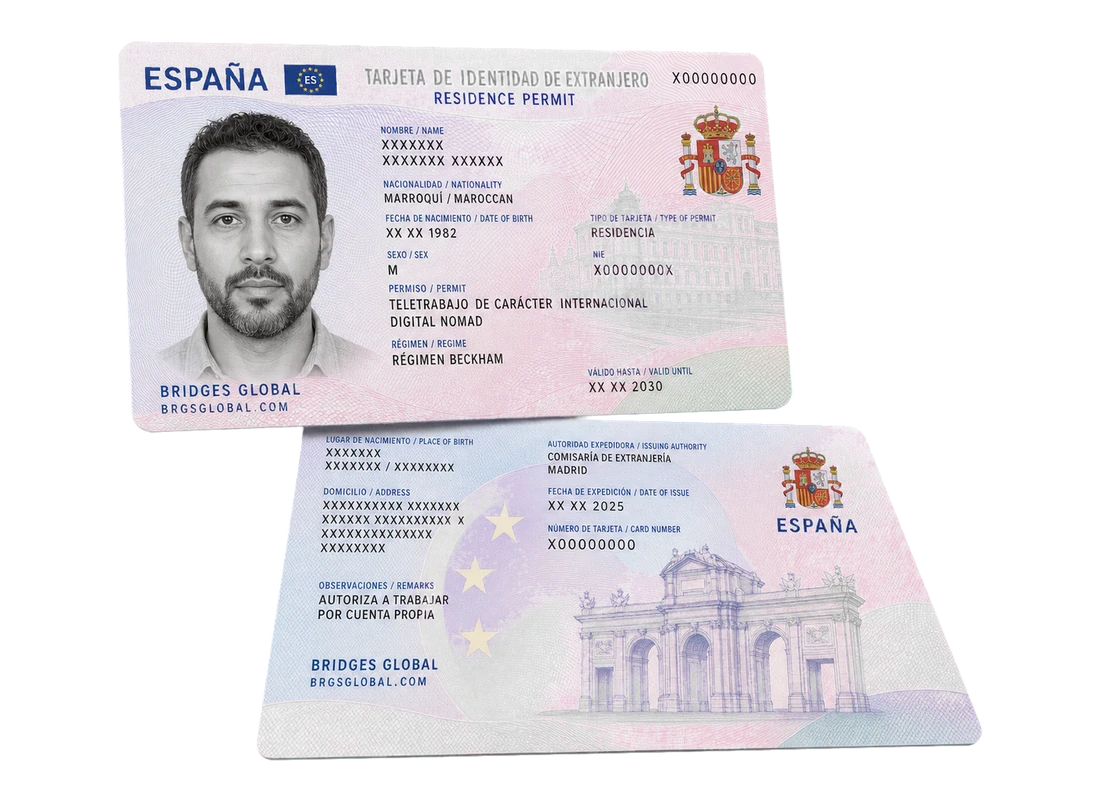
A Spanish residence card under the digital nomad visa
from €2,442 a monthIncome for the applicant
Three years at onceThe term of the residence card
The family in the applicationA spouse and children with you

01 / About the program

How the digital nomad visa works

Spain introduced this status by law 28/2022 to attract remote professionals. The applicant works for companies outside the country and lives in Spain — lawfully, with access to medicine and schools for the children.

01

The employer must be foreign

An employee may work only for companies located outside Spain. Freelancers are allowed a limited share of Spanish clients.

02

The income is measured from the minimum wage

The requirement is 200% of the SMI. With the 2026 minimum wage of €1,221 that is €2,442 a month, or €29,304 a year.

03

The family adds to the threshold

For a second family member the requirement rises by 75% of the SMI and for each further one by 25%. It is worked out in advance, before filing.

04

This is a working status, not a passive one

Unlike the residencia no lucrativa, employment is compulsory here: an employment contract or client contracts and a record of working with them are evidenced.

02 / What you get

What the status gives you

Lawful life in Spain

The right to live in the country and move around Schengen for up to 90 days in every 180 while keeping your work for a foreign employer.

A status for the family

A spouse and children receive the status together with the applicant. The income requirement rises by 75% and 25% of the SMI respectively.

Schools and medicine

Children study in state schools and the family uses medicine through insurance or the social security system.

A tax regime for new residents

Where the conditions are met the special regime for posted workers is available. Whether it applies is worked out individually.

The road to permanent residence

Five years of lawful residence open up European Union long-term residency.

Fast processing

Applications under the start-ups law are considered on an accelerated basis — one of the things that sets this status apart from general grounds.

A preliminary assessment

Calculate the budget for your family

Set out who is applying with you. With the calculation you get the full Spanish picture: the income required, the budget for the move, the timeline and a plan of action.

Who is applying for the residence permit?

Get the calculation

about a minuteno calls and no obligationsconfidential

  • The full calculation for your family composition
  • The timeline for each stage of the process
  • A plan of action: where to start
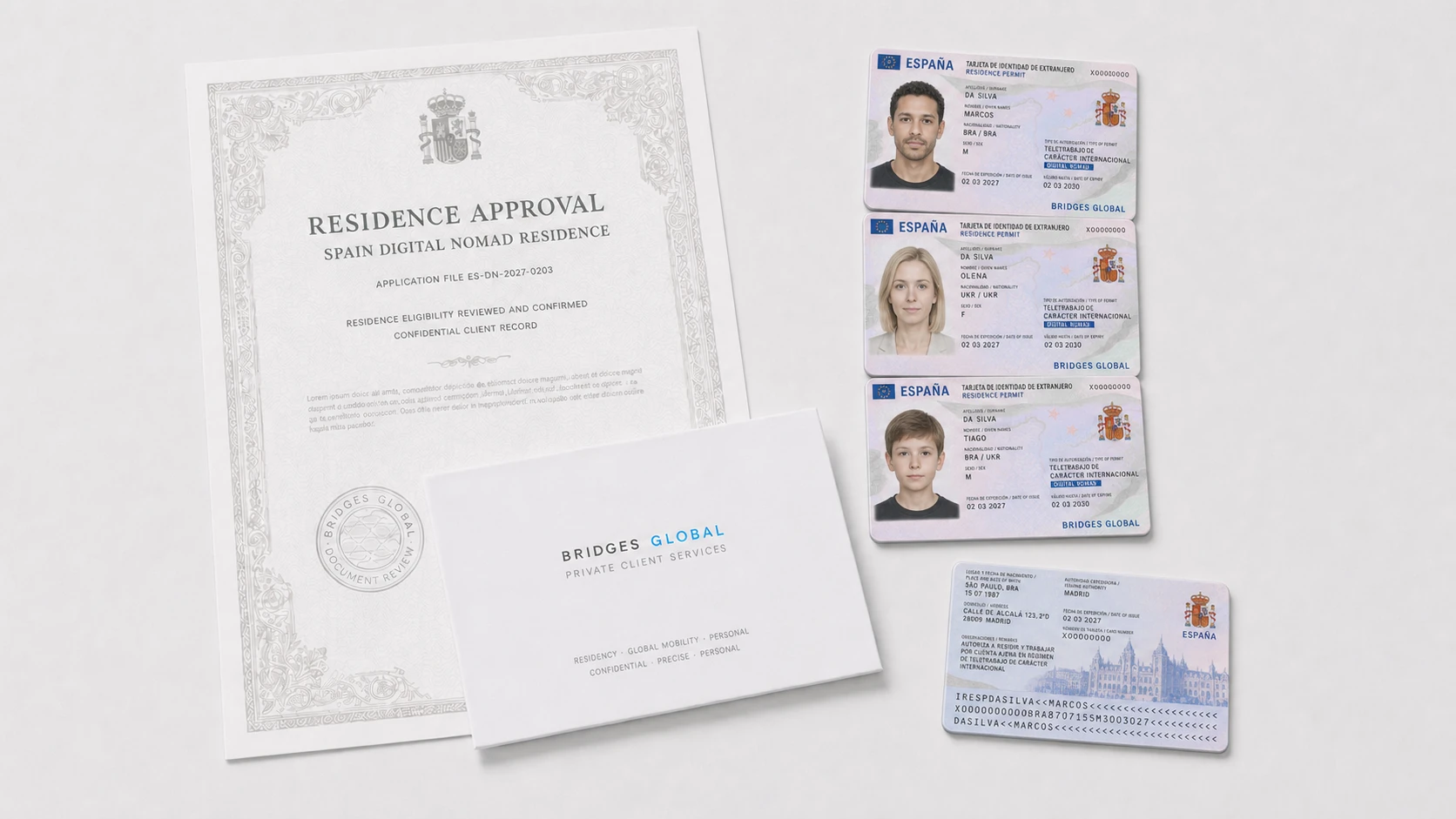
A Spanish residence card and a set of nomad visa documents

03 / Why people apply

Why people arrange the status

It is the answer for those who already work remotely and want to live in Spain lawfully rather than on tourist visas.

The work stays the same

You carry on working for your employer or clients outside Spain — there is no need to change your employment.

A lower threshold than the passive statuses

€2,442 a month against €28,800 a year of savings under the no lucrativa: for a working professional that is more attainable.

Education for the children

State schools and universities at resident rates, and international schools in the large cities.

Tax planning

The special regime for posted workers can change the final burden substantially. It is worked out before the move.

Life by the sea

Barcelona, Valencia, Malaga — developed infrastructure for remote work and a mild climate all year round.

A path to a long-term status

After five years long-term residency, and after ten the right to apply for citizenship under the general qualifying period.

04 / Travel

Where you can travel on the residence card

The TIE card gives the right to live in Spain and travel around Schengen; the work meanwhile stays outside the country.

Mode 01

Spain without limits

Residence, entry and exit for the whole term of the card. The status is designed for real residence in the country.

Mode 02

Schengen, 90 days in 180

Travel around the Schengen countries without a visa — up to 90 days in every 180.

Mode 03

Work for a foreign employer

An employee works only for companies outside Spain. A freelancer may have a limited share of Spanish clients.

Mode 04

The rest of the world on your own passport

You travel to third countries on your passport of citizenship: that is what sets the visa regime.

Sources: law 28/2022 on supporting the start-up ecosystem, the procedure of the Ministry of Inclusion and the Schengen Borders Code (Regulation (EU) 2016/399).

05 / The composition of the application

Who can obtain the status

Each family member raises the income requirement. Open a row to see the conditions.

  • Work for a company outside Spain
  • An income from 200% of the SMI
  • At least three months of working with the employer or the clients
  • Medical insurance and no convictions
  • In a registered marriage or partnership
  • Adds 75% of the SMI to the income requirement
  • Entitled to work in Spain under the general rules once the status is obtained
  • The children of the applicant or the spouse
  • Each adds 25% of the SMI
  • They are enrolled in state schools
  • They evidence financial dependency on the applicant
  • Each adds 25% of the SMI
  • Medical insurance is compulsory

06 / Cost

What income has to be evidenced

The requirement is tied to the minimum wage: 200% of the SMI for the applicant plus the additions for family members.

A single applicant · 200% of the SMI

€29,304

≈ $34,000

Evidenced The whole term of the status

  • €2,442 a month on the 2026 minimum wage
  • An employment contract or contracts with foreign clients
  • At least three months of working with the employer or the clients
  • The employing company must have existed for at least a year

The applicant and a spouse · 200% plus 75% of the SMI

€40,293

≈ $47,000

Evidenced The whole term of the status

  • For a second family member 75% of the SMI is added — €915.75 a month
  • The marriage is evidenced by documents with an apostille and a translation
  • The income may belong to the main applicant
  • Medical insurance is arranged for each person

A couple with a child · 200% plus 75% and 25%

€43,956

≈ $51,000

Evidenced The whole term of the status

  • For each further family member 25% of the SMI is added — €305.25 a month
  • Children are enrolled in schools on equal terms with residents
  • Housing is evidenced for the whole family
  • The requirement is checked again when the status is renewed

The composition of the application

The main applicant
1
Spouse
0
Minor children
0
Dependent parents
0

The thresholds are given on the 2026 SMI (€1,221) and the requirements of law 28/2022. On top of the income come the consular fee, the TIE card, the insurance, the housing and the support. This is a preliminary calculation, not a decision of a state authority.

07 / Comparison

Spain against the neighbouring nomad visas

The European nomad visas differ in the income threshold and in how strictly work inside the country is limited.

SpainPortugal D8GreeceItalyCroatia
Income requirement€2,442 a monthfrom €3,680 a monthfrom €3,500 a monthunder the decree’s requirementsby the country’s formula
How it is calculated200% of the SMI4 minimum salariesa fixed suma fixed suma fixed sum
Work in the countryOnly for foreign employersOnly for foreign employersOnly for foreign employersOnly for foreign employersOnly for foreign employers
The path to permanent residence5 years5 years5 years5 yearsdoes not lead
The tax regimeA special regime for posted workersthe general rulesa concession for new residentsthe general rulesan exemption under the rules

The thresholds are given as at the date this page was updated; the conditions for each country are set out on its own page.

Full program comparison →

10 / How it works

How the process works

STEP 1

Checking the employment and the income

We go through who your employer or clients are, where they are registered and whether the income is evidenced at 200% of the SMI.

STEP 2

The documents from the employer

The employment contract or client contracts, a certificate of how long you have worked together and proof that the company has existed for at least a year.

STEP 3

The personal documents

Police clearance certificates, medical insurance and proof of qualifications or work experience.

STEP 4

Filing: the consulate or Spain

You can file at the consulate for your place of residence or in Spain itself, while there lawfully.

STEP 5

The TIE card

After approval the residence card is arranged: the biometrics and the registration of residence.

STEP 6

Renewal and taxes

We run the renewal of the status, the tax registration and the assessment of whether the special regime applies.

Historic buildings in central Barcelona

The work stays foreign and the life becomes Spanish — lawfully and with the family.

SpainThe European Union and SchengenLaw 28/2022
Go through your situation

11 / Our role

Why people arrange the nomad visa with us

Refusals here come down not to the amount but to the employer’s documents: they have to be assembled in the form the authority accepts.

01

We check the employer in advance

The company must have existed for at least a year and have worked with you for at least three months. That is settled before filing.

02

We work out the threshold for the whole family

The additions of 75% and 25% of the SMI are often forgotten. We calculate the total in advance and show how to cover it.

03

We prepare the documents for the authority

Certificates, the apostille, sworn translations and proof of qualifications in the accepted format.

04

We run the tax question

We check whether the special regime for posted workers applies before the move, not after the first return.

15 / Materials

Useful materials on Spain

Materials on the nomad visa: calculating the income, the employer’s documents and the order of filing.

The main materialPresentation

The Spanish digital nomad visa

The presentation gathers the essentials: the requirements as to income and employment, the documents, the order of filing and the tax regime.

Inside:

  • how much income is required for your family composition
  • which documents are needed from the employer
  • how the status differs from the no lucrativa
  • which family members come into the application
  • where to file: the consulate or Spain
  • how the special tax regime works
  • how work with BRIDGES is organised

PDF · free · current as of August 2026

A short check: where the employer is registered, whether the income is enough and whether you have the required record of working together.

The list for the applicant and each family member, the employer’s documents included.

We calculate the income required, the budget for the move, the fees and the support.

All the materials are updated regularly by our team and are used when supporting BRIDGES clients.

16 / News

What matters to know

2026-01-01

The minimum wage for 2026 is €1,221. The nomad visa requirement rose with it: €2,442 a month for the applicant.

2026-08-11

An employee on this status may work only for companies outside Spain; freelancers are allowed a limited share of Spanish clients.

Worth having

Prepare for the Spain Digital Nomad Visa

The short document we give clients before the start: the income, the employer’s documents, the stages and the timelines.

Inside the document

  • The income required by family composition
  • What is needed from the employer or the clients
  • The current conditions for 2026

We will send it after a short form - no call or obligation.

17 / Questions

Answers to common questions

200% of the interprofessional minimum wage. With the 2026 SMI of €1,221 that is €2,442 a month, or €29,304 a year. For a second family member 75% of the SMI is added, and 25% for each further one.

An employee — only for companies located outside Spain. A freelancer may work with Spanish clients, but their share is limited; the bulk of the income must come from abroad.

At least three months of working with the employer or the clients before filing, and the company itself must have existed for at least a year. Those are the key formal conditions.

At the consulate for your place of residence, or in Spain itself if you are there lawfully. The second route is often faster.

Yes. A spouse, children and dependent parents come into the application. Each raises the income requirement: 75% of the SMI for a second family member and 25% for each further one.

Where the conditions are met the special regime for posted workers is available, with a flat rate on income from Spanish sources. Whether it applies to your case is worked out individually, before the move.

The no lucrativa forbids work and requires savings of €28,800 a year to be evidenced. The nomad visa, by contrast, is built on work: a regular income from a foreign employer is evidenced.

Yes. Five years of lawful residence open up European Union long-term residency, and ten years the right to apply for citizenship under the general qualifying period.

Applications under the start-ups law are considered on an accelerated basis: usually from a few weeks to a couple of months, allowing for the preparation of the documents.

There are no restrictions on citizenship. The practical difficulty is evidencing the employment and the transfers from a foreign employer; we go through that part before filing.

INITIAL ASSESSMENT

Tell us what outcome your family needs

We will design a solution for your case, choose the country and the right status, and take the whole process through to the result.

Or message us on WhatsApp or Telegram

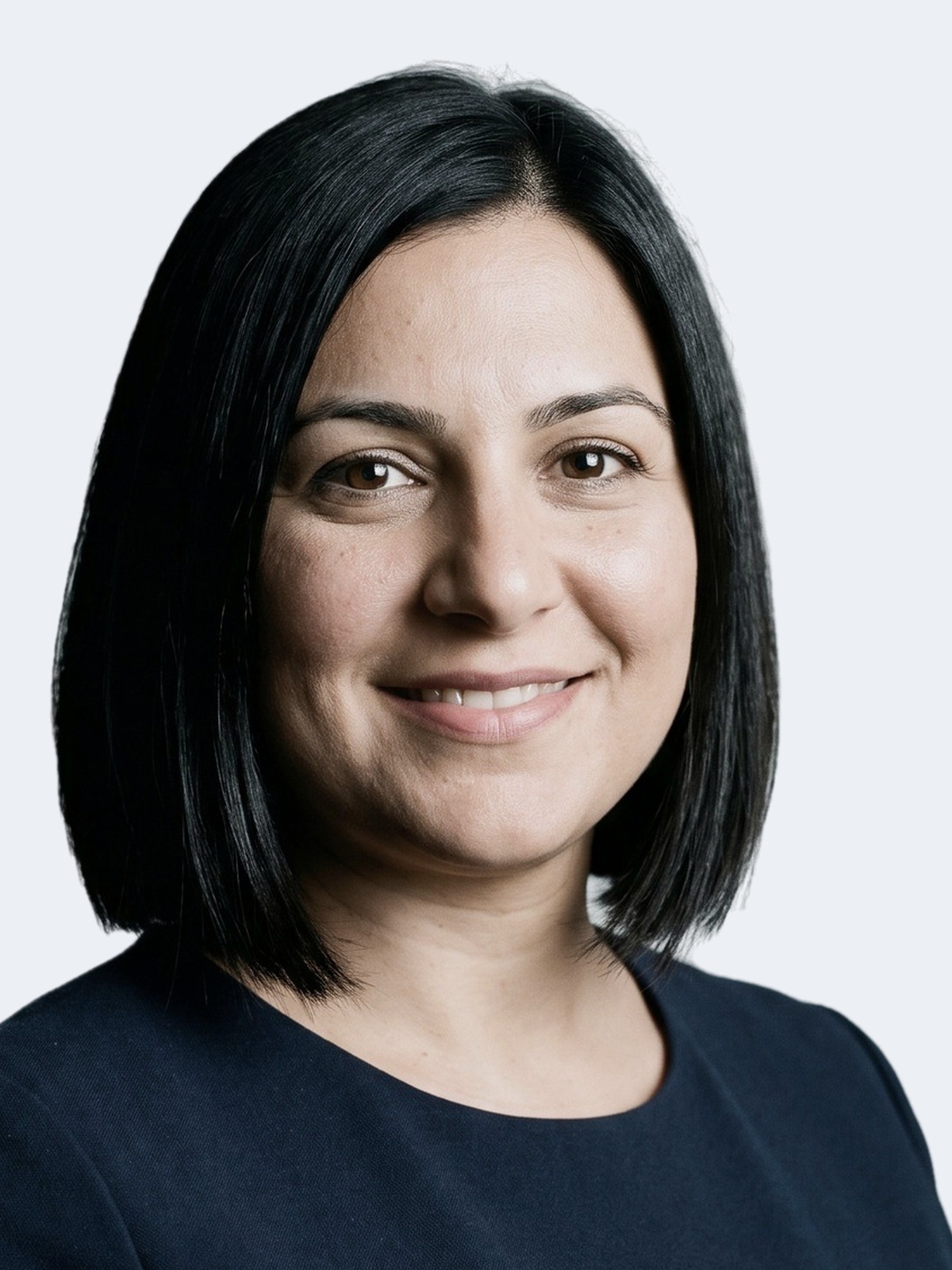
Anna Kovalevskaya, lead lawyer at BRIDGES GLOBAL
Anna KovalevskayaLead lawyer, citizenship and residency, 12 years of practice