







Updated

IL-CBD

Citizenship by descent

Israeli citizenshipby repatriation

The right comes from the Law of Return: a Jew, their children and grandchildren and their spouses may repatriate and obtain citizenship on the day of arrival. The law provides for no contributions and no investment — everything turns on the documents of descent.

  • 20 years of practice in citizenship programmes
  • We raise the archives before the documents are filed
  • A straight assessment of the ground before the start
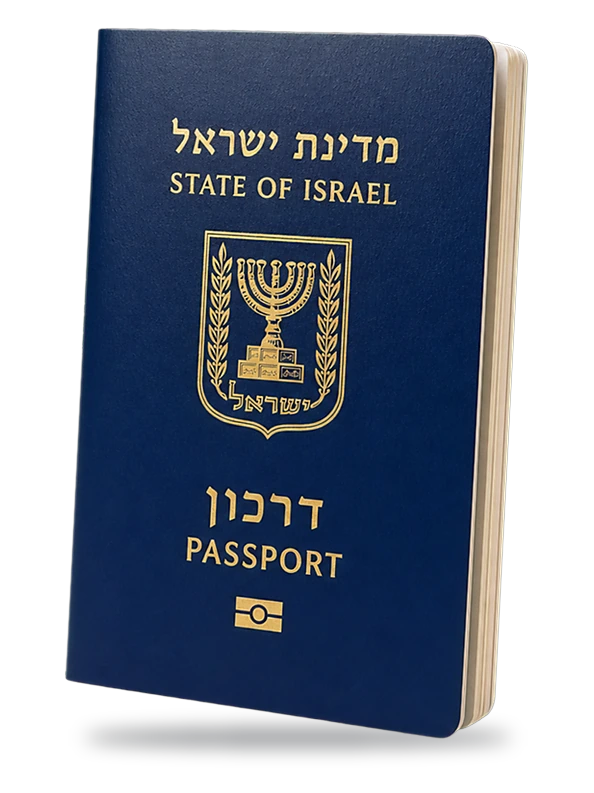
The passport of a citizen of the State of Israel
Three generationsA Jew, their children and grandchildren
No investmentThe law requires no contribution to the budget
On the day of repatriationThe moment citizenship arises

01 / The mechanism

What the right rests on

Repatriation is not a programme with entry conditions you can meet. It is a right that a person either has by the fact of descent or does not. Two laws work here: one gives the right to come, the other turns the arrival into citizenship.

01

The Law of Return, 1950

Article 1: every Jew has the right to repatriate to the country. The right is exercised through an immigrant visa issued by Israel’s Ministry of the Interior.

02

The 1970 amendment, article 4A

The same rights went to the child and grandchild of a Jew, the spouse of a Jew, the spouse of a Jew’s child and the spouse of a Jew’s grandchild. It is this amendment that opened repatriation to people who are not Jews under Halakha.

03

The definition in article 4B

A Jew under the law is a person born of a Jewish mother or who has undergone conversion, and who is not a member of another religion. The definition applies for this law alone and for nothing else.

04

The Nationality Law, 1952

Article 2: citizenship by return arises from the day of repatriation. There is no separate naturalisation application, no residence requirement and no exams — citizenship appears by the fact of arriving with the status of an immigrant.

05

The ancestor may have died long ago

Article 4A says expressly that it makes no difference whether the Jew through whom the right is claimed is alive, or whether they ever repatriated to Israel. It is enough to prove the kinship and their descent with documents.

06

The line makes no difference

For article 4A it does not matter whether the kinship runs through the mother or the father. The limit to the maternal line belongs to the definition of a Jew in article 4B, not to the rights of children and grandchildren.

Sources: the Law of Return 5710-1950 (articles 1, 2, 4A and 4B as amended in 5730-1970) and the Nationality Law 5712-1952 (article 2). The interpretation of these provisions in a particular case falls to Israel’s Ministry of the Interior and the Israeli courts.

02 / Checks

How the right is checked

The right to repatriate is established by the state, not by the applicant and not by an adviser. The check goes in two rounds: first the documents and the descent, then the person and the grounds for refusal.

The consular check

A meeting in person at an Israeli diplomatic mission with the official responsible for repatriation. They look at the originals, ask questions about the family history and match the answers against the documents. It is the key stage: this is where the ground is either borne out or not.

Nativ

For people from the countries of the former USSR the right to repatriate is checked by Nativ, a service under the office of Israel’s prime minister. You can only book and take the check at your own place of residence, and the booking procedure depends on the country.

The Jewish Agency

In other countries the organisational side of repatriation is handled by the Jewish Agency. It prepares the case and supports the move, but the decision on the right is not taken by it.

The check on grounds for refusal

The circumstances in article 2(b) of the Law of Return are checked separately: activity against the Jewish people, a threat to public health or the security of the state, a criminal past. A certificate of no criminal record is always requested.

The decision and the immigrant visa

On a positive decision an immigrant visa is affixed in the passport. By settled practice it is valid for six months — the country has to be entered within that time or the procedure has to be gone through again.

The timing depends on the queue

There is no single statutory period for consideration: the queue for the check and the time the archives take to answer differ by country and change. The queue cannot be influenced — what can be avoided is losing time on documents that will not be accepted.

Sources: the Law of Return 5710-1950, articles 2(b) and 4A(c). The procedure for the consular check and for booking it is set by Israel’s Interior Ministry, Foreign Ministry and Nativ; it differs by country and may change without prior notice.

A preliminary assessment

Find out the cost

Set out who is applying with you. In the preliminary assessment we go through the family history for that composition and name the timelines, the cost of the support and the first step.

Who is applying for citizenship?

Get the calculation

about a minuteno obligationsconfidential

  • The cost of the support for your composition
  • The timeline for each stage of the work
  • A plan of action: where to start
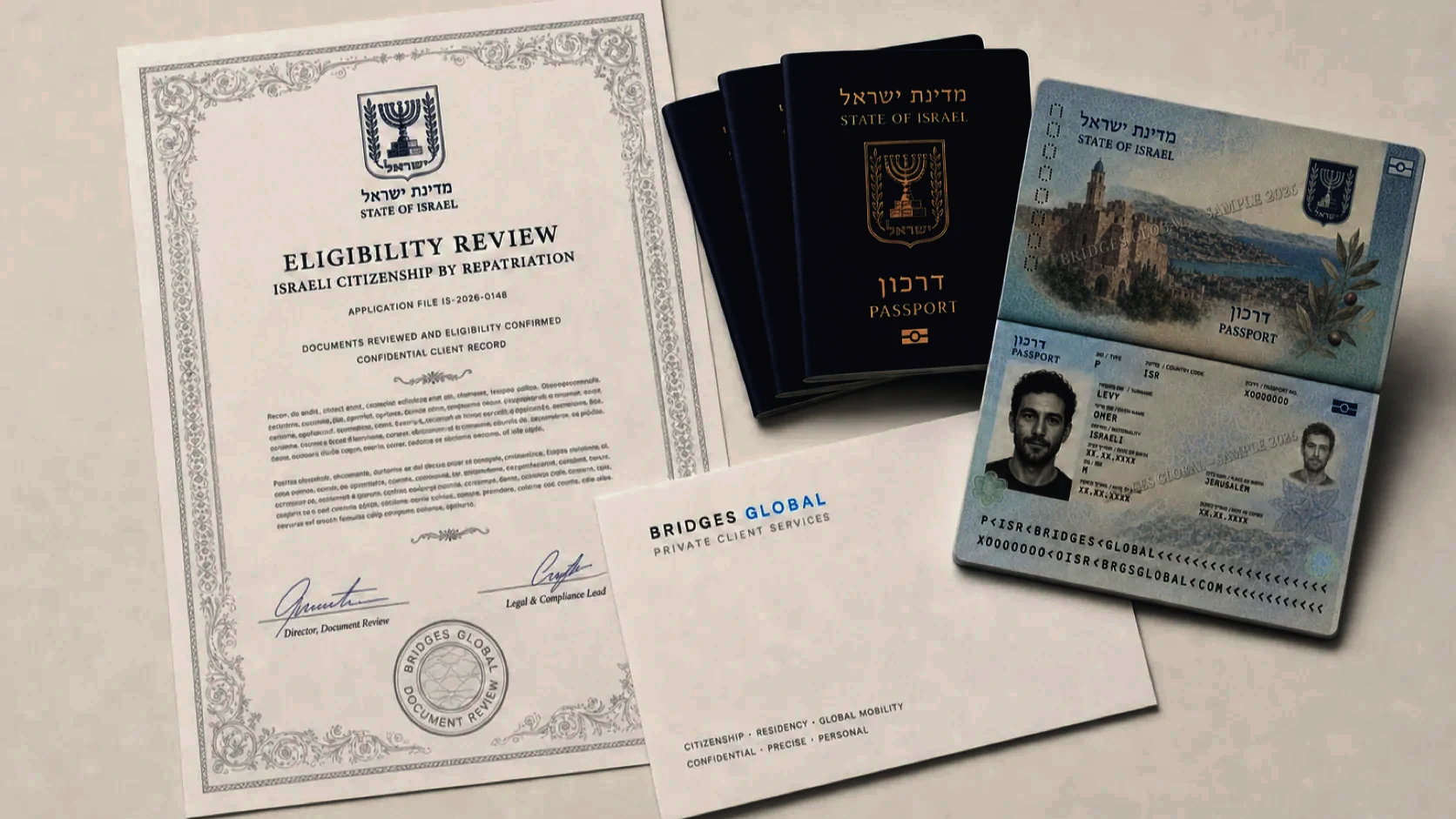
A set of documents for repatriation to Israel

03 / Travel

Where you can travel and where a visa is needed

The destinations fall into four entry regimes. We do not publish a total number of visa-free countries: the lists change, and a figure with no date of checking misleads. We prepare a current list as at the date of your request.

Mode 01

Without a visa

Most European, American and Asian destinations are open to an Israeli passport with no visa arranged in advance.

Mode 02

An electronic authorisation

A number of countries require an electronic entry authorisation arranged online before travel. Formally it is not a visa, but without it you will not be boarded.

Mode 03

A visa on arrival

The authorisation is arranged at the airport or at the border. The requirements as to the validity of the passport and the supporting documents are set by the receiving country.

Mode 04

A visa is needed in advance

Some destinations, among them particular countries of the Middle East, Asia and Africa, require a visa arranged before travel or do not accept an Israeli passport at all.

Every country on an Israeli passport

160+ destinations with nothing to arrange in advance — visa-free or with a visa on arrival

Where you are let in without a visa, where the authorisation is arranged online, where the visa is issued at the border and where a consular one is needed — with the length of stay given for each country.

Entry rules are set by the receiving states and may change at any moment, including for political reasons. The regime has to be checked as at the date of travel, not as at the date the passport was obtained.

04 / Grounds

Who has the right

Six categories, and the law knows no others. Open a row to see what exactly has to be proved for each of them.

  • Born of a Jewish mother
  • Not a member of another religion
  • The descent is evidenced by documents, not by relatives’ testimony
  • The conversion was made in a community recognised for the purposes of repatriation
  • Confirmation from the community and documents on the procedure are required
  • Whether a particular conversion is recognised is assessed separately by the Interior Ministry — the most contested category
  • One of the parents is a Jew under the definition of the law
  • The line may be maternal or paternal
  • The applicant themselves need not be a Jew under Halakha
  • One of the four grandparents is a Jew under the definition of the law
  • An unbroken documentary chain is needed: you — the parent — the grandparent
  • It is the last generation to which the law gives the right
  • The marriage is registered and subsists at the time of consideration
  • The right is derivative: it exists while the marriage exists
  • What is checked is the validity of the marriage, not its length
  • The right arises from the spouse, not from your own descent
  • The spouse’s ground is proved in the same measure as if they were filing on their own
  • The couple as a rule files together — filing separately complicates the check

05 / Evidence

What descent is proved by

What is checked is not the story of the family but the papers. The task is to assemble an unbroken chain from you to the ancestor with an entry as to Jewish nationality, where every link is evidenced by a document from a state body.

01

The ancestor’s descent

  • A birth certificate with the entry as to nationality
  • An archive certificate from the registry office or the regional archive
  • Entries in the registers and pre-war documents
  • The ancestor’s marriage certificate
  • The death certificate

02

The chain of kinship

  • Birth certificates for every link with no gaps
  • Marriage certificates where surnames changed
  • Adoption documents where there was one
  • Certificates of a change of given name or surname

03

The applicant’s documents

  • A valid passport
  • The internal passport and a certificate of marital status
  • A certificate of no criminal record
  • A marriage or divorce certificate
  • The military record and the employment record book if requested

Documents of foreign origin go through legalisation: as a rule an apostille and a translation. The requirements as to the validity period of certificates and the form of legalisation are set by the receiving side and they change — we assemble the current list as at the date of your filing.

06 / Comparison

Israel against the other programmes by descent

Our catalogue holds three programmes where citizenship comes from descent rather than from investment. They differ not in the sum — there are no sums here — but in what exactly has to be proved and whether you have to move.

IsraelBulgariaHungary
The groundThe Law of ReturnDescentDescent
InvestmentNot provided forNot provided forNot provided for
The depth of generationsTo a Jew’s grandchildBy the ancestors’ documentsBy the ancestors’ documents
A move to obtain itCompulsoryNot requiredNot required
What you getAn Israeli passportAn EU passportAn EU passport
The timingOn the result of the checkPR in 6 months / a passport in 2 yearsFrom 6 months

The conditions for Bulgaria and Hungary come from our catalogue of programmes; the details are on the pages for those directions. The timing for Israel depends on the queue for the consular check and the speed of the archives’ answers; there is no single statutory period.

Full program comparison →

07 / How we work

How repatriation works

STEP 1

The review of the family history

We go through every branch of the family and look for where the right arises and through whom. It often turns out not to be where it was expected: with a spouse, with a parent, along a line the family never discussed. The stage ends with a clear diagram of kinship and a list of what has to be proved.

STEP 2

The archive search

We order certificates from the archives and registry offices for every missing link. It is the longest and the most underrated stage: an archive answers over months, and without it the chain does not close.

STEP 3

Gathering and legalising the documents

We assemble the set for each participant, put the discrepancies in given names and surnames in order and arrange the apostille and the translations. Discrepancies are cleared in advance — at the consular check they turn into questions.

STEP 4

Booking and preparing for the check

We book the consular check at your place of residence, prepare the forms and go through the possible questions on the family history with you. You come to the meeting with the chain reconciled, not with a folder of papers.

STEP 5

The consular check

The meeting is held in person. On its result the decision on the right to repatriate is taken, and on a positive outcome an immigrant visa is affixed in the passport.

STEP 6

Arrival and arranging the status

The status of an immigrant is arranged on arrival. From that day citizenship arises and the immigrant certificate and the identity card — the teudat zehut — are issued.

A panorama of Tel Aviv and the Mediterranean, photo by Dan Gold

What decides the case is not intentions but documents. The right is either proved by a chain of papers or it is not — there is no third way in this procedure.

The State of IsraelThe Law of Return, 1950Citizenship by descent
Check the ground

08 / After arrival

What happens after arrival

Citizenship appears on the day of repatriation, but the set of documents does not open at once. The order is worth knowing in advance: it bears directly on travel plans in the first year.

Citizenship on the day of repatriation

Under article 2 of the Nationality Law, citizenship by return arises from the day of repatriation. No separate naturalisation application, residence requirement or exams are needed for it.

The right to decline citizenship

An adult foreigner may declare that they do not wish to become a citizen of Israel — before the day of repatriation or within three months after it. Such a person keeps the status but does not become a citizen.

The immigrant certificate and the teudat zehut

The immigrant certificate records the status and the period of entitlements; the teudat zehut is a citizen’s identity card. Both are arranged on arrival.

The first year without a passport

Under the Interior Ministry’s rules in force since July 2023, in the first year after repatriation a travel document — a teudat maavar — is issued rather than a passport. The measure was brought in against repatriation for the sake of a passport.

The passport follows life in the country

A five-year passport becomes available a year after the date of repatriation, provided the person spent at least 60 per cent of that time in Israel. The bar was lowered from 75 per cent by a decision of the Interior Ministry in January 2025.

If citizenship is not needed at once

Someone entitled may not take citizenship immediately but obtain the status of a temporary resident — an A/1 visa. It allows them to live in the country and settle the question of citizenship later.

The rules for issuing travel documents have changed twice in the last three years and remain a matter of departmental instructions rather than of law. Before planning travel in the first year, check the procedure as at the current date.

09 / Our role

Why people run an Israeli case with us

We have worked since 2004 and more than 8,000 families have come through us. In repatriation our value lies not in filing the documents but in what happens before that: in finding the ground and restoring the chain.

01

We look for the ground where nobody looked

We go through every branch of the family, not the one you mentioned first. The right often turns out to belong to a spouse, or to run along a line the family had not discussed for decades.

02

We raise the archives before filing

The archive search starts before the check is booked, not after a refusal. An archive answers over months, and that clock should be the first thing started, not the last.

03

A straight assessment before the start

If we see there is no ground, or that the chain cannot be closed, we say so directly and offer an alternative. We do not take on cases we are not sure of.

04

We promise no timelines that do not depend on us

The queue for the consular check and the speed of the archives’ answers are beyond our control. What we answer for is that not a day is lost on documents that will not be accepted.

12 / Questions

Answers to common questions

No. A Jew under the definition of the law is a person born of a Jewish mother or who has undergone conversion. But article 4A gives the same rights to the child and grandchild of a Jew and to their spouses — whether the line runs through the mother or the father. That is exactly why most immigrants of recent decades are not Jews under Halakha.

Under the Law of Return, no: article 4A ends at the grandchild. The great-grandchild’s parent usually does have the right, though, and the minor children of an immigrant obtain the status together with their parent by decision of the Interior Ministry. So in fourth-generation families you have to look at the generation above.

Yes. Under the Nationality Law citizenship arises from the day of repatriation, that is on physical entry with the status of an immigrant. The law provides for no remote procedure. If living in Israel is not planned for now, what should be discussed is not repatriation but other directions.

In the first year after repatriation a teudat maavar travel document is issued. A five-year passport becomes available a year after the date of repatriation, provided at least 60 per cent of that time was spent in Israel. The bar was lowered from 75 per cent in January 2025.

Israel requires no renunciation of another citizenship on repatriation. What is worth checking separately is how the law of your present country of citizenship treats a second one — restrictions turn up there more often.

That is the usual situation, not a dead end. Records are restored through the registry offices, the regional and departmental archives and the registers. The answer takes months, so we start the archive search first, not after a refusal at the check.

It affects it directly. The law excludes from those entitled anyone who was a Jew and voluntarily changed religion, and the definition of a Jew does not cover a member of another religion. If there are such circumstances in the biography, they have to be gone through before the documents are filed.

Yes. An adult may declare that they do not wish to become a citizen — before the day of repatriation or within three months after it. Besides that, someone entitled may obtain an A/1 temporary resident visa and settle the question of citizenship later.

There is no single statutory period. The case is made up of the archive search, the preparation of the documents and the queue for the consular check, and the last two depend on the country and change. We give a realistic guide for your situation after going through the family history, not before it.

No, and nobody is entitled to guarantee one. The right to repatriate is established by the consul and Israel’s Interior Ministry. What we answer for is the preparation: the ground found, the chain of documents closed and a straight conversation about the risks before you spend a year on the case.

13 / Materials

What you get with the support

During the support you receive a set of materials prepared by our team: they help you get to grips with the ground, the documents, the order of the check and what happens after arrival.

The main materialPresentation

Repatriation to Israel by descent

The presentation gathers the essentials on the right to repatriate: who has a ground, how it is proved and what happens after arrival.

Inside:

  • who has the right to repatriate
  • which relatives give a ground
  • what descent is proved by
  • what the consul checks
  • which documents will be needed
  • how work with BRIDGES is organised
  • what happens after arrival

PDF · free · current as of August 2026

A short check: which relatives and documents give the right to repatriate and which details create no ground.

The list of documents on the applicant and on the direct line of descent, marking what has to be translated and certified.

We explain how to begin a check from a few surnames, towns, photographs and family stories.

The materials are updated by our team and are used when supporting BRIDGES clients.

14 / News

What has changed in the rules

22 January 2025

Israel’s Interior Ministry eased the rules for issuing passports to new immigrants: the share of time that has to be spent in the country was lowered from 75 to 60 per cent. The first passport, a year after the date of repatriation, is issued for five years.

10 July 2023

A rule was brought in under which a teudat maavar travel document, rather than a passport, is issued in the first year after repatriation. The reason was repatriation for the sake of a passport with no intention of living in the country.

9 August 2026

As at the date of checking, article 4A of the Law of Return stands in its earlier form: the right of a Jew’s grandchild has not been abolished. Bills to repeal the “grandchild clause” have been laid before the Knesset repeatedly, in 2023 and 2025 among other years, and have still not been passed. We keep the subject under watch and amend the page when things change.

Worth having

We will go through your ground before the documents are filed

An hour with a lawyer on your family history: where the right arises, what will have to be proved and which documents to raise first. You come away with a diagram of kinship and a list of archive requests.

Inside the document

  • A diagram of kinship marking the ground under the law
  • A list of documents and archive requests for each link
  • A straight assessment of the risks, the cases where there is no right included
Book the review

We will send it after a short form - no call or obligation.

INITIAL ASSESSMENT

Tell us what outcome your family needs

We will design a solution for your case, choose the country and the right status, and take the whole process through to the result.

Or message us on WhatsApp or Telegram

Anna Kovalevskaya, lead lawyer at BRIDGES GLOBAL
Anna KovalevskayaLead lawyer, citizenship and residency, 12 years of practice