Residency · Greece
The digital nomad visa in Greece: the Independent Worker Visa in 2026

Updated: June 2026·9 min read·Expert reviewed
Terms and costs verified: June 2026

Contents
Greece opened a dedicated visa for remote professionals in 2021, and the country has since become one of the most sought-after destinations among specialists from Russia, Kazakhstan and Ukraine. The national category D visa allows you to live on Crete, on Rhodes or in Athens for up to twelve months with the right to extend, while the 50% income tax relief runs for a full seven years. The road from the first visa to Greek EU citizenship takes seven years and opens visa-free travel to more than 180 countries. Below is a complete practical account: requirements, documents, tax and a step-by-step plan.
Who can obtain the digital nomad visa in Greece
The Greek digital nomad visa is formally called the Independent Worker Visa. It is designed for freelancers and remote employees whose employer or clients are outside Greece. The fundamental condition is that you may not supply services to Greek companies or to individuals in Greece. If clients appear inside the country, the form of employment has to change to a standard work permit.
The programme is open to third-country nationals — Russian, Kazakh, Ukrainian, Belarusian and other citizens. There is no restriction by profession: developers, designers, marketers, financial analysts, copywriters and consultants all qualify. What matters is documented, stable income from remote activity.
The minimum income threshold is €3,500 a month. This is a net figure — the money you actually receive in your account, before tax. Income is evidenced by three months of bank statements, an employment contract with a foreign employer or service acceptance certificates from foreign clients. If you work through a platform (Upwork, Toptal, Deel), the platform agreement plus a transaction history is accepted.
One important point: the visa application must be filed in person at a Greek consulate. There is no route through an intermediary or online without attending. The consulates currently accepting applications from CIS residents are Moscow, Istanbul, Belgrade and Tbilisi. Given the current geopolitics, Belgrade and Tbilisi are the most accessible for most Russian citizens.
The programme sets no age limit. A spouse and minor children may enter on a family reunification visa once the principal applicant has legalised their status in Greece. This adds nothing to the income requirement, which applies to the principal visa holder alone.
The document pack: what you need to assemble
The document pack for the Greek digital nomad visa is standardised, but several certificates need an apostille — allow four to eight weeks to assemble it.
- Travel passport valid for at least 15 months, with two blank pages.
- Visa application — the Schengen D form, completed in English or Greek.
- Photographs — two, 3.5 × 4.5 cm, in biometric format.
- Proof of income — an employment or services contract with a foreign employer or clients, three months of bank statements and a salary certificate. Every document is translated into Greek or English with notarial certification.
- Certificate of no criminal record with an apostille. In Russia it is issued by the Ministry of Internal Affairs and takes up to three months; the apostille is affixed by the regional Ministry of Justice office. The certificate must be translated into Greek by a certified translator.
- Medical insurance with cover of at least €30,000, valid throughout the EU. Greek consulates are strict here: the policy must cover inpatient treatment, repatriation and emergency care.
- Proof of accommodation in Greece — a long-term tenancy agreement of at least one year, or a booking under a notarially certified agreement. Short-term rentals such as Airbnb are not accepted. The minimum rent depends on the region: from €500 a month for a studio in Athens, from €350 on Crete.
Processing takes 10 to 30 working days. The state fee is €180, payable on filing. After entering Greece you have 30 days to register your place of residence with the local municipality (KEP) and to file for a residence permit.
The 50% tax relief: how it works in practice
The most attractive feature of the Greek programme is its special tax regime for new tax residents. Law 4758/2020 provides a 50% reduction of the taxable base for income tax for individuals who transfer their tax residence to Greece and were not Greek tax residents for five of the previous six years.
The mechanism is simple: if your foreign-source income is €60,000 a year, only €30,000 enters the Greek tax base. The basic Greek income tax rate is progressive — 9% up to €10,000, 22% from €10,001 to €20,000, 28% from €20,001 to €30,000 and higher above that. The effective burden on income of €60,000 with the relief is around 10 to 12% of actual income, materially lower than in most EU countries.
The relief runs for exactly seven years from your first Greek tax year. There is no extension: after seven years you move to the standard progressive scale. That is why many remote professionals plan the Greek stage for precisely seven years, aligning it with the route to citizenship.
An important qualification: the relief applies only to foreign-source income. If you also work with Greek clients — which formally breaches the terms of the visa — that income is taxed at standard rates. The tax return is filed annually by 30 June for the previous year through the AADE portal (aade.gr). We recommend engaging a local accountant from the first year, at €300 to €500 a year.
Greece has double taxation treaties in force with Russia, Kazakhstan and Ukraine. Correctly structured, tax residence in Greece means you pay tax in Greece alone and are released from obligations in your former country of residence.
Extending the visa, residence and the road to permanent residence
After the first year in Greece you are entitled to extend your status. The extension is handled not by a consulate but by the local migration authority. The document set mirrors the original application, with the addition of evidence of genuine residence in the country: paid utility bills, an extract from the municipal register and a tax residence declaration.
Each extension runs for two years after the initial one-year period. Five years of continuous residence in Greece opens the right to permanent residence — an open-ended status that does not need annual renewal. The requirements are proof of continuous lawful residence for at least five years, sufficient income, medical insurance and no criminal record.
After seven years of continuous lawful residence, and provided every condition is met, you may apply for Greek citizenship and therefore for an EU passport. The key additional requirement for naturalisation is Greek at level B1 on the Common European Framework. The examination is taken at certified centres. Preparing for B1 from a standing start takes 12 to 18 months of intensive study.
Note that your residence must not be interrupted by an absence of more than six consecutive months, or by total absences of more than ten months in any five-year period. This needs planning in advance, particularly if you travel frequently.
A Greek passport gives visa-free entry to more than 185 countries, including the United States, Canada, Australia and Japan, together with the right to live and work in any of the 27 EU member states without restriction.
Crete, Rhodes, Athens: where to live
Greece offers a wide choice of locations, from busy Athens to quiet island villages. The choice affects the cost of living, internet speed and the scope for networking.
Athens is the capital and the main hub for remote professionals. The infrastructure is concentrated here: co-working spaces (The Hub Athens, Stone Soup, Impact Hub), plenty of cafes with good wi-fi and the best transport links. A one-bedroom flat in a decent district (Koukaki, Kolonaki, Exarchia) rents for €600 to €1,000 a month. Fibre reaches 1 Gbit/s in newer buildings. The drawbacks are summer heat up to 38°C and the tourist load.
Heraklion and Chania (Crete) are the popular choice for combining work with life by the sea. Rent starts at €350 to €600. Internet on Crete runs reliably at 100 to 300 Mbit/s in urban flats. A full lunch in a restaurant costs €8 to €12. The drawbacks are less networking and limited direct flights in winter.
Rhodes sits between Crete and Athens. It has well-developed tourist infrastructure, several co-working spaces and rent from €400 to €700. With a population of around 115,000, it is large enough for city life.
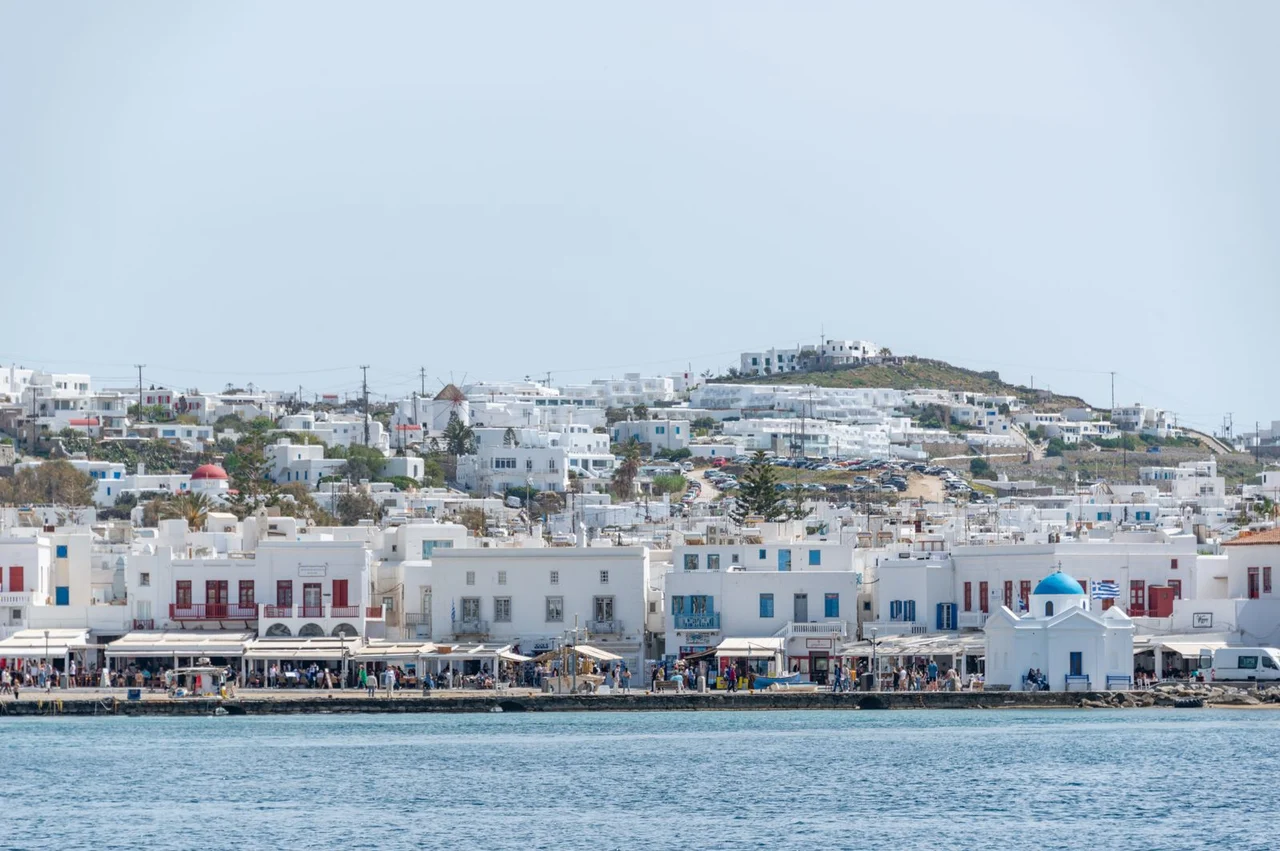
Mykonos and Santorini suit short stays rather than a base: rent runs from €1,200 to €2,000 and above, and out of season the islands empty out.
A comfortable monthly budget in Greece is €1,800 to €2,500, covering rent, food, transport and leisure. That is noticeably cheaper than Western Europe at a comparable quality of life.
The Greek Golden Visa as the next step
Alongside the digital nomad visa, Greece offers investment residence — the Golden Visa. These are two different instruments with different purposes, but they can complement each other in a long-term strategy.
The Golden Visa is granted for an investment in Greek property. Since 2023 the thresholds have risen substantially and vary by region:
- €800,000 — for property in Athens, Thessaloniki, Mykonos, Santorini and on islands with a population above 3,100.
- €400,000 — for the rest of Greece.
- €250,000 — only for properties undergoing a change of use (for example, commercial to residential) or requiring restoration.
The key difference from the digital nomad visa: the Golden Visa does not require you to live in Greece. You can hold residence, keep a base in the country and spend most of your time abroad. The route to citizenship through the Golden Visa, however, still requires genuine residence — seven years of actually living in Greece.
Combining the two programmes looks like this: for the first five to seven years you live on the digital nomad visa with its tax relief, while investing in property through the Golden Visa and holding that property as an asset (letting it long-term, since short-term letting is formally prohibited for Golden Visa holders). After seven years you file for citizenship.
Returns on Greek property in 2024 and 2025 ran at 4 to 6% a year on long-term letting in Athens and the tourist areas.
Consulates: where to file from the CIS
Greek consulates around the world accept digital nomad visa applications. For CIS citizens several filing points are relevant.
Moscow — the Greek Consulate General operates as normal and queues are moderate. Appointments are booked through the consulate's official site, with a wait of three to six weeks.
Istanbul — the Greek Consulate General. The most popular option for Russians who have moved to Turkey. Capacity is adequate and the wait for an appointment is two to four weeks. Documents are accepted in English without an additional translation into Turkish.
Belgrade — the Greek embassy in Serbia. In practice the most convenient filing point for anyone who has moved to Serbia. The wait is one to three weeks, and Serbia requires no visa from Russian citizens, so travelling to file causes no difficulty.
Tbilisi — the Greek embassy in Georgia. Available to every category of CIS citizen, since entry to Georgia is visa-free for most of them. The wait is two to five weeks.
The consular fee is €180 everywhere. One point to plan for: you must already have a signed tenancy agreement in Greece when you file — it is a mandatory condition. We therefore recommend finding accommodation first (for example through Airbnb, moving to a long-term agreement afterwards) and only then booking the appointment.
Advantages and drawbacks of the Greek digital nomad visa
Before deciding it is worth weighing every aspect of the programme. Greece is attractive, but it is not the right answer for everyone.
The clear advantages:
- An EU country with a high quality of life, a warm climate with more than 300 sunny days a year and developed infrastructure.
- 50% tax relief for seven years — among the best in the EU for new residents.
- A direct route to an EU passport after seven years of residence.
- A rich culture, excellent food and a low crime rate.
- An affordable cost of living by Western European standards.
- Good internet quality in the cities.
The material limitations:
- A ban on working with Greek clients: you cannot build a business inside the country without changing status.
- A genuine residence requirement — the status cannot be held at a distance.
- Greek at B1 for citizenship is a serious barrier.
- Bureaucracy: the Greek administrative system is slow and not always predictable.
- Summer heat and tourist crowds on the popular islands in July and August.
- Banking takes patience: opening an account as a non-resident requires time and documents.
For most remote professionals from the CIS, Greece is one of the best options in the EU: an affordable entry price, a real tax advantage and a clear route to European citizenship.
How to start: a step-by-step plan
Here is a practical road map for anyone who has decided to move towards the Greek digital nomad visa.
Step 1 (three to four months before filing): order the certificate of no criminal record from the Ministry of Internal Affairs. At the same time, start looking for accommodation in Greece through Spitogatos.gr, XE.gr or a local agent.
Step 2 (two to three months before): obtain the apostille on the criminal record certificate and have it translated into Greek with notarial certification. Sign a long-term tenancy agreement in Greece — this can be done remotely if the agent certifies it notarially.
Step 3 (one to two months before): arrange medical insurance with EU cover from €30,000. Book the consular appointment. Prepare the bank statements and the employment contract with translations.
Step 4 (filing): attend the consulate in person, pay the €180 fee and give biometrics. The decision takes 10 to 30 working days.
Step 5 (after arrival): within 30 days, register with the municipality, obtain a Greek tax number (AFM) and file for the residence permit. We recommend engaging a local immigration lawyer (€500 to €1,000 for support with registration).
BRIDGES GLOBAL supports clients at every stage: from reviewing documents and preparing the pack to coordinating with Greek lawyers and handling registration after the move. Contact us for an individual assessment of your situation.
Frequently asked
Questions people ask before deciding
01What is the Greek digital nomad visa formally called?
The Independent Worker Visa — a national category D visa.
02What is the minimum income for this visa?
€3,500 a month net.
03How long is the visa issued for and can it be extended?
For one year, with annual extensions.
04What tax relief applies to visa holders?
A 50% reduction of income tax, running for seven years.
05Can I work with Greek clients on this visa?
No. It is a mandatory condition that the employer or clients are outside Greece. If Greek clients appear, you have to move to a standard work permit.
06How many years does it take to obtain permanent residence and citizenship in Greece?
Permanent residence after five years, citizenship after seven, with Greek confirmed at level B1.
07At which consulates can documents be filed?
Moscow, Istanbul, Belgrade and Tbilisi.
Transparency
How this material was prepared
- Author
- Sofia Mendes, investment Programs Expert, BRIDGES
- Terms and costs last verified
- June 2026
- Sources
- official government authorities of the relevant country and state publications
- Methodology
- government minimum requirements are stated separately from due diligence charges, state fees, legal and banking costs
Sources and methodology
Figures, terms and timelines are checked against official sources as of June 2026. Link availability verified in August 2026. Third-party blogs and agent websites are not used as a source of programme terms.
- [1]Ministry of Migration and Asylum of GreeceResidence permits, including the investor permitmigration.gov.gr/en
- [2]Enterprise GreeceConditions of the investor programmewww.enterprisegreece.gov.gr/en
Methodology: tables and charts state government minimum investment requirements; due diligence charges, state fees, legal, banking and other costs are calculated separately and are not included in the minimum thresholds.
About the author
Related materials
What to read next
 ArticleGreek citizenship by descent in 2026: by roots, parents, grandparents
 ComparisonGolden Visa of Greece or Caribbean citizenship 2026: EU residence permit versus second passport
 AnalysisWhat is due diligence and why the Caribbean is rejecting applications
Personal programme selection is conducted by Anna Kovalevskaya, Head of Legal, BRIDGES.
Residency in Greece: timelines and requirements
Grounds, document list, presence requirements and what is needed for renewal.
