Residency · Portugal
Real estate in Porto 2026: districts, prices, investment, and rental

Updated: June 2026·12 min read·Expert reviewed
Terms and costs verified: June 2026
Contents
Porto is Portugal's second city and one of the most interesting spots on Europe's investment map. It's cheaper here than in Lisbon, the market is growing confidently, and the historic center and ocean coast attract both tourists and tenants. In 2026 the city's average price approached €3,900-4,100 per m2, premium Foz do Douro went above €5,000, and across the river, in Vila Nova de Gaia, a meter costs almost half as much. We break it down by district, prices, short-term rental yield accounting for AL restrictions, and explain why buying housing no longer gives the Golden Visa.
Why Porto: the second city with a capital's character
Porto has long outgrown the status of "Lisbon's little brother". It's an independent economic and cultural center of northern Portugal, the birthplace of port wine, with a UNESCO-recognized historic center, a hub airport, a strong IT and creative cluster, and the student energy of one of the country's oldest universities. For an investor this means a rare combination: prices noticeably below the capital's, and demand for rental - both long-term and tourist - steadily high year-round.
In 2026 the city's average price per square meter approached the €3,900-4,100 mark, while in Lisbon it holds around €5,200. This third of a difference is exactly Porto's main argument. At the same time the city isn't standing still: the market is gaining 4-6% a year depending on the district, and analysts expect continued growth amid the new housing shortage and an inflow of foreign buyers.
It's important to understand the city's structure. The historic core (Ribeira, Baixa, Se) is tourism and emotion. The coast (Foz do Douro) is premium and Atlantic views. The gentrification quarters (Cedofeita, Bonfim) are growth points. And across the Douro river lies Vila Nova de Gaia - formally a separate city, but effectively part of the agglomeration, where a meter costs almost half as much. Next we'll break down each zone separately.
Prices 2026: the overall picture for the city
To avoid drowning in figures, let's fix the 2026 benchmarks. Porto's average price is around €3,900-4,100 per m2. But the averaged figure says little: the spread between districts is huge, and it's exactly this that determines your strategy.
- Apartmentson average pricier than houses - around €4,800 per m2 against €3,500, since the main demand is exactly for compact housing in the center and by the water.
- Historic center(Ribeira, Baixa, Miragaia) - one of the most expensive segments, the average asking price is around €5,300 per m2.
- The most affordable quarterswithin the city, such as Campanha, start from around €3,100 per m2 - these are spots for those seeking a cheaper entry with room for growth.
The market's dynamics in 2026 are uneven. In some segments, a local price and rental rate correction was recorded - this isn't a decline, but more a window for entry on attractive terms. At the same time certain districts, primarily Bonfim, show a growth forecast up to 8-12% a year. That is, Porto's market isn't a monolith, but a set of very different micromarkets, and district choice matters more than city choice. We break down the basic logic of buying housing in the country in our general article onbuying real estate in Portugal.
Ribeira and Baixa: the historic center and tourism's heart
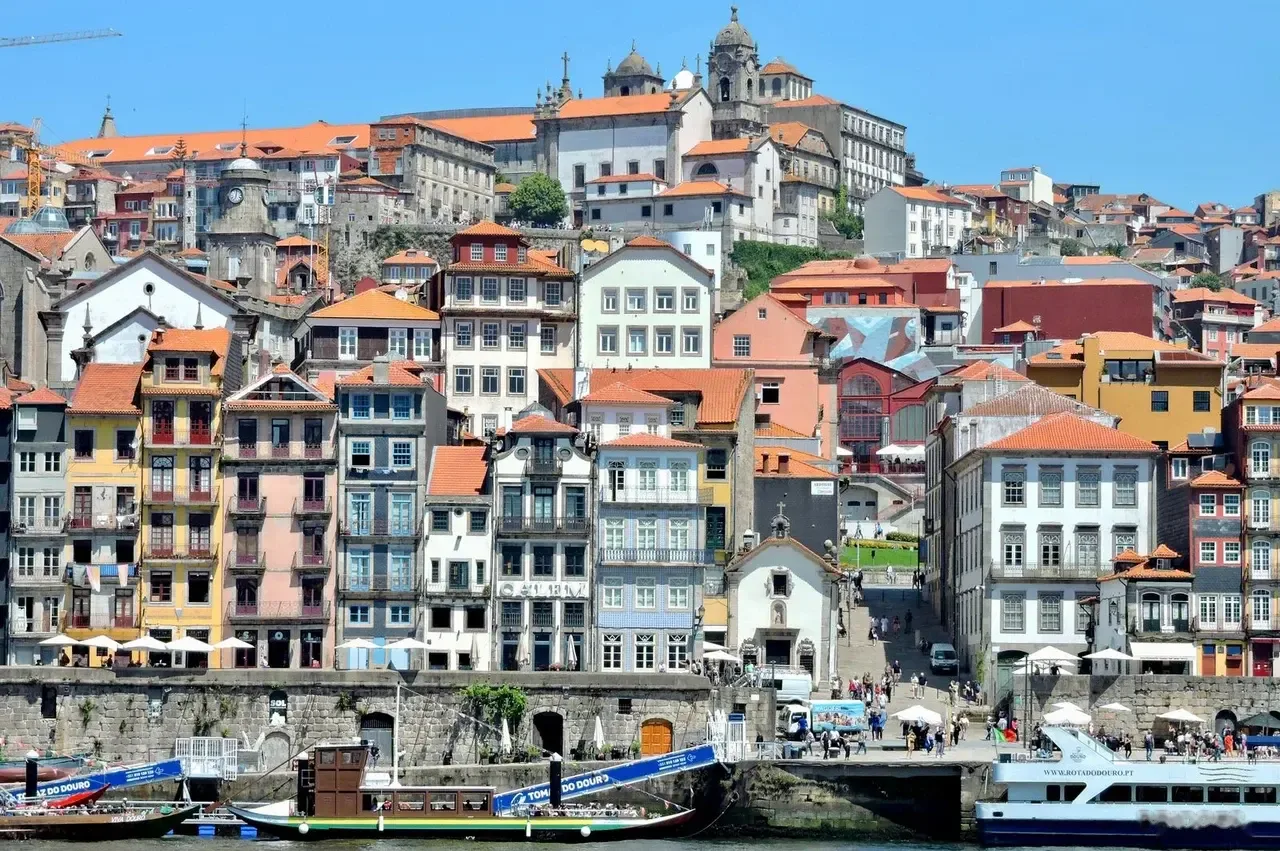
Ribeira is postcard Porto. Colorful houses along the Douro waterfront, bridges, wine cellars across the way, crowds of tourists, and views impossible to mistake for anything else. Together with the adjacent Baixa (the city's lower business and commercial district) and Miragaia, this is the historic core listed with UNESCO. For an investor focused on tourist flow, this is the most obvious and most expensive zone.
Prices here are among the city's highest: on average around €5,300 per m2 for the historic center, in Ribeira itself the benchmark is €4,000-5,000 per m2. For this money you're buying not so much square meters as a location with guaranteed demand - tenants and guests are ready to pay a premium exactly for an address in the city's heart.
- Pros:maximum recognition, year-round tourist demand, liquidity on resale.
- Cons:a high entry price, dense development, restrictions on new short-term rental licenses, noise and strain from the tourist flow.
A subtle point - the housing stock's condition. Many buildings in the historic center are old and need restoration. This is both a risk (unforeseen expenses) and an opportunity: dilapidated building restoration projects fall under the "special interest to the city" category and can get exceptions from short-term rental restrictions. It's worth buying in Ribeira with a sober assessment of the property's real condition and the renovation budget.
Foz do Douro: premium by the ocean
Where the Douro river flows into the Atlantic Ocean, Foz do Douro begins - Porto's most prestigious residential district. This is the Portuguese equivalent of an expensive waterfront: villas and apartments with ocean views, high-level restaurants, a waterfront promenade, a calm and status-conscious atmosphere. Wealthy local families and foreigners who value air, space, and ocean proximity live here.
Prices match the status. Apartments in Foz do Douro cost on average €4,600-5,500 per m2, and standalone houses in the upper segment reach €7,000 per m2 and above. This is the city's most expensive residential segment, and analysts expect one of the strongest price gains from it in the coming years - premium waterfront real estate traditionally holds its value best.
For an investor, Foz do Douro isn't a story about maximum rental yield, but about preserving and growing capital. What's bought here is quality of life and a reliable asset. If your goal is to invest a large sum in real estate that will confidently hold its price while giving a pleasant bonus of living by the ocean, Porto's premium coast is one of the smartest choices in the country's north.
Cedofeita and Bonfim: gentrification and growth quarters
If Foz is about capital preservation, Cedofeita and Bonfim are about its growth. These are two active gentrification districts, where old working-class quarters are turning into fashionable creative zones with galleries, coffee shops, bars, and studios. It's exactly here that investors wanting to enter before the peak and profit from value growth look.
- Cedofeita- a bohemian, artistic district almost in the center, a favorite of youth and the creative class. Prices here are already high - in certain segments up to €5,600 per m2, reflecting the completing stage of gentrification and strong demand.
- Bonfim- an earlier stage and therefore more interesting for the price-to-potential ratio. Some properties start from around €3,600 per m2, and the district's price growth forecast for 2026 is one of the city's highest, in the 8-12% range.
The logic is simple: you buy in a district that hasn't yet peaked, but is already on the rise - with an influx of young people, new venues, and improving infrastructure. Bonfim in this sense is a classic candidate for a "buy on growth" strategy. The risk is also clear: gentrification can slow, and part of the housing stock needs renovation. But with a horizon of several years, these are among Porto's most promising addresses.
Vila Nova de Gaia: across the river, wine, and affordable prices
On the Douro's south bank, right opposite the historic center, lies Vila Nova de Gaia - formally a separate city, but essentially part of Porto's agglomeration. It's exactly here that the famous port wine cellars are located, and the waterfront offers the best view of colorful Ribeira. And at the same time a square meter here costs almost half central Porto's price.
Gaia's average price in 2026 is around €2,800 per m2 (apartments around €3,100, houses around €2,550). The district shows confident annual growth - around 5-6%, and it has a powerful driver for the coming years: Porto metro expansion (the Rubi line to Santo Ovidio) and the Lisbon-Porto high-speed railway project with a station nearby.
- Pros:a low entry price, an excellent balance of price and rental yield, transport connectivity with the center, notable growth potential from infrastructure.
- Cons:formally a different municipality with its own rules, including on short-term rental; prestige is still lower than central Porto's.
For an investor with a medium budget, Gaia is one of the most rational choices in the agglomeration: you pay less, get access to the same rental market, and bank on growth from new transport projects. It's also worth noting that Gaia introduced a moratorium on new short-term rental registrations in a number of zones - more on this below.
Porto vs. Lisbon: where's it more advantageous to invest
The main question for an investor choosing Portugal: Porto or Lisbon? There's no unambiguous answer - it all depends on the strategy, but the figures speak in Porto's favor for affordability.
| Parameter | Porto | Lisbon |
|---|---|---|
| Average price per m2 (2026) | around €3,900-4,100 | around €5,200 |
| The most expensive segment | Foz do Douro, houses up to €7,000 | Chiado, around €7,650 |
| Gross rental yield | 4,0-6,5% | generally lower due to the entry price |
| Entry price | noticeably lower | higher, a capital premium |
| Liquidity | high, growing demand | maximum, the capital market |
Lisbon is capital-city liquidity, maximum choice and status, but also the highest prices, which press down on returns. Porto is a lower entry threshold, comparable tourist demand, and often more attractive rental yield with less capital invested.
Roughly speaking: if you have a large budget and the priority is the capital's liquidity, look at Lisbon. If the price-to-yield ratio matters more and you're ready to work with a growing but less "hyped" market - Porto will give more for the same money. A detailed breakdown of the capital's market is in our article onreal estate in Lisbon, and the southern beach segment is in our overviewreal estate in the Algarve.
Three strategies for an investor: preservation, income, growth
To avoid spreading yourself thin, it's useful to determine in advance why you're buying real estate in Porto. Both the district and property type depend on this. Three clear strategies have taken shape.
- Capital preservation.The goal - a reliable asset that holds and grows in value. This is Foz do Douro and premium waterfront addresses. Rental yield isn't the main thing here, the main thing is the asset's quality and stability. Suits those investing a large sum for a long horizon.
- Income rental.The goal - cash flow. This is the historic center for tourist letting (with an AL license) or student and residential quarters for long-term rental. What matters here is calculating returns, management, and AL rule compliance.
- Betting on growth.The goal - to earn on value growth. This is Bonfim and Vila Nova de Gaia's developing zones, where gentrification and new transport projects work. Entry is cheaper, growth potential is higher, but the horizon is also longer.
Many investors combine: for example, a premium apartment in Foz for themselves and an income property in Gaia or Bonfim for rental. The main thing is not to buy "real estate in Porto in general", but to clearly understand which of the three tasks a specific property solves. This immediately cuts off half the unsuitable options and saves both money and time.
Porto market's risks and pitfalls
Porto is an attractive but not trouble-free market. a investor must see the flip side too.
- The historic stock's condition.Many buildings in the center are old and need serious restoration. Buying "with a view" can turn into a renovation budget comparable to the apartment's own price. Always check the technical condition and budget for restoration.
- Short-term rental regulation.AL restriction zones, the moratorium in Gaia, mandatory registration-number checks by platforms from May 2026 - the tourist model is becoming increasingly regulated. Build your calculation on a valid license, not the hope of getting one.
- A local price and rate correction.In 2026 a decline was recorded in some segments - this is a normal market phase, but it requires a sober yield calculation, not a buy "on hype".
- Compliance for buyers from the CIS.The source-of-funds check is strict. An opaque money trail can delay or derail the deal.
None of these risks cancels Porto's investment appeal - but each requires the decision to be made on figures and verified facts, not on emotions from beautiful Douro views.
How professionals check a property before purchase
On Porto's market, the difference between a successful and a failed deal is almost always in details visible only through thorough checking. Here's what's mandatorily checked before signing.
- Legal cleanliness.An extract from the property registry (Certidao Permanente), absence of debts, liens, and encumbrances, matching actual area with the documents.
- Short-term rental status.Whether the property has a valid AL license, whether it's in a restriction or moratorium zone - this is critical for the tourist model.
- Technical condition.For historic buildings - a real assessment of the structure, roof, utilities, the need for restoration, and its budget.
- Total cost of ownership.IMT, stamp duty, annual IMI, management and maintenance expenses - so the yield calculation is .
- Source of funds.Preparing transparent documentation for the bank and notary, especially for buyers from Russia and the CIS.
Current rules, taxes, and official requirements should always be checked on the official portal ofgov.pt. And breaking down each of these points for a specific property is already an expert's job, one who won't let beautiful river views obscure the figures and legal nuances.
Not sure which country and status to choose?
We will compare suitable residency programs on budget, timelines and stay requirements - with a full cost calculation for your family.
Free of charge, we reply right away, no obligation.
Rental yield: short-term and long-term
Porto is one of Portugal's strongest rental markets, and this is the second reason (after price) for investor interest. Gross yield here averages 4.0-6.5% depending on the district, property type, and letting strategy.
There are two fundamentally different models:
- Short-term (tourist) rentalthrough Airbnb and Booking. Gives maximum revenue per night, especially in the historic center and Foz. But this is an active model: an AL license, management, cleaning, seasonality, plus growing regulation. Returns are higher, but so are hassle and risks.
- Long-term rentalto local residents and students. A stable cash flow with no tourist bustle, easier to manage, fewer regulatory risks. Returns are more modest, but more predictable.
An important 2026 nuance: in some segments a temporary decline in rental rates (around -6%) was recorded, which for a buyer means not a threat but a convenient entry point - you're entering on the correction. The choice between the two models depends on the district and your readiness to deal with the property. In the center and by the water, tourist rental more often works (if the license allows), in residential quarters and student zones - long-term. Many investors today are banking on exactly the long-term model due to AL rule tightening.
"Over years of working with Porto's market, I've learned one thing: you can't buy 'real estate in general' here, only for a specific task. A common and costly mistake - a person falls in love with the Ribeira view, takes an apartment in an old building, and then it turns out an AL license in that zone won't be issued anymore, the facade needs hundreds of thousands in restoration, and the rental yield isn't what it seemed. I advise starting not with the property, but with the strategy: preserving capital - look at Foz, wanting income - calculate rental with a valid license, betting on growth - go to Bonfim or Gaia for the future metro. And I repeat to CIS clients: prepare the source of funds in advance, a transparent money trail decides a deal's fate no less than the apartment choice."
Short-term rental (AL) restrictions: what's important to know
Short-term rental in Portugal is processed through the Alojamento Local (AL, "local accommodation") regime with mandatory registration (RNAL). And here in Porto you need to be especially careful: the city actively restricts new licenses to curb pressure on the housing stock.
- Restriction zones.New AL licenses are restricted in districts where the share of tourist housing reaches or exceeds 15% of the total apartment count. In oversaturated historic-center quarters, getting a new license is difficult.
- Exceptions.Licenses are still issued for projects of "special interest to the city" - for example, restoring dilapidated buildings vacant three years or more, or creating affordable housing.
- Vila Nova de Gaiaintroduced a moratorium on new AL registrations in a number of zones back in 2024, and it continues in 2026.
- The alternative - medium- and long-term rentalfrom one month, which doesn't fall under strict AL restrictions.
From May 2026, platforms (Airbnb, Booking) are required to check and publicly display the AL registration number and automatically remove listings with invalid numbers - buying into a "grey" rental will no longer work. So the key rule: when buying for short-term letting, check whether the property has a valid AL license and isn't in a restriction zone. Buying an apartment hoping to "get AL later" in an oversaturated district can turn into an inability to legally let to tourists.
Real estate and the Golden Visa: an important caveat
This is the point where many buyers relying on outdated information stumble. Let's state it directly and unambiguously:buying real estate in Portugal no longer gives the right to the Golden Visa (a residence permit for investment).
The real estate investment route, which for years was the programme's foundation, was abolished by the Mais Habitacao ("More Housing") law in October 2023. At the same time the direct €1.5 million capital transfer option was removed too. This was done exactly to relieve foreign demand's pressure on major cities' housing markets and redirect capital into productive sectors.
- Buying an apartment in Porto for €500,000 and automatically getting a residence permit for investment todaycan't.
- The Golden Visa as a programme continues to exist, but only through other routes: investment funds from €500,000, scientific research, cultural heritage support, job creation.
- If your goal is a residence permit, real estate in Porto is bought separately, as an investment asset, and the residence permit is processed on other grounds.
At the same time real estate combines well with migration paths not tied to an investment threshold. For example, for theD7 for rentiers and pensionersyou need housing in Portugal anyway - and an apartment bought in Porto closes this question, while remaining an income asset. This is exactly the smart combination: real estate as an investment plus a separate, lawful ground for a residence permit.
Purchase conditions and costs: what to budget for
Before calculating returns, you need to understand the full entry cost. Besides the property price, the buyer bears taxes and associated expenses, and they should be budgeted right away - generally this is 6-8% above the real estate price.
- IMT (the property transfer tax)- the main one-off tax, the rate is progressive and depends on the price and type of property.
- Stamp duty (Imposto do Selo)- 0.8% of the deal value.
- Notary and registration- processing the deal and entering it in the property registry.
- Lawyer and agent's commission- deal support and checking the property's cleanliness.
- Annual IMI- the municipal property tax, paid every year.
A separate important block for buyers from Russia and the CIS is compliance and source-of-funds confirmation. Deals proceed strictly within the law, with no circumventing sanctions, with enhanced checks on the money's origin. The bank and notary will require a transparent trail: where the funds came from, how they arrived in the account, what confirms the income's legality. This isn't an obstacle, but a normal procedure to prepare for in advance. We break down the taxation details of ownership and rental in our article onreal estate taxes in Portugal.
Frequently asked
Questions people ask before deciding
01How much does real estate in Porto cost per square meter in 2026?
The city average price is around €3,900-4,100 per m2. The spread is large: the historic center (Ribeira, Baixa) - around €5,300, premium Foz do Douro - €4,600-5,500 (houses up to €7,000), affordable quarters like Campanha - from €3,100. Across the river, in Vila Nova de Gaia, a meter costs around €2,800.
02Is Porto cheaper than Lisbon?
Yes, noticeably. Porto's average price is around €3,900-4,100 per m2 versus approximately €5,200 in Lisbon, that is roughly a third lower. At the same time tourist demand is comparable, and Porto's gross rental yield is often higher thanks to the lower entry price - 4.0-6.5% depending on the district.
03Does buying real estate in Porto give the Golden Visa?
No. The Golden Visa route through buying real estate was abolished by the Mais Habitacao law in October 2023, along with the €1.5 million capital transfer option. The programme survived only through other routes - investment funds from €500,000, research, cultural heritage. Real estate is bought separately, as an asset, and the residence permit is processed on other grounds.
04Which Porto district is best for investment?
Depends on the goal. For capital preservation - premium Foz do Douro by the ocean. For income rental - the historic center (with an AL license) or student quarters for long-term letting. For betting on growth - Bonfim (a forecast of +8-12% a year) and Vila Nova de Gaia with new transport projects.
05What's the rental yield in Porto?
Gross yield averages 4.0-6.5% depending on the district, property type, and strategy. Short-term tourist rental gives more revenue per night, but requires an AL license and active management. Long-term rental is more modest in yield, but more stable and easier to manage.
06Can an apartment in Porto be rented daily to tourists?
You can, but through the Alojamento Local (AL) regime with registration, and with restrictions. New licenses aren't issued in zones where the tourist housing share reaches 15% and above; in Vila Nova de Gaia a moratorium applies in a number of districts. Before buying for daily letting, check the valid license and zone - getting one "later" in an oversaturated quarter may not work out.
07Is it worth buying in Vila Nova de Gaia?
For a medium budget, this is one of the most rational options in the agglomeration. A meter costs around €2,800 - almost half central Porto's price, while the district is opposite the historic core, with wine cellars and Ribeira views. Growth drivers - metro expansion (the Rubi line) and the future Lisbon-Porto high-speed railway.
08Why are Bonfim and Cedofeita called growth districts?
These are active gentrification quarters: old working-class zones are turning into fashionable creative districts with an influx of young people. Cedofeita is already at the completing stage (up to €5,600 per m2), while Bonfim is more interesting for potential - entry from €3,600 and a price growth forecast up to 8-12% for 2026, one of the city's highest.
09What costs are there besides the property price when buying?
Budget approximately 6-8% above the price: the IMT property transfer tax (a progressive rate), 0.8% stamp duty, notary and registration, lawyer and agent's commission. Plus the annual IMI municipal ownership tax. A full ownership cost calculation is important to do before the deal, so the yield is .
10Can a Russian citizen buy real estate in Porto in 2026?
Yes, there are no citizenship restrictions on purchase. The deal proceeds strictly within the law, with no circumventing sanctions, with enhanced compliance and source-of-funds confirmation. The bank and notary will require a transparent trail of the money's origin - this needs preparing in advance, then the deal proceeds smoothly.
11What to choose - short-term or long-term rental in Porto?
Depends on the district and readiness to deal with the property. In the center and by the water, tourist rental is more advantageous if there's an AL license. In residential and student quarters - long-term: more stable, simpler, with no regulatory risks. Against the backdrop of AL rule tightening and registration checks by platforms from May 2026, many investors choose the long-term model.
12Can real estate in Porto be used for the D7 visa?
Yes, and this is a good combination. The D7 visa for rentiers and pensioners requires housing in Portugal and stable passive income, there's no investment threshold on the purchase amount for it. An apartment bought in Porto closes the housing requirement and remains an income asset, while the residence permit is processed on D7 grounds, not through the abolished Golden Visa investment route.
Transparency
How this material was prepared
- Author
- Igor Venc, real Estate Managing Director, BRIDGES
- Terms and costs last verified
- June 2026
- Sources
- official government authorities of the relevant country and state publications
- Methodology
- government minimum requirements are stated separately from due diligence charges, state fees, legal and banking costs
Sources and methodology
Figures, terms and timelines are checked against official sources as of June 2026. Link availability verified in August 2026. Third-party blogs and agent websites are not used as a source of programme terms.
- [1]Agência para a Integração, Migrações e Asilo (AIMA)Residence permits and how to applyaima.gov.pt/en
- [2]Portal das FinançasTax regimes and obligations of residentswww.portaldasfinancas.gov.pt
Methodology: tables and charts state government minimum investment requirements; due diligence charges, state fees, legal, banking and other costs are calculated separately and are not included in the minimum thresholds.
About the author
Related materials
What to read next
 ArticlePortuguese citizenship by descent in 2026: by parents, grandparents and birth
 ComparisonResidence permit for investment in 2026: Greece, Portugal or UAE - what to choose
 AnalysisWhat is due diligence and why the Caribbean is rejecting applications
Personal programme selection is conducted by Anna Kovalevskaya, Head of Legal, BRIDGES.
Buying property in Portugal: what to check
Title, encumbrances, outstanding debts and what to look for in the contract.