



Updated

GR-CBD

Citizenship by descent

Greek citizenship by descent

We help you obtain Greek citizenship by descent, from finding your ancestor and restoring documents to filing the application and receiving the passport.

  • No relocation and no investment
  • We support the process in Greece
  • We find the documents
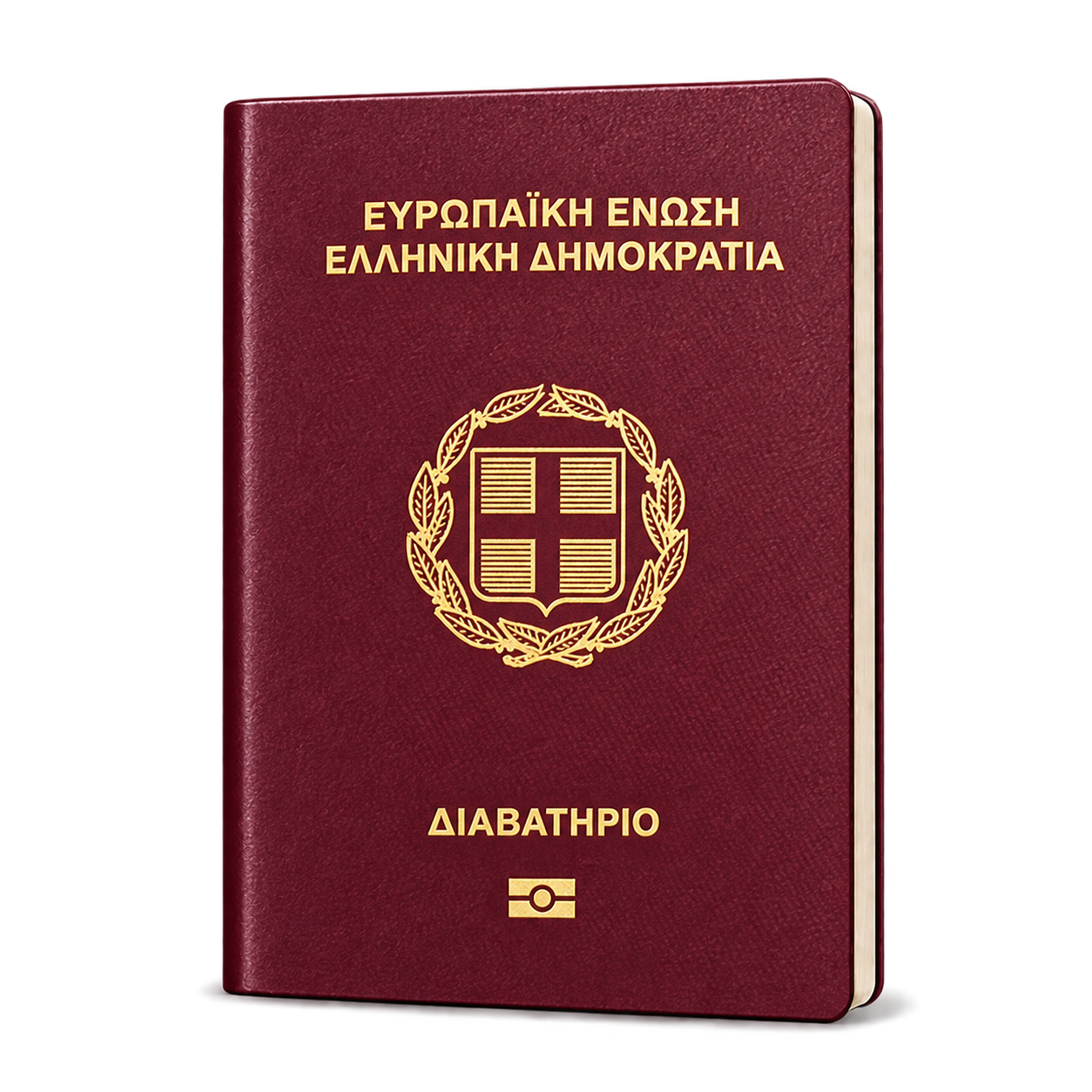
The passport of a citizen of Greece
No residenceYou do not need to move to Greece
No investmentThe ground is descent; money plays no part
The whole familyChildren, parents, brothers and sisters

01 / The mechanism

What the programme is

Greece recognises citizenship for descendants of Greeks and grants citizenship to ethnic Greeks from the countries of the former USSR. The ground is documented descent. Investment, residence in the country and a language exam are not conditions.

01

An EU passport without investment

Greece has no citizenship-for-money programme. An investment gives an investor residence permit, which is a different status and a different page.

02

No move to Greece

For descendants, the law does not require living in the country for a set period. You can live where you live now, while the process runs in Greece.

03

No limit on the number of generations

The law speaks of descent from a Greek citizen and does not say how many generations ago they lived. The limit is documentary: each link of the family line has to be proven by a record.

04

You can start without ready documents

If the exact history of the ancestor is unknown and you have almost nothing in hand, we start from surnames, towns and relatives’ names and rebuild the line through the archives.

The ground is the Greek Citizenship Code, Law 3284/2004, and the ministerial decisions in force. BRIDGES checks the family history, finds the documents, prepares the application and supports the process. The decision is made by the competent Greek authority.

02 / Checks

What a Greek passport gives you

It is a full European Union passport.

All of Europe to live in

Live, work, study and run a business in the 27 EU countries, as well as Norway, Iceland, Liechtenstein and Switzerland. No visas, permits or quotas.

Visa-free travel

Borderless Schengen, the UK, the USA, Canada, Japan and almost the whole world, visa-free or under simplified rules.

Education for children

European universities on equal terms with locals: local tuition fees and access to European scholarships.

Healthcare and social rights

The European Health Insurance Card and EU social systems on equal terms with citizens of the country where you live.

Passes to children

Children born after you become a citizen acquire Greek citizenship by birth, whichever country they are born in.

Restoring the ancestor’s surname

At registration you can record the Greek form of your name and the ancestor’s surname as it appears in the Greek records.

Preliminary assessment

Find out the cost and procedure for Greek citizenship

We study the family history and the grounds of each applicant. Then we set the cost of support, the indicative timeline and the stages of the process.

Who is applying for citizenship?

Get a calculation

about 1 minuteno obligationconfidential

  • The cost of support for your family
  • Grounds and documents for each applicant
  • The sequence of steps and indicative timelines
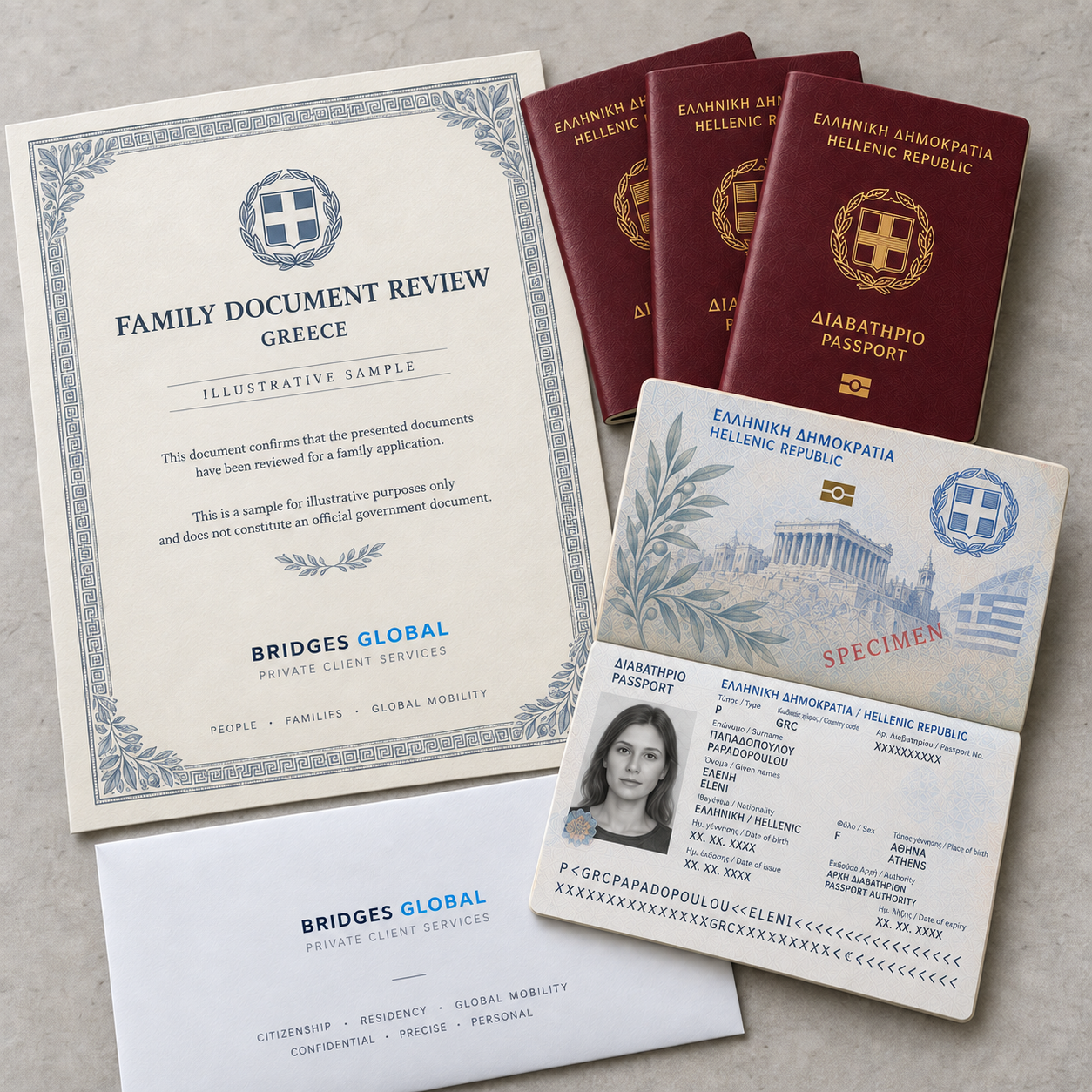
Sample Greek passports, a certificate and a Bridges Global envelope

03 / Why it matters

Why people obtain a Greek passport

Every family has its own reason, but most often there are four.

Reason 01

Moving to Europe

EU citizenship removes visas, work permits and quotas. The passport is Greek, but you can live in Germany, Austria or the Netherlands: one right across the whole union.

Reason 02

Your children’s future

A European university at local fees and an open labour market after graduation. Citizenship then passes on to their own children.

Reason 03

Family history

For many it is the return of what history took away: resettlements, shifting borders, forced departure from the Black Sea region and Asia Minor.

Reason 04

A plan B for the family

Citizenship is not renewed and is not lost because you live in another country. The decision is made once and stays for good.

EU citizen rights come from citizen status, not from the passport itself. Entry regimes for third countries are set by the receiving states and change without notice.

04 / Grounds

Who can obtain citizenship

One ground can extend to several generations of one family. The documents on the ancestor are gathered once and then used to prepare the relatives’ applications. Each adult still files their own application.

  • Citizenship is recognised for a direct descendant of a Greek citizen
  • The law sets no limit on the number of generations
  • A record of the ancestor in the Greek registers and a proven family line are needed
  • Residence in Greece and a language exam are not required
  • The ground is proven Greek origin, not an ancestor’s entry in the register
  • It is proven with archive, church and Soviet-era documents
  • The procedure differs from recognition of citizenship under Article 1
  • We assess whether it applies at the preliminary assessment
  • A spouse’s descent alone gives no right
  • The law gives a spouse a separate route with cohabitation and a child in common
  • Timelines and conditions differ from citizenship by descent
  • Once you obtain citizenship, your spouse can obtain the right to live with you in any EU country
  • A separate set is prepared for each child
  • The child’s documents are filed together with the family’s documents
  • The common documents on the ancestor do not need to be gathered again
  • Adult children file their own applications
  • Their applications are prepared at the same time as the parents’
  • The shared archive base for the family line is used
  • Everyone who is a direct descendant of a qualifying ancestor has the right
  • A separate application is prepared for each adult
  • A parent’s ground is usually stronger: they are one generation closer to the ancestor

05 / Evidence

Which documents are needed

We prepare the full set for recognition of Greek citizenship by descent. Some documents you have; others we find in the archives.

01You gather

From you

  • A valid passport and photos
  • Birth certificate
  • Marriage, divorce or change of name
  • Consent of both parents for a child

02We gather together

The family line

  • Birth certificates across the generations
  • Marriage and change of surname certificates
  • Documents linking different spellings of the name
  • Records of the ancestor: birth, marriage, place of registration

03We do it for you

We prepare

  • The application and annexes in Greek
  • Sworn translations and legalisation
  • Applications to register births and marriages
  • Support of the process at the municipality in Greece

04Our work

Where we search

  • Greek municipal registers
  • Church registers of births, marriages and deaths
  • Archives of the Black Sea and Azov regions
  • Soviet archives and resettlement records

06 / How we work

How the work on Greek citizenship runs

We run the whole process from analysing the family tree to the passport. Everything that can be done without you, we take on.

STEP 1

Analysing the family tree · 1-2 weeks

You tell us about the family and pass on what you have: certificates, old passports, letters, photos. If there are few documents, names, dates and town names are enough.

We determine which ground is yours and say straight away if it is weak. This is also where the volume of archive work becomes clear.

STEP 2

Contract and work plan · 1-2 days

We agree the family members, the scope of archive and legal work, the stages, timelines and budget.

Once signed, you are assigned a lawyer, an archive specialist and a coordinator.

STEP 3

Archives and documents · 2-10 months

Requests to Greek municipal registers, church books and archives of the Black Sea and Azov regions, restoring birth records and resolving differences in surnames.

The least predictable stage: in some places the answer comes in a month, elsewhere a book is lost and the family link is proven another way.

STEP 4

The set, translations and legalisation · 1-2 months

We prepare the application and annexes, sworn translations and legalisation of the documents.

We check the set for discrepancies in names and dates to avoid an additional request on the application.

STEP 5

Filing and review · from 6 months

The application is filed in Greece through the municipality where the ancestor was registered. We support the process of its review. The applicant takes part in person where the procedure requires it.

The application is then reviewed by the Greek authority. After a positive decision we support the registration and the passport.

In our practice the full cycle takes from 9 to 16 months. The main variable is how well the archive records for your line have survived.

The Acropolis of Athens and the Parthenon in soft evening light

Citizenship by descent helps restore the link with your family’s history.

GreeceIn the EU since 1981Citizenship Code 3284/2004
Check the ground

07 / After the decision

What happens after the decision

After a positive decision, registration and the citizen’s documents remain. You do not need to move to Greece for this.

Registration in the registers

The entry is made in the municipal register and, for male applicants, the male population register. From this point citizenship is complete.

Greek passport

Issued after registration together with an identity card. We book the appointment and prepare the documents.

Documents for the whole family

We handle registration and passports for all family members who filed separate applications.

Children born afterwards

They acquire Greek citizenship by birth, whatever the country of birth; nothing has to be proven separately.

Your current passport

Greece does not require you to give up your previous citizenship. We only check whether the country of your current passport allows a second citizenship.

Military registration

Men aged 19 to 45 are registered. For those living permanently abroad there is a deferral and reduced service. We go through this before filing, not after.

08 / Our role

Why families choose our support in Greece

The process rests on archive documents: the key is to find the ancestor, prove the family line and prepare a complete set for the application.

01

We check the ground first

Before the contract we analyse the family tree and say plainly: there is a ground, there is none, or an archive search with an uncertain outcome is needed. We do not offer work with no prospects.

02

We find the documents for you

Greek municipal registers, church books, archives of the Black Sea and Azov regions, Soviet resettlement records and different spellings of surnames. You do not need to write the requests yourself.

03

We support the process in Greece

The work goes through the municipality where the ancestor was registered. This is our standard support procedure for this ground.

04

We do not promise the impossible

We do not guarantee the state’s decision or name timelines that do not exist. Our job is to prepare a complete, consistent set of documents and show the risks in advance.

10 / Questions

Answers to common questions

No. Greece has no citizenship by investment programme. An investment gives an investor residence permit, which is a different status and a different page.

The law does not set a number of generations. The limit is documentary: you need a record of the ancestor and a proven family line down to you. A great-grandparent or great-great-grandparent both qualify.

No. Citizenship by descent does not require a period of residence in the country. You can live where you live now.

This ground does not provide a language exam. However, the authorised official may hold an interview: questions may be asked in Greek, and answers through an interpreter are allowed.

This is a common situation. The family link is proven with neighbouring archive records, documents of other family members and, if necessary, through the courts. The process takes longer, but the search for evidence continues.

It applies to men aged 19 to 45. For those who live permanently abroad, the law provides a deferral and reduced service. We work out the consequences for each man in the family before filing.

In our practice the full cycle takes from 9 to 16 months. The main variable is how well the archive records for your line have survived.

Greece does not require it. What needs checking is the opposite: whether the country of your current passport allows a second citizenship.

Yes. The documents on the ancestor are gathered once and used to prepare the relatives’ applications. Each adult still files their own application.

Surnames, names, approximate dates and town names are enough. The archive search starts from there: we rebuild the line from records, not family stories.

11 / Materials

Useful materials on Greece

The conditions for citizenship, the document requirements and how the work runs. The materials are prepared both for families who know their ancestor and for those just starting to research their origins.

Main materialPresentation

Greek citizenship by descent

The key information on recognition of citizenship for direct descendants of Greek citizens and for ethnic Greeks from the former USSR.

Inside:

  • who can obtain citizenship
  • which family members apply together
  • what to do if the ancestor or documents are unknown
  • which archives are checked for your territories
  • which documents will be needed
  • how the work with BRIDGES runs
  • what happens after the decision

PDF · free · current as of September 2026

A short family tree check: which details about ancestors point to Greek descent and when an archive search is needed.

A list of documents for the applicant, the family line and the ancestor, noting what needs translating and legalising.

Who has to register, and how the deferral and reduced service work for those living permanently abroad.

12 / Timeline

How this right came about

The right of descendants of Greeks to citizenship has existed for a long time, and the conditions regarding the ancestor have not changed in recent years.

1981

Greece joins the European Communities.

From then on a Greek passport gives the rights of a citizen of the union in all member states.

2004

The Greek Citizenship Code, Law 3284/2004, is adopted.

The current version of the code remains the basis for recognising citizenship by descent today.

2005

Law 3421/2005 sets the rules on military service, including a deferral and reduced service for those living permanently abroad.

A clear procedure appeared for men who obtain citizenship while living in another country.

2026

The conditions regarding the ancestor and the family line have not changed, and Greece still has no citizenship by investment programme.

We follow the wording of the code and municipal practice and tell clients about changes.

Worth having

Get the checklist for Greek citizenship by descent

We have gathered the documents and the sequence for checking the family line, from finding the ancestor’s record to preparing the application and registration.

Inside the document

  • Which documents prove the link to the ancestor
  • Where to look for archive and church records
  • How to build the family chain without gaps
  • What is needed for the application and registration
Get the Greece checklist

After a short form, with no call and no obligation

13 / Sources

Official sources

The information on this page was checked against the text of the code and materials of the government authorities on the date of the update.

INITIAL ASSESSMENT

Tell us what outcome your family needs

We will design a solution for your case, choose the country and the right status, and take the whole process through to the result.

Or message us on WhatsApp or Telegram

Anna Kovalevskaya, lead lawyer at BRIDGES GLOBAL
Anna KovalevskayaLead lawyer, citizenship and residency, 12 years of practice