Residency · Turkey
An Izmir property residence permit in 2026: where you can buy, how much a meter costs, and which districts are closed

Updated: ·11 min read·Expert reviewed
Terms and costs verified: undefined
Contents
Izmir is Turkey's third city and the most European in pace of life on the Aegean coast. It's calmer than Istanbul and cheaper than premium Antalya, and the infrastructure - waterfronts, universities, an airport, a high-speed railway - is at capital level. But for property to grant the İkamet residence permit, two conditions must be met simultaneously: invest from $200,000 per the SPK valuation and buy an apartment in a district not closed to foreigners. We break down where this works in 2026.
Why Izmir interests an investor and a family
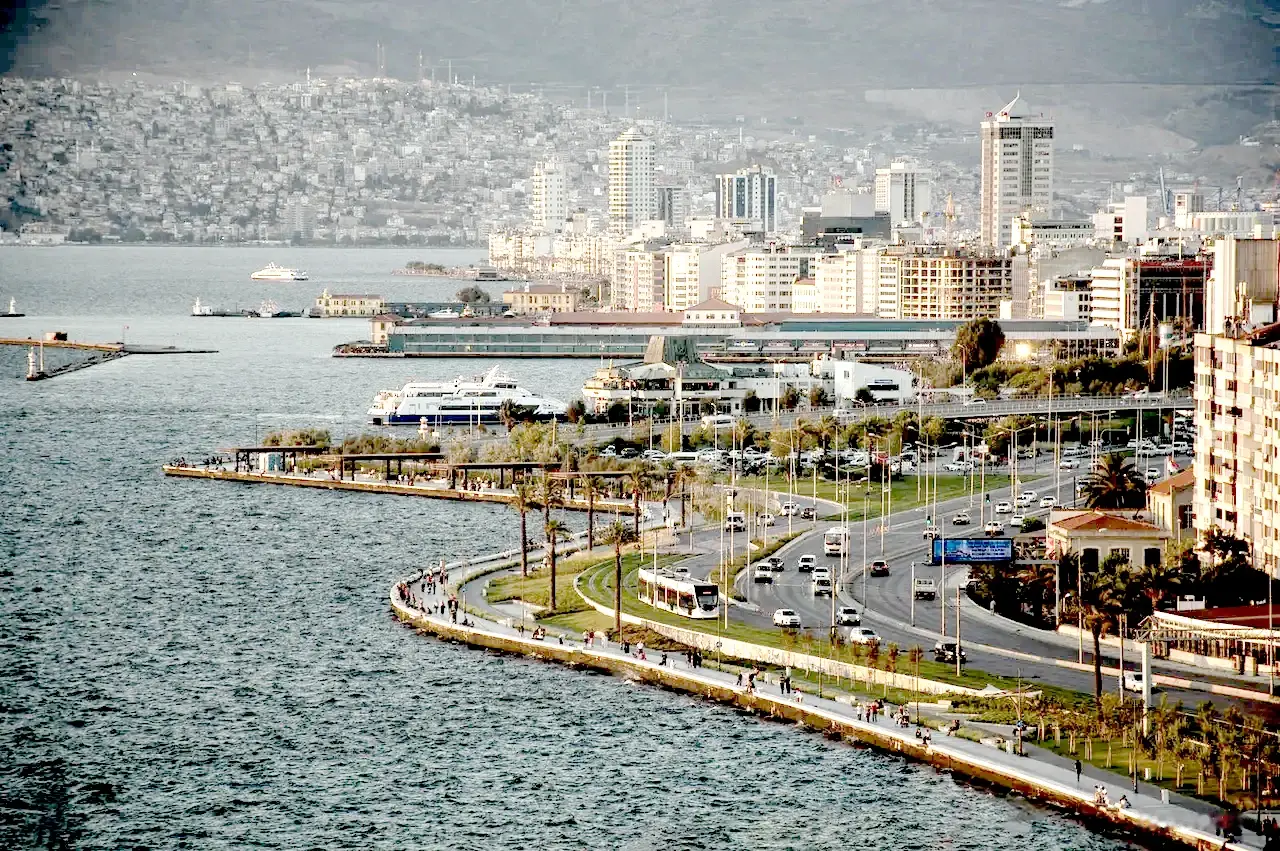
Izmir is Turkey's third-largest city after Istanbul and Ankara, but in character it's closer to Europe's Mediterranean resorts than a metropolis. The city stretches along the Aegean Sea bay, the Kordon waterfront runs for several kilometers, and the pace of life here is noticeably calmer than the capital's. For a family choosing a place not only for investment but for actual living, this is a significant argument.
The city's infrastructure is capital-city level. Adnan Menderes International Airport operates with direct flights across Europe and the CIS, there's a metro and the İZBAN suburban train connecting the center with suburbs and the airport. Izmir has several major universities - Ege, Dokuz Eylul, Izmir Institute of Technology - strong healthcare, and a developed network of private schools.
- mild Aegean climate: long summer and warm winter;
- housing prices lower than Istanbul's at comparable quality;
- convenient logistics to European capitals;
- a calm urban environment oriented toward families.
All this makes Izmir attractive for those considering Turkey not as a transit point but as a place to live. We break down the basic property residence permit rules in detail in the guide ona Turkey residence permit through property; below - Izmir's specifics.
Izmir districts: where an investor should look
Izmir is divided into dozens of districts and hundreds of mahalle (neighborhoods), and for a foreigner it's important to understand not only prestige but each neighborhood's residence permit status. The city is conditionally divided into the urban core, the northern shore, and the western coast of the Cesme peninsula.
Karsiyaka- the bay's northern shore, one of the most sought-after residential districts. Modern residential complexes here, its own waterfront, convenient ferry and train links with the center. This is a typical choice for a family wanting an urban environment with a water view.
Bornova- a green university district deeper into the city. Many students, developed healthcare and education, prices more moderate than the waterfront neighborhoods. A good option for rental and a calm family life.
Cesme and Urla- the western coast. Cesme is known for beaches, thermal springs, and a yacht marina, this is an elite resort zone with villas and boutique residences. Urla, half an hour from the center - vineyards, coves, signature cuisine, and demand for houses with a garden. Properties here are more expensive, and seasonality is more pronounced.
- urban life by the water - Karsiyaka, Alsancak, Konak;
- greenery, universities, healthcare - Bornova;
- resort and a seaside villa - Cesme, Urla.
Closed districts: the rule on a foreigner share above 25%
Since 2022, Turkey has closed individual mahalle to foreigner registration if the foreign resident share in a neighborhood exceeds 25%. If a specific address ends up on the closed list, no residence permit will be granted or renewed at that address - regardless of how much the apartment costs or whether SPK calculated the needed $200,000.
It's important to understand the scale: closure works at the mahalle level, not the whole district. That is, the Karsiyaka or Bornova district isn't closed entirely, but individual neighborhoods within it can be on the stop list. According to the migration directorate's official data, dozens of neighborhoods in Izmir are closed to foreigners processing residence permits, and the list is periodically updated.
- the restriction works at the neighborhood (mahalle) level, not the district;
- lists are published by the migration directorate and Izmir's provincial office;
- you can buy in a closed neighborhood - but no residence permit will be granted at that address;
- the list changes, so it needs checking as of the deal date.
Current closure notices are published by Izmir's provincial migration office -izmir.goc.gov.tr. We break down the stop-list mechanics in detail in an article onTurkey's closed districts for the residence permit.
Conditions of the property residence permit in Izmir in 2026
For property in Izmir to grant the right to the İkamet residence permit, the property must simultaneously meet several requirements. The main change of recent years - the value threshold was raised from $75,000 to $200,000, and it's counted not by the contract price but by the official valuation.
- Value from $200,000per an independent appraiser's report, licensed by the Capital Markets Board (SPK). This is the sum the migration service considers real, not the figure from the sale contract.
- Only residential property.Commercial premises, land plots, and properties for demolition don't work for the İkamet residence permit.
- Full ownership rights.The apartment must be registered 100% in the applicant's name; a fractional share doesn't grant the right to the residence permit.
- An open neighborhood.The address must not be on the list of mahalle closed to foreigners.
- Valid TAPU.The ownership certificate must be registered in the cadastre in the applicant's name.
The residence permit itself is usually processed for 1-2 years with subsequent renewal, requires medical insurance, and is filed through the e-ikamet system. It's important to remember: the property residence permit doesn't automatically lead to citizenship - these are two different paths, and the citizenship-by-investment threshold is higher. If the goal is specifically a passport, the logic and sums are different: see the guide onTurkish citizenship by investment.
We will find the right basis for residency in Turkey
We calculate the budget and timing for your family and list the documents you need.
How much a meter costs and what budget is needed
At the start of 2026 the average price of a square meter of housing in Izmir holds around 48,000-50,000 lira, though city centers and waterfronts are more expensive and residential districts cheaper. But for the residence permit what matters isn't the average market figure but the final sum per the SPK valuation of the specific property - it's this that must cross the $200,000 threshold.
Below is an approximate map of Izmir districts with residence permit status. Prices are approximate and depend on proximity to the sea, the complex's newness, and the neighborhood's condition; before the deal, the neighborhood's status must always be checked separately.
| Izmir district | Residence permit status | Approximate price per m2 |
|---|---|---|
| Karsiyaka (waterfront) | mostly open, individual neighborhoods closed | ~55,000-75,000 lira |
| Bornova | mostly open, check the mahalle | ~40,000-55,000 lira |
| Konak / Alsancak (center) | partially closed by neighborhood | ~60,000-85,000 lira |
| Cesme (resort) | predominantly open | ~80,000-130,000 lira |
| Urla | predominantly open | ~50,000-90,000 lira |
To reach an SPK valuation of $200,000, a quality 80-120 m2 apartment in a good complex or a coastal villa is usually needed. In resort Cesme and Urla the threshold is reached with less area due to the higher price per meter.
Checking the address BEFORE the deal - the key step
The main mistake a buyer makes in Izmir is buying an apartment they liked first, then finding out foreigners aren't granted the residence permit in this neighborhood. The money's invested, TAPU processed, but the migration service refuses on the address. So checking the neighborhood's status must happen before signing the contract and paying a deposit, not after.
What we check before the deal:
- The mahalle's status- whether the neighborhood is on the list closed to foreigners as of the current date;
- The SPK valuation- we order a licensed appraiser's report and make sure the final value confidently covers $200,000 with a margin;
- TAPU's cleanliness- no mortgage, lien, or other encumbrances on the property;
- Address matchin TAPU and in the registration system - discrepancies stall residence permit processing.
Ownership registration and cadastral data can be checked through the General Directorate of Land Registry and Cadastre -tkgm.gov.tr, and official migration rules and statuses - on the portalen.goc.gov.tr. This combination - the neighborhood's status plus the SPK valuation - decides the fate of the whole deal.
"In Izmir, the entire difference between a successful and a failed deal comes down to two checks that cost incomparably less than the apartment itself. The first - the mahalle's status: the district as a whole may be open, but a specific neighborhood within it closed to foreigners, and then no residence permit will be granted at that address no matter how much you pay. The second - the SPK valuation: the migration service cares not about the contract figure but the licensed appraiser's official report, and it's this that must confidently cover $200,000. I always advise clients to do both checks before the deposit, not after. Buying an apartment in Turkey is easy, but reversing the deal when it turns out the residence permit is impossible at that address - almost never."
A residence permit for the whole family
The property residence permit in Turkey is processed not only for the owner but for their family. The apartment buyer gets the residence permit as the property owner, and the spouse and minor children get a family or accompanying residence permit. This allows the whole family to relocate to Izmir under one investment, with no need to buy separate property for each person.
Key requirements for the family package:
- Medical insurancefor each family member - mandatory and must be valid for the entire residence permit term; private insurance or registration in the state SGK system works;
- Proof of kinship- marriage and birth certificates with translation and apostille;
- Sufficient income- the migration service assesses the family's financial solvency;
- Registered address- all family members register at the purchased housing's address.
The family residence permit is granted for up to 3 years, but no longer than the main holder's status is valid. Children who've lived in Turkey under the family residence permit and turned 18 can switch to a short-term residence permit independently. For a family, Izmir is especially convenient due to the abundance of private schools, universities, and strong healthcare.
Term, renewal, and the path to permanent residence
The property residence permit is generally granted for 1-2 years and renewed as long as the grounds persist - that is, as long as the property remains owned and the neighborhood hasn't ended up on the stop list. Renewal is filed through the e-ikamet system in advance, before the current term expires, with current insurance and confirmation that the property is still registered to the applicant.
What's important to keep in mind for the long haul:
- if the property is sold, the residence permit's grounds disappear - the status needs to be changed or reconfirmed;
- long departures from the country can interrupt the continuity of residence, which matters for permanent residence;
- insurance can't be interrupted - a gap creates a problem at renewal.
After 8 years of continuous residence, you can apply for permanent residence - the long-term residence permit (uzun donem ikamet), which doesn't need annual renewal. Naturalization (getting a passport) is considered separately, usually after 5 years of residence and subject to conditions - and this is already a different track, not directly tied to the investment threshold. Important: the property residence permit by itself doesn't automatically turn into citizenship.
Izmir versus Istanbul and Antalya
The three most popular Turkish destinations for foreigners - Istanbul, Antalya, and Izmir - solve different tasks. Understanding the difference helps choose a city not by fashion but for your goal: living, rental, or resale.
| Parameter | Izmir | Istanbul | Antalya |
|---|---|---|---|
| Housing prices | average | high | high in resort zones |
| Pace of life | calm, European | metropolis, intense | resort, seasonal |
| Closed neighborhoods | exists, but the city is large | a lot in central districts | significant restrictions in the resort zone |
| Liquidity | good in the center and by the sea | the highest | high, but seasonal |
| Buyer profile | family, calm life | business, maximum liquidity | resort, rental to tourists |
Istanbul gives maximum liquidity and a business environment, but is more expensive and denser. Antalya is a resort and tourist rental with pronounced seasonality. Izmir is in the middle: cheaper than Istanbul, calmer and more year-round than Antalya, with good infrastructure for permanent living. Detailed comparisons - in the guides onAn Istanbul residence permitand An Antalya residence permit.
Liquidity and rental: what to expect
A property investor cares not only about the right to a residence permit but what happens to the property next - does it rent out, does it grow in price, is it easy to sell. In Izmir the picture depends on the district, and this is worth factoring in in advance.
The urban core - Karsiyaka, Konak, Alsancak, Bornova - gives year-round rental demand thanks to students, medics, specialists, and the local middle class. Liquidity here is stable, though rates are more modest than Istanbul's. Resort Cesme and Urla are a seasonal story: high demand and good yield in summer, life quiets down in winter.
- stable long-term rental - urban districts by the water and universities;
- high seasonal yield - the Cesme and Urla resort coast;
- resale - easier in liquid central neighborhoods;
- the currency factor - prices in lira, yield should be counted in hard currency.
Separately consider: a neighborhood convenient for tourist rental may be closed for the residence permit due to a high foreigner share. Sometimes you have to choose between rental appeal and the ability to process a residence permit at that address - and this is a tradeoff better understood before buying.
Taxes when buying and owning
Buying and owning property in Turkey involve several taxes and fees worth budgeting for on top of the apartment's price. They're the same for Izmir and the rest of the country.
- The TAPU processing fee- 4% of the property's declared value when registering the deal in the cadastre;
- VAT (KDV)- the standard rate is 20%, though reduced rates apply to part of residential property, and there can be exemption conditions for foreigners on a first purchase;
- Annual property tax- a small percentage of the cadastral value, the rate depends on the property type and location.
As for personal taxes: Turkish tax residency arises with residence exceeding 183 days a year. Residents pay progressive income tax at rates of roughly 15% to 40%, while non-residents are taxed only on income from Turkish sources - they have no tax on worldwide income. This is an important nuance for those getting a residence permit but actually living between two countries. Exact rates and thresholds are published by the tax directorate; before relocating, the calculation is better done individually.
Typical mistakes when buying for the residence permit in Izmir
Most problems with the property residence permit arise not from complex legal nuances but from haste and carelessness at the start. We've gathered the most common mistakes we see in practice.
- Buying with no check of the neighborhood's status.The costliest mistake: the property is bought in a closed mahalle, and no residence permit is granted at the address.
- Betting on the contract price, not the SPK valuation.The threshold is counted per the appraiser's official report, and it may turn out lower than the contract price.
- A fractional share.Buying half an apartment for two doesn't grant the right to the residence permit - a full property in the applicant's name is needed.
- A commercial property instead of residential.An office or shop doesn't work for the property İkamet.
- A gap in insurance.Interrupted medical insurance stalls residence permit renewal.
- Ignoring continuity.Long departures reset the residence track record for future permanent residence.
Each of these mistakes is fixable before the deal and almost unfixable after. So the sequence of actions must be strict: first check the neighborhood and the SPK valuation, only then the deposit and TAPU.
We will send a document checklist for your case
Leave your details: we will put together documents and timelines for your family.
How we handle the deal for the residence permit
Our task is for the investment and the residence permit to align, not exist separately. We structure the work so you don't end up in a situation where the apartment is bought but the residence permit at that address is impossible.
- Selecting a district for your goal.We separate requests for a calm life from requests for rental and resale - each profile has its own Izmir districts.
- Checking the neighborhood against current listsbefore paying a deposit - so the address is guaranteed to fit the residence permit processing.
- Monitoring the SPK valuationand TAPU's legal cleanliness - so the $200,000 threshold is covered with a margin and with no encumbrances.
- Processing the residence permit for the whole familythrough e-ikamet, with insurance and a full document package.
- Support with renewals and strategywith permanent residence on the horizon after 8 years.
If you're considering Izmir for living or investment, we'll help select a district, check the address, and go through residence permit processing with no refusals on formal grounds. Your case can be discussed throughthe feedback form- we'll advise on specific neighborhoods and budget.
Frequently asked
Questions people ask before deciding
01How much do you need to invest in Izmir property for the residence permit?
From $200,000 per the official valuation of an SPK-licensed expert, not the contract price. The threshold was raised from the previous $75,000, and it's the same across all of Turkey, including Izmir.
02Can you buy any apartment in Izmir and get the residence permit?
No. The neighborhood mustn't be on the list of mahalle closed to foreigners (a foreigner share above 25%), the property must be residential and fully registered in the applicant's name. In a closed neighborhood you can buy, but no residence permit will be granted at the address.
03Which Izmir districts are open for the residence permit?
The city is large, and there are no fully closed districts - restrictions work at the level of individual neighborhoods. Bornova, most of Karsiyaka, and resort Cesme and Urla are mostly open. The specific address must be checked as of the deal date.
04Where in Izmir is the most expensive and most affordable property?
The most expensive are the resort Cesme and central waterfront neighborhoods. More affordable - Bornova and residential districts away from the sea. On average across the city a meter costs around 48,000-50,000 lira, noticeably higher in premium zones.
05Does the property residence permit grant Turkish citizenship?
No, it doesn't automatically grant it. The İkamet residence permit and citizenship by investment are two different paths with different thresholds. Citizenship requires property from $400,000 held for 3 years. Naturalization is possible separately, usually after 5 years of residence.
06For how long is a property residence permit issued?
Usually for 1-2 years with the option to renew, as long as the grounds persist - that is, as long as the property is owned and the neighborhood hasn't ended up on the stop list. Renewal is filed in advance through the e-ikamet system.
07Can a residence permit be processed for the whole family?
Yes. The owner gets the residence permit as the property owner, and the spouse and minor children - a family residence permit under the same investment. Medical insurance is mandatory for each family member, plus proof of kinship.
08Is medical insurance needed?
Yes, insurance is mandatory for each family member and must be valid for the entire residence permit term. Private insurance or registration in the state SGK system works. An insurance gap stalls renewal.
09When can you get permanent residence in Turkey?
The long-term residence permit (uzun donem) can be obtained after 8 years of continuous residence with no significant breaks, with valid insurance and no social assistance received. Permanent residence doesn't need annual renewal.
10How is Izmir better than Istanbul and Antalya?
Izmir is cheaper than Istanbul at comparable housing quality and calmer, more year-round than resort Antalya. This is a choice for a family's permanent life: developed healthcare, universities, mild climate, and good logistics to Europe.
11What taxes are paid when buying property?
The TAPU processing fee - 4% of the value, VAT (KDV) - standard 20% with possible housing exemptions, plus a small annual property tax. Personal income tax arises with tax residency (more than 183 days a year).
12How to check that a neighborhood isn't closed to foreigners?
The mahalle's status is published by the migration directorate and Izmir's provincial office; cadastral data is checked through tkgm.gov.tr. The check is done before paying a deposit, because after the purchase reversing the deal due to a closed address is almost impossible.
Transparency
How this material was prepared
- Author
- Sergey Evdokimov, managing Partner, BRIDGES
- Terms and costs last verified
- Sources
- official government authorities of the relevant country and state publications
- Methodology
- government minimum requirements are stated separately from due diligence charges, state fees, legal and banking costs
Sources and methodology
Figures, terms and timelines are checked against official sources. Link availability verified in August 2026. Third-party blogs and agent websites are not used as a source of programme terms.
- [1]Presidency of Migration ManagementResidence permits and citizenshipen.goc.gov.tr
- [2]General Directorate of Land Registry and CadastreProperty transactions and valuationwww.tkgm.gov.tr/en
Methodology: tables and charts state government minimum investment requirements; due diligence charges, state fees, legal, banking and other costs are calculated separately and are not included in the minimum thresholds.
About the author
Related materials
What to read next
 ArticleTurkish citizenship by investment in 2026: complete guide
 ComparisonCaribbean or Turkey: Citizenship for Contribution or Real Estate in 2026
 AnalysisWhat is due diligence and why the Caribbean is rejecting applications
Personal programme selection is conducted by Anna Kovalevskaya, Head of Legal, BRIDGES.
Buying property in Turkey: what to check
Title, encumbrances, outstanding debts and what to look for in the contract.