BRIDGES Insights
Where to move from Russia with children: best countries for families in 2026
Updated: June 2026·11 min read·Expert reviewed
Terms and costs verified: June 2026
Contents
Who this is for. This article is written for citizens of Russia. Visa, banking, sanctions and dual citizenship rules depend on your passport: for other nationalities they may differ.
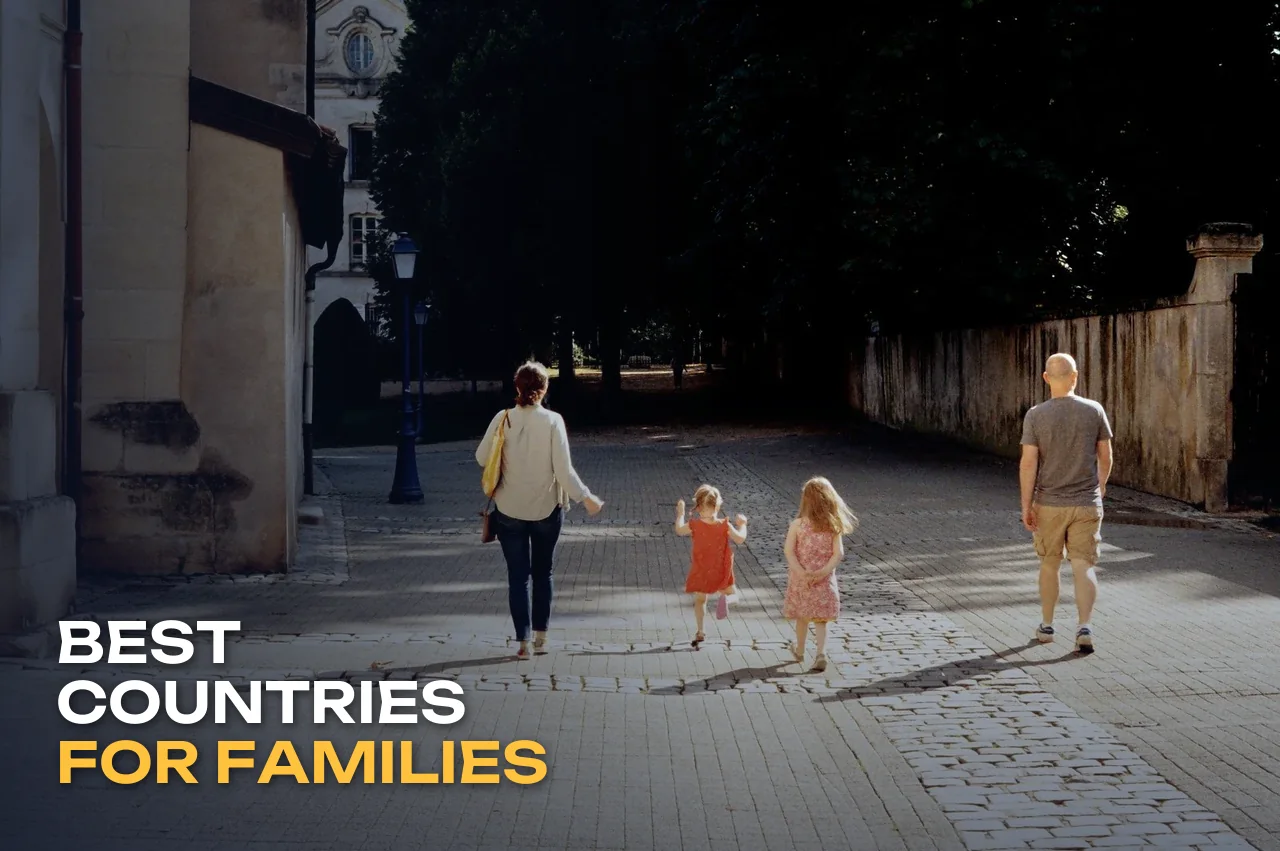
Every week families come to me with one request: we want to leave, but we have children. School, language, adaptation, healthcare - these need to be thought through immediately, not after the move. I'll be : relocating with children is more complicated than as a couple. But it is families with children who adapt faster - children pull parents forward. I will analyze six countries that are truly suitable for families in 2026. Not based on rankings, but on what I have seen myself. And separately - notarized consent of the second parent for departure: without it you can be turned back at the border.
How to choose a country when you have children
When there are no children, choosing a country is a matter of taxes, climate, and residence permit. When children are present, five more layers are added to this: school, language, pediatrician, street safety, and - most importantly - how quickly your child will find friends.
I advise clients to evaluate a country by five criteria. First - availability of international or Russian-speaking schools. Second - safety level (not subjective, but by indices). Third - quality of children's healthcare, especially if the child is young. Fourth - language environment: how quickly will the child begin to understand the surroundings. Fifth - administrative simplicity: can you enter without a visa and obtain a residence permit without months of waiting.
No country is perfect in all five. But each of the six that I will analyze below meets most criteria for families with different budgets and different needs.
We will send a programme overview for your case
Leave your details: we will put together current terms, timelines and amounts in one document.
Notarized consent of the second parent: what it is and why
I will start with a document that is most often overlooked. If you are traveling with a child without the second parent - temporarily or permanently - the Russian authorities have the right to demand a notarized consent for departure. Without it, border guards may not let the child out.
Consent is required if you are traveling alone or with children, the second parent remains in Russia or lives in another country. If both parents are traveling together - the document is not required.
Consent is executed by a notary in Russia. It specifies the country or countries of destination and validity period. You can make an "open" consent for all countries - notaries practice this. The validity period is at your discretion: can be for a year or indefinite.
If the second parent is deprived of parental rights or deceased - corresponding documents with apostille are required. If the parents are divorced and one opposes the departure - you will have to go to court. It is a long process, but it exists.
My advice: arrange consent in advance, not at the airport. And make several notarized copies - they will be needed when applying for residence permit in a number of countries.
UAE: safety and the region's best schools
UAE is my first recommendation for families where international-level school is important. Dubai ranks in the top 5 cities in the world by concentration of accredited international schools: British, American, IB programs, French lycées. The choice is huge.
Safety is objectively the best in the region. The crime index in Dubai is lower than in most European capitals. Children can walk to school independently - this is rare for a megacity.
Healthcare is paid, but high quality. Pediatricians speak English; there are Russian-speaking doctors in private clinics. Mandatory health insurance is included in the residence permit package.
The main drawback is cost. School in Dubai costs from $8,000 to $25,000 per year. Rent for a three-bedroom apartment in a good area - from $2,500 per month. This is not a country for average budget.
Family residence permit is arranged through real estate from 2 million AED (~$545,000) - Golden Visa for 10 years. Or through an employer, freelance visa, startup. Children are added to the parent's visa with no age limit.
Cyprus: EU, English language and Mediterranean rhythm
Cyprus is my personal favorite for families who value European status. The island is part of the EU, children study in the European education system, and upon obtaining citizenship - automatically become EU citizens.
Education in Cyprus is bilingual: public schools operate in Greek, private schools - mainly in English. There are several Russian-speaking schools in Limassol. The level of British school of Limassol or Pascal is quite competitive with European standards.
The climate is mild, hot in summer, but children tolerate it well. Safety is high - Cyprus consistently ranks in the top 10 safest countries in Europe. Pediatrics is developed: there are both public clinics and private clinics with Russian-speaking staff in Limassol.
Residence permit through real estate - Regulation 6(2) - from €300,000 in new construction. Lifetime status, visit to the island once every two years to maintain it. Children under 25 are added to the parent's card.
Downside - small labor market. If you are going to work as an employee, there are fewer vacancies than in Dubai or Lisbon. But for remote work or business - an excellent base.
Portugal: stability, safety and good pediatric care
Portugal is a country for families who value long-term stability. Lisbon and Porto rank among Europe's top cities for living with children. Safety is high, pace of life is leisurely, people are friendly.
Schools are good - both state (free) and private international institutions. English is taught from primary school, with high proficiency levels among local children. There are several Russian-speaking communities, especially in Lisbon - adaptation proceeds more smoothly.
Pediatrics is one of the strengths. The state healthcare system SNS covers children, vaccinations are free, and pediatricians are accessible. Private clinics with English-language services are available in every major city.
Residence permits via Golden Visa were reformed in 2024: property purchases in Lisbon and Porto no longer grant GV eligibility. Current pathways include investment funds from €500,000, support for culture/science from €250,000, or the D7 visa for passive income. D7 is an accessible option for families with remote income from €760/month per adult.
I have seen cases where families chose Portugal specifically for the prospect of citizenship within 5 years - this is a real pathway to a European passport for the entire family, including children.
Bulgaria: affordable, EU, and Cyrillic script.
Bulgaria is the most accessible EU option for families with limited budgets. Rent for a two-bedroom apartment in Varna or Burgas costs €400–600 per month. Groceries are cheaper than in Russia relative to quality. Daycare starts from €150 per month.
The main advantage for children is Cyrillic script. Bulgarian is close to Russian; children can read signs from day one. This reduces adaptation stress significantly. I have witnessed cases where children aged 7–10 began understanding Bulgarian within 2–3 months without formal courses.
State schools are free and operate in Bulgarian. Quality is average by European standards but acceptable. Varna and Burgas have private schools with English-language instruction elements.
State healthcare is weaker than in Western Europe. For serious cases, insurance covering private clinics is recommended. Private pediatric consultations cost €30–50 per visit.
Residence permits are obtained through apartment rental (address registration) or property purchase. Citizenship by descent - if you have Bulgarian ancestry - is our area of expertise and represents a separate major topic.
Serbia: familiar environment without a visa.
Serbia is ideal for those seeking minimal relocation stress. Russians can stay here visa-free for up to 30 days, with the option to extend via exit-entry. The language is similar - Serbian is understood intuitively, and children adapt quickly.
Belgrade is a vibrant city with good infrastructure. State schools are free and operate in Serbian. Private international schools are fewer than in the UAE or Cyprus, but they exist - particularly in Belgrade.
Child adaptation in Serbia is among the easiest of all countries I review. The mentality, food, music, and traditions are all familiar. Children quickly make friends at school because they can communicate almost immediately.
State healthcare is at a satisfactory level. For residence permits, temporary residence must be registered through apartment rental. Serbia is not part of the EU - a drawback for those considering long-term prospects. However, as an interim base or for several years of residence, it is a workable option.
To be frank: Serbia does not provide a European passport and does not resolve Schengen visa issues. However, it does provide a calm, comprehensible environment for children - and that is valuable.
Georgia: simple entry and free state schooling.
Georgia is the simplest entry point for families just beginning to consider relocation. Russians can live here visa-free for up to 365 days. Cost of living is low: rent for a two-bedroom apartment in Tbilisi is €400–700, cheaper in Batumi.
State schools are free. Instruction is in Georgian, but English is taught from primary grades. Tbilisi has several private schools with international curricula and Russian-language instruction.
Child adaptation is rapid. Georgians are very warm toward children - this is a cultural characteristic. A child will be greeted with a smile anywhere. Older generations understand Russian; younger people do so less often, but many speak English.
State clinic healthcare is weak. For families with young children, I recommend insurance providing access to private clinics - it costs modestly, €50–80 per month for a family.
Georgia's main drawback is that it does not offer a pathway to European residence permits or citizenship. It is a transit point, not a final destination. However, for a quick start, during initial months when you need to catch your breath and sort things out - Georgia works excellently.
"In twelve years of practice, I have seen hundreds of families relocate with children. And you know what strikes me every time? Parents fear the move more than children do. Children adapt - it is their nature. Adults carry the burden of 'what if it doesn't work out,' 'what if my child never forgives me.' This fear is understandable, but it must not paralyze. I advise thinking not about the 'best country' but about the 'country that suits us now.' What I always say at the first consultation: do not delay with documents. Notarized consent, apostilles, vaccination certificates - these are what prevent border problems at 6 a.m., not create them. I have seen families turned back right at the airport. This is easily preventable."
Country comparison by budget and documentation.
I have compiled key parameters in one place so you can compare.
UAE: Rent from $2,500/month, school from $8,000/year, residence permit via Golden Visa from $545,000 or freelance visa from $1,500/year. Family members are listed on parent's visa.
Cyprus: Rent from €1,200/month (Limassol), private school from €5,000/year, residence permit through property from €300,000. Lifetime status without language exam.
Portugal: Rent from €900/month (Porto), state school free, D7 visa with income from €760/month. Golden Visa through funds from €500,000.
Bulgaria: Rent from €400/month, school free (state), residence permit through rental or property. Most affordable EU option.
Serbia: Rent from €500/month, school free, visa-free for 30 days plus renewal. Not EU, no pathway to European passport.
Georgia: Rent from €400/month, school free, visa-free for 365 days. Transit point, does not offer European residence permit.
We will find the right residency basis
We calculate the budget and timing for your family and list the documents you need.
International schools: what to look for when choosing.
A school is not just a building. It is an environment where your child will spend 6–8 hours daily. Wrong choice - and adaptation stretches over years.
What to consider: accreditation (IB, Cambridge, Pearson are internationally recognized standards), language of instruction (English opens more doors than local language), class size (up to 20 is good, 30+ is difficult for newcomers), presence of psychologist and adaptation programs for new students.
The UAE offers enormous choice - more than 200 licensed schools in Dubai. Check KHDA (Knowledge and Human Development Authority) ratings - this is the official regulator; look for Outstanding or Good ratings.
Cyprus and Portugal have excellent British schools - a familiar format for those educated in the classical Russian style. In Bulgaria and Serbia, state school will require language effort from the child, but it does integrate quickly into the local community.
My advice: visit the school in person before relocating, speak with the director, ask to introduce your child to the class. This is the best way to understand whether it will suit your child.
Pediatrics: state or private healthcare
Pediatrics is not abstract. When a child gets sick, you need a pediatrician, sometimes a specialist or emergency services. I always advise clients to verify three things before relocating: whether the city has a Russian-speaking pediatrician, how emergency services operate, and whether your insurance covers private clinics.
UAE: healthcare is paid but high-quality. Insurance is included in the residency visa package—it's mandatory. Pediatricians in private clinics speak English; Dubai has Russian-speaking doctors.
Cyprus: state healthcare system GESY exists—after obtaining residency, you pay contributions and gain access. Private clinics operate well; pediatrician consultation costs €50–80.
Portugal: SNS (state healthcare) covers children. Vaccination is free. State clinics have waiting times; private pediatrics costs €50–70 per consultation.
Bulgaria and Serbia: state medicine functions but at a more modest level. Insurance with private clinic access is essential for families with young children.
Georgia: private clinics in Tbilisi are good; state ones are weaker. Insurance is mandatory and affordable.
Child adaptation: what actually helps
I've witnessed various cases. Children aged 4–6 adapt in 2–3 months—they're not yet deeply attached to school peers. Children aged 10–14 find relocation harder: friendships, first love, teenage identity—everything breaks during the move.
What actually helps: local clubs and activities—children meet outside school in informal settings. Russian-speaking community nearby—not for isolation but for support during initial months. Psychologist—not shameful but wise, especially for teenagers.
Important: don't rush children. "You've been here three months, why haven't learned the language yet?" is pressure that slows adaptation. Give them time.
From my observations: easiest adaptation is in Georgia and Serbia (familiar environment); hardest is UAE when choosing local Arabic school instead of international. Choose an environment that welcomes your child with understanding, not barriers.
Exit documents: family checklist
Before relocating with children, verify each point.
Passports: International passports for all family members, valid for at least 6 months after planned return (or indefinite if relocating permanently). Children's international passport for children under 14—mandatory.
Notarized consent from second parent: If traveling without one parent—arrange in advance. Specify particular countries or "all countries worldwide"—notaries accept this formulation.
Children's birth certificates: Originals plus apostilles. Required for residency registration, school enrollment, pediatric visits.
Vaccination records: International form (yellow booklet) or medical record extract in English—useful everywhere.
Marriage/divorce documents: If divorced traveling alone with children—bring court order and custody documents.
Insurance: For entire period until local coverage arranged. Coverage minimum €100,000, including pediatrics and emergency services.
My advice: scan all documents and store in cloud. Papers get lost, especially during initial weeks of relocation.
Three mistakes I see most often
First—choosing a country without checking schools. Some families choose by climate or taxes, then discover the nearest suitable school is two hours away. School is the first thing to check, not the last.
Second—traveling for reconnaissance without documents. I've seen cases where people flew to "look around" and faced situations requiring urgent school enrollment. Without birth certificate with apostille and medical records this is impossible. Bring documents even on reconnaissance trips.
Third—underestimating teenagers. Parents think: "They're grown up, they'll manage." Actually teenagers aged 12–16 are the most vulnerable group during relocation. They need not just a school but an understandable social environment. Discuss relocation, give them a role in country selection—it works.
How to make the choice
There's no one right answer—only one right for your family. If safety and top schools matter—UAE. If you want EU with affordable costs—Bulgaria or Cyprus. If you need smooth adaptation—Serbia or Georgia as a start. If considering long-term perspective and European passport—Portugal or Cyprus.
I always tell clients: relocation decisions with children aren't made based on internet articles. They're made after you've visited, seen schools, talked with people already living there. We assist at all stages—from country selection through residency registration and school enrollment.
Frequently asked
Questions people ask before deciding
01Is notarized consent from the second parent required if we travel together as a family?
No. If both parents travel with the child, consent is not required. It is only needed when the child travels with one parent or a third party (grandmother, aunt).
02Can consent for all countries be issued at once without listing each one?
Yes, Russian notaries accept the wording "to all countries of the world without exception." This is more convenient than listing specific countries, especially if plans may change.
03What is the cheapest EU country to live in with children?
Bulgaria is the most affordable EU option. Rent from €400, state schools are free, groceries are inexpensive. Downside - healthcare is weaker than in Western Europe, and private insurance is required.
04Do children receive citizenship of a country at birth abroad?
It depends on the country. Most EU countries follow the principle of blood - citizenship through parents, not by place of birth. There are exceptions, for example in Portugal under certain conditions. This needs to be clarified for each country individually.
05How do I enroll a child in an international school in the UAE?
Required: child's passport, birth certificate with translation and apostille, vaccination certificate, letter from previous school (transcript). Many Dubai schools accept documents online before relocation - I recommend contacting in advance, places in popular schools fill up quickly.
06Can I move to Portugal without large investments?
Yes. D7 visa - for people with passive income or remote work. Minimum income is approximately €760 per month for an adult plus allowances for children. This is not an investment visa, but a residence visa. After 5 years you can apply for citizenship.
07Is it mandatory to enroll a child in a local school or can homeschooling be used?
Homeschooling is legal in most of the countries discussed, but with different conditions. In Cyprus and Portugal it is permitted but requires registration. In the UAE homeschooling is regulated more strictly. Check for each country - and remember that school aids adaptation just as much as education.
08What country is best for a teenage child?
In my experience - Serbia or Bulgaria, if linguistic proximity and smooth adaptation are important. UAE - if the priority is an international school and a wide circle of friends from foreign peers. Teenagers find complete language disruption difficult, so environment matters more than climate.
09Is a visa required to enter Georgia with children?
No. Russians can stay in Georgia for up to 365 days without a visa. Children enter on a passport. For stays longer than a year, a residence permit must be obtained - through apartment rental or business registration.
10How does health insurance work in Cyprus after obtaining a residence permit?
Cyprus has the GESY system (Government Health System) - an analogue of compulsory insurance. After obtaining a residence permit and starting to pay contributions (2.65% of income), you and your children gain access to state doctors and hospitals. Private clinics - additionally, by insurance or cash payment.
11What if the second parent opposes the child's departure?
This is resolved through court. The parent wishing to leave with the child files a suit to determine the child's place of residence or permission to depart. The process takes several months. This is a difficult route, but it exists - and we help prepare the necessary documents for your lawyer.
12Can I move to Bulgaria and keep Russian citizenship?
Yes. Bulgaria does not require renunciation of Russian citizenship to obtain a residence permit. When obtaining Bulgarian citizenship (EU) through descent, Russia formally does not recognize dual citizenship but does not strip it automatically either. This is a separate legal issue that should be discussed before making a decision.
About the author
Related materials
What to read next
 ComparisonAntigua and Barbuda or Grenada: Family Passport for Large Families in 2026
 AnalysisWhat is due diligence and why the Caribbean is rejecting applications
 AnalysisHow to Choose a Program: Citizenship, Residence Permit or Permanent Residency through Investment
Personal programme selection is conducted by Anna Kovalevskaya, Head of Legal, BRIDGES.
How a programme is chosen: goals breakdown
Budget, family, timelines and relocation plans - which answers lead to which programme.