BRIDGES Insights
Where should a Russian pensioner relocate: countries where Russian retirees live well
Updated: June 2026·9 min read·Expert reviewed
Terms and costs verified: June 2026
Contents
Who this is for. This article is written for citizens of Russia. Visa, banking, sanctions and dual citizenship rules depend on your passport: for other nationalities they may differ.
I have been working with people relocating abroad for 12 years. And I'll be : among my clients, pensioners are one of the most decisive categories. They don't wait for the "right moment." They simply pack and go. The most common question is: "Where exactly?" Russian pensions are paid abroad—this is a fact. If you are not officially employed, the Pension Fund continues payments. Money can be received to a Russian bank card or through a designated representative. The mechanism works. But a pension is one thing, and life is another—it's about climate, rental costs, healthcare, language, and mentality. I have compiled six countries where Russian pensioners actually live and feel good. Not based on internet ratings—based on our clients' experience and what I see myself.
Russian pension abroad: how it works
The first question everyone asks without exception: "Will the pension actually be paid?" Yes, it will. Russian pension legislation does not tie payments to place of residence. You can live in Bulgaria, Thailand, or Georgia—your pension continues to accrue.
Important nuance: this only works if you are not officially employed. Working pensioners abroad lose indexation—the same situation as in Russia.
There are two ways to receive money. The first is a Russian bank card with the ability to use it abroad (this depends on the sanctions situation and the specific bank). The second is a power of attorney to a person in Russia who withdraws and transfers funds. The second method is more reliable in terms of payment guarantee.
I advise you to sort out this issue before departure specifically for your bank and destination country—the situation changes.
Bulgaria: EU, sea, and Cyrillic script
Bulgaria is my first recommendation when a pensioner says "I want Europe but affordably." An EU country with the Bulgarian language in Cyrillic—that's already half the barrier removed. Locals understand Russian speech; many speak it themselves.
Varna and Burgas are seaside cities with good infrastructure. Veliko Tarnovo and Plovdiv—if you want peace and history. Rent for a one-bedroom apartment starts from €250–300 per month outside resort areas. Products are cheaper than in major Russian cities.
Healthcare in Bulgaria is public and private. Public healthcare quality is "tolerable." I've seen cases where clients created their own scheme: basic care in Bulgaria, serious procedures in Germany or Hungary. This is feasible within the EU.
Residence permit in Bulgaria for pensioners is issued as a residence permit for financially solvent persons. Income must be confirmed—typically €2,000–2,500 per month for a family. A Russian pension plus savings easily cover this requirement.
Montenegro: climate and sea without visa complications
Montenegro is not an EU member, and this is a plus for Russians. Visa-free entry for 30 days, then simple extension. A small, cozy country with an Adriatic coastline and mountains.
Kotor, Budva, and Tivat are tourist cities with developed infrastructure. Bar and Herceg Novi are quieter and cheaper. Rent from €300–400 per month for a one-bedroom apartment.
Montenegrins have a good attitude toward Russians—this is not just words; it's a fact confirmed by my clients over years. The language is so similar to Russian that basic communication happens naturally.
Healthcare here is more modest than in Bulgaria. For serious cases, people go to Serbia or Croatia. But as a place for a calm, measured life by the sea—Montenegro is excellent.
Serbia: the closest mentality
Serbia is a country for those who value "their own" mentality. Orthodoxy, Cyrillic script, similar culture, open attitude toward Russians. Belgrade is a vibrant European city with good healthcare, cafes, and public transport.
Entry for Russians is visa-free for 30 days; temporary residence status is arranged relatively easily. Rent in Belgrade: €400–600 for a one-bedroom. In small towns—considerably cheaper.
What I like about Serbia for pensioners: good public healthcare by regional standards, an active Russian-speaking diaspora, affordable food prices.
What to consider: the climate is not Mediterranean—winters are cold, summers are hot. If the sea is important to you—it's not the best choice. But for those who want Europe without a language barrier and with like-minded people—Serbia works.
Georgia: visa-free for a year and incredible hospitality
Georgia is a special story. Russians can stay there for 365 days without a visa. Not 30, not 90—a full year. This is a unique condition in the current situation.
Tbilisi has become a very Russian-speaking city since 2022. This is both a plus and a minus: on one hand—your community, on the other—prices have risen. Rent in central Tbilisi is now comparable to Russian cities, sometimes higher. Batumi by the sea is cheaper and warmer.
Georgian cuisine, wine, mountains, warmth from April to October—these are real advantages. Local residents are genuinely hospitable—not for tourists, but by nature.
Healthcare is paid, at the level of "acceptable for basic needs". Serious surgeries should be planned elsewhere.
For a retiree with a budget of €600–800 per month, Georgia is one of the best options in terms of quality of life to cost ratio.
Thailand: retirement visa and eternal summer
Thailand is the only country on this list with a dedicated retirement visa. The Non-Immigrant Visa O-A is issued to people over 50 years old and allows you to stay in the country for a year with annual renewal.
Requirements: you need to confirm the presence of 800,000 baht (~€22,000) in your account or a monthly income of 65,000 baht (~€1,700). This is a substantial sum, but many clients close it through a combination of pension and savings.
Why Thailand is popular: year-round warmth, inexpensive living (apartment rental from €200–300 in Chiang Mai, more expensive in Pattaya and Bangkok), healthcare at above-average level—especially in private clinics accustomed to working with foreigners.
There is a language barrier, but English is sufficient in tourist areas. The Russian-speaking diaspora is huge—finding fellow countrymen will not be difficult.
To be : Thailand requires more preparation and financial reserves than European options. But if climate is the priority—this is the best choice.
Cyprus: English-standard healthcare and mild climate
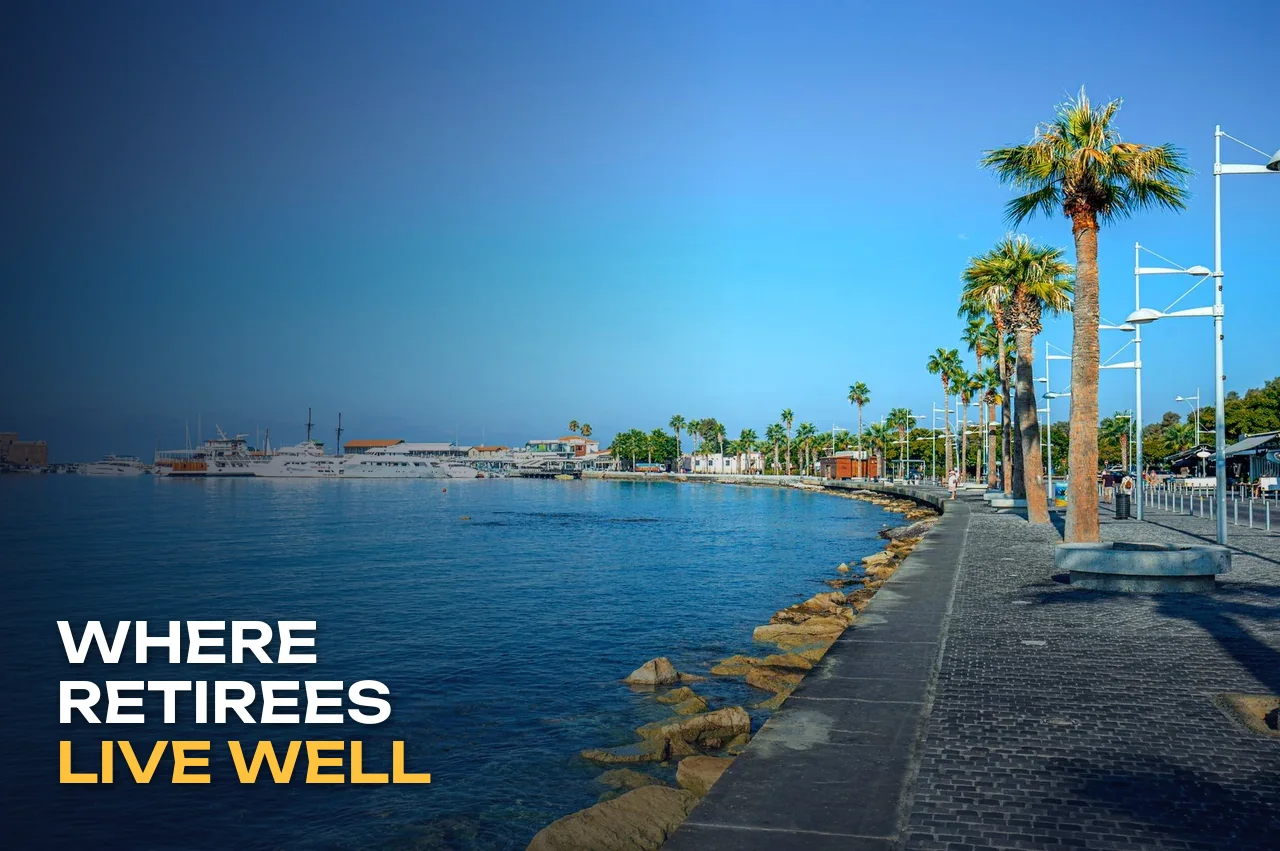
Cyprus is an EU country with 340 sunny days per year. Winters are mild, the sea is warm from May to November. The official languages are Greek and English, with English functioning everywhere: in clinics, banks, government agencies.
For Russian retirees, Cyprus is attractive primarily for its healthcare. Private clinics here operate by European standards, with many doctors educated in the United Kingdom. This matters when health becomes a priority.
Rental: from €600–700 for a one-bedroom apartment in Limassol, cheaper in Paphos and Larnaca. Cyprus is not the most budget-friendly option on this list. But the combination of climate + healthcare + EU + safety is hard to beat.
Residence permit in Cyprus for retirees—through the income-based permanent residence route program (residence permit for financially self-sufficient persons). You need to confirm stable income from abroad. We assist clients with the application process. Consideration now takes several years: the Cyprus migration department has had a backlog since 2019.
We will find the right residency basis
We calculate the budget and timing for your family and list the documents you need.
How much money you need: real figures by country
I intentionally collected the figures in one place so you can compare:
Bulgaria: rent €250–400 + groceries €200–300 + healthcare/other €150–200 = €600–900/month per person.
Montenegro: rent €300–450 + groceries €200–250 + other €150 = €650–850/month.
Serbia: rent €400–600 (Belgrade) + groceries €200 + other €150 = €750–950/month.
Georgia (Tbilisi): rent €400–600 + groceries €200 + other €150 = €750–950/monthBatumi is 20–30% cheaper.
Thailand (Chiang Mai): rent €200–300 + groceries €150–200 + other €150 = €500–650/month provided you have the required amount in your account for the visa.
Cyprus: rent €600–800 + groceries €300–400 + other €200 = €1,100–1,400/month.
These are baseline figures excluding travel, major purchases, and unforeseen medical expenses. Budget a reserve.
"I've been working with retirees who relocate abroad since around 2014. And you know what's changed in that time? Previously, the main fear was 'what if I don't like it'. Now it's 'what if I don't have time'. People who postponed relocation 'when the grandchildren grow up' or 'when my health allows', sometimes come to me in a situation where there's no time for deliberation anymore. That's why I always say: don't wait for the perfect moment. Start with reconnaissance. What I appreciate about working with retirees is their pragmatism. They don't romanticize. They ask about hospitals, about winter, about neighbors, about how to withdraw money. These are the right questions. The most common mistake I see is choosing a country based on summer climate. A client arrives in Tbilisi in August, falls in love, rents an apartment for a year. And then November comes... and November in Tbilisi is a different city. That's why my rule is: reconnaissance in the off-season, minimum one month, preferably with a minor illness—to test how local healthcare works. About money: Russian pensions are paid abroad. But the mechanism of receiving it is a separate task that needs to be solved before you leave, not after. I've seen people spend three months sorting this out on the ground. Don't do that. And one last thing: don't leave Russia—move toward the life you want. It's a different motivation, and it works better."
Living conditions: visa, residence permit, what needs to be arranged
Each country has its own rules. I'll break it down briefly for each:
Bulgaria: Residence permit through income verification. Minimum ~€2,000–2,500/month for a family. Filed through the consulate or in-country.
Montenegro: Visa-free entry for 30 days. Extension through exit-re-entry or temporary residence. Arranged in-country, relatively straightforward.
Serbia: 30 days visa-free. Temporary residence—through housing rental and registration. Many live by exit-re-entry, but this is not a reliable long-term strategy.
Georgia: 365 days visa-free—a unique provision. For longer stays—residence permit through property purchase or other grounds.
ThailandNon-Immigrant O-A (50+ years old), annual visa with extension. Requires financial confirmation. Processed at Russian consulate or Thai embassy in a third country.
CyprusResidence Permit income-based permanent residence route - for individuals with passive foreign income. Income verification is mandatory. Processed through Cyprus Migration Department.
Healthcare Abroad: What to Expect
Healthcare is the primary concern for retirees, and justifiably so. I assess it by country:
Cyprus - the best option on this list. Private clinics at European standards, doctors with British diplomas, English spoken everywhere.
Bulgaria - acceptable for basic care. For complex cases, patients travel to Germany or Austria (EU countries, which is possible).
Thailand - private healthcare at unexpectedly high standards. Bangkok Hospital, Bumrungrad - known worldwide. Prices are reasonable relative to quality.
Serbia - state healthcare is decent by regional standards. For foreigners - paid services.
Montenegro and Georgia - basic level. For planned operations, it is better to plan travel to a more medically advanced country.
My advice: always obtain international medical insurance. This is not optional, it is an obligation to yourself.
Taxes: What a Retiree Pays Abroad
Tax questions arise less often than they should. Here is what matters:
Russian pension - is not taxed in Russia or in most countries (it is not considered "employment income"). However, verify for your specific country.
If you have other income sources - property rental in Russia, dividends - tax residency is crucial. Residing abroad more than 183 days per year, you cease to be a Russian tax resident. The personal income tax rate for non-residents on Russian income increases from 13% to 30%.
This is critical if you have income sources in Russia beyond your pension. Consult before moving - not after.
In EU countries (Bulgaria, Cyprus), resident retirees pay local taxes. Bulgaria - 10% income tax, one of Europe's lowest. Cyprus - special "non-dom" status provides significant benefits for 17 years.
How to Choose a Country: My Criteria
After 12 years in this field, I see several universal selection rules:
Climate - comes first. Not internet pictures, but real winter. If you tolerate cold poorly - Montenegro and Serbia are eliminated. If heat is unbearable - Thailand is not for you.
Healthcare matters more than price. Retirees economize on rent and overpay at clinics. It is better to immediately choose a country with good healthcare and build a budget .
Check banking accessibility. It is 2026, sanctions reality. Receiving money from Russia is a challenging task. Work out the mechanism BEFORE departure.
Talk to those already there. Do not read 2019 forums. The real picture changes rapidly. Russian-language Telegram communities for each country have real people who will answer specific questions.
Start with reconnaissance. Three months in a potential country - the best way to verify if it suits you. Do not sell your apartment immediately.
Practical Steps Before Moving
What to do before departure - short checklist:
1. Notify Russian Social Fund of departure and clarify payment procedures. For some countries, annual proof of life is required (life certificate certified by consulate).
2. Open a bank account with a bank operating abroad. Resolve the card or power of attorney issue.
3. Obtain medical insurance with coverage in destination country. Minimum €50,000, preferably €100,000+.
4. Consult on tax residency if you have income sources in Russia beyond your pension.
5. Research visa requirements specific to your situation - citizenship, passport, entry history.
6. Make copies of all documents - passport, pension certificate, medical records, property documents. Store in cloud and paper format.
This is not a complete list, but the foundation. The rest depends on the country.
How to Verify a Country Before Moving
I always advise clients one thing: do not decide based on photographs. Go on reconnaissance in off-season.
Why off-season? Because Bulgaria is beautiful in summer, but you will live there in winter. November Tbilisi is not August Tbilisi. January Thailand is ideal, but February Paphos may surprise you with coolness.
What to check during reconnaissance:
- Nearest hospital and real patient reviews (not tourist ones)
- Supermarket and prices for familiar products
- Transportation accessibility - how to reach center, airport
Russian-speaking diaspora - find a local chat group and meet people
Internet - check connection speed in your specific area
Direct housing rental without agent fees
Three months of reconnaissance costs less than a mistake that lasts several years
We will send a programme overview for your case
Leave your details: we will put together current terms, timelines and amounts in one document.
Summary: which country for which retiree
Here's a brief overview:
Bulgaria - for those who want the EU, seaside, Cyrillic script, and a modest budget. The best starting point for most people
Montenegro - for those who value the Adriatic Sea and a quiet life without EU bureaucracy
Serbia - for those who need a "familiar" atmosphere and close mentality. No seaside, but Belgrade instead
Georgia - for those who want maximum freedom with minimal formalities. 365 days without a visa - that's a gift
Thailand - for those who prioritize climate and are ready to navigate visa formalities. A financial cushion is necessary
Cyprus - for those who value healthcare and safety over savings. The best comfort/climate/healthcare ratio in the EU
There is no universal answer. There is your specific situation. If you want to analyze it - contact us
Frequently asked
Questions people ask before deciding
01Will I receive my Russian pension if I move abroad?
Yes. Russian legislation does not tie pension payments to place of residence. Your pension continues to accrue provided you are not officially employed. To receive payments, you need either to maintain access to a Russian bank card or to issue a power of attorney to a person in Russia. Some countries require annual confirmation of life status through the consulate.
02Which country is easiest for a Russian pensioner to relocate to?
Considering all factors - Georgia. Russians enter visa-free for 365 days, without special permits or financial requirements upon entry. Housing is affordable, and Russian-speaking communities are well-developed. Bulgaria and Montenegro are also accessible, but require residency permits for long-term stay.
03Which country is cheapest for a pensioner to live in?
Thailand (Chiang Mai) and Georgia (Batumi) are the most budget-friendly options, from €500–650 per month. Bulgaria and Montenegro - €650–900. Serbia - €750–950. Cyprus is the most expensive on this list, from €1,100 per month.
04Do I need to pay taxes in Russia after relocating abroad?
If you reside abroad for more than 183 days per year, you lose Russian tax resident status. The personal income tax rate on Russian income (rent, dividends) increases from 13% to 30%. Pensions as such are not subject to tax. Clarify your situation before departure - especially if you have income beyond your pension.
05What healthcare is best for pensioners abroad?
The best option on this list is Cyprus. Private clinics at European standards, doctors with British education, English widely spoken. Thailand is also known for quality private healthcare at reasonable prices. Bulgaria and Serbia offer acceptable standards for basic medical care.
06Can I obtain a residence permit in Bulgaria based on my pension?
Yes. Bulgaria offers a residence permit for financially capable individuals. You need to confirm stable income - typically €2,000–2,500 per month for a family. A combination of a Russian pension and savings usually meets this requirement. We assist with document preparation.
07What is a retirement visa in Thailand?
Non-Immigrant Visa O-A is an annual visa for people over 50 years old. Requirements: €22,000 (approximately 800,000 Thai baht) in your account or a monthly income of 65,000 baht (approximately €1,700). The visa is renewed annually with no limit on the number of years. It is issued at the consulate prior to entry.
08How can I receive money from Russia while abroad?
Two main methods: a Russian bank card with the ability to withdraw abroad (depends on the specific bank and sanctions situation) or a power of attorney to a person in Russia. The second method is more reliable. I recommend resolving this before departure and testing the mechanism.
09Is Cyprus suitable for Russian pensioners?
Yes. Cyprus is an EU country with a mild climate, British-standard healthcare, and 340 sunny days per year. Residence permit income-based permanent residence route is issued upon confirmation of income from abroad. Cyprus is not the most budget-friendly option, but in terms of climate + healthcare + safety, it ranks first on this list.
10Do I need to confirm my life status to receive my Russian pension?
For most countries - no. However, some countries and regional offices of the Russian Social Fund may request annual certification of life, certified at the Russian consulate. Clarify this with your Social Fund office before departure.
11Serbia or Montenegro - which is better for a pensioner?
It depends on your priorities. Montenegro - the sea, mild climate, tourist infrastructure. Serbia - Belgrade as a vibrant European city, more developed healthcare, active diaspora. Montenegro is quieter and further south, Serbia is an urban option with good infrastructure.
12How should a pensioner begin preparing for relocation?
In four steps: notify the Social Fund and clarify the pension payment mechanism; obtain health insurance; consult on tax consequences; visit your potential country for 1–3 months during off-season for reconnaissance. Do not sell property in Russia until you have made a final decision.
About the author
Related materials
What to read next
 ComparisonAntigua and Barbuda or Grenada: Family Passport for Large Families in 2026
 AnalysisWhat is due diligence and why the Caribbean is rejecting applications
 AnalysisHow to Choose a Program: Citizenship, Residence Permit or Permanent Residency through Investment
Personal programme selection is conducted by Anna Kovalevskaya, Head of Legal, BRIDGES.
How a programme is chosen: goals breakdown
Budget, family, timelines and relocation plans - which answers lead to which programme.