BRIDGES Insights · Saint Kitts and Nevis
St Kitts residency requirement: what is announced, what is in force and how to plan a trip to the island
Updated: October 2026·25 min read·Expert reviewed
Terms and costs verified: October 2026
Contents
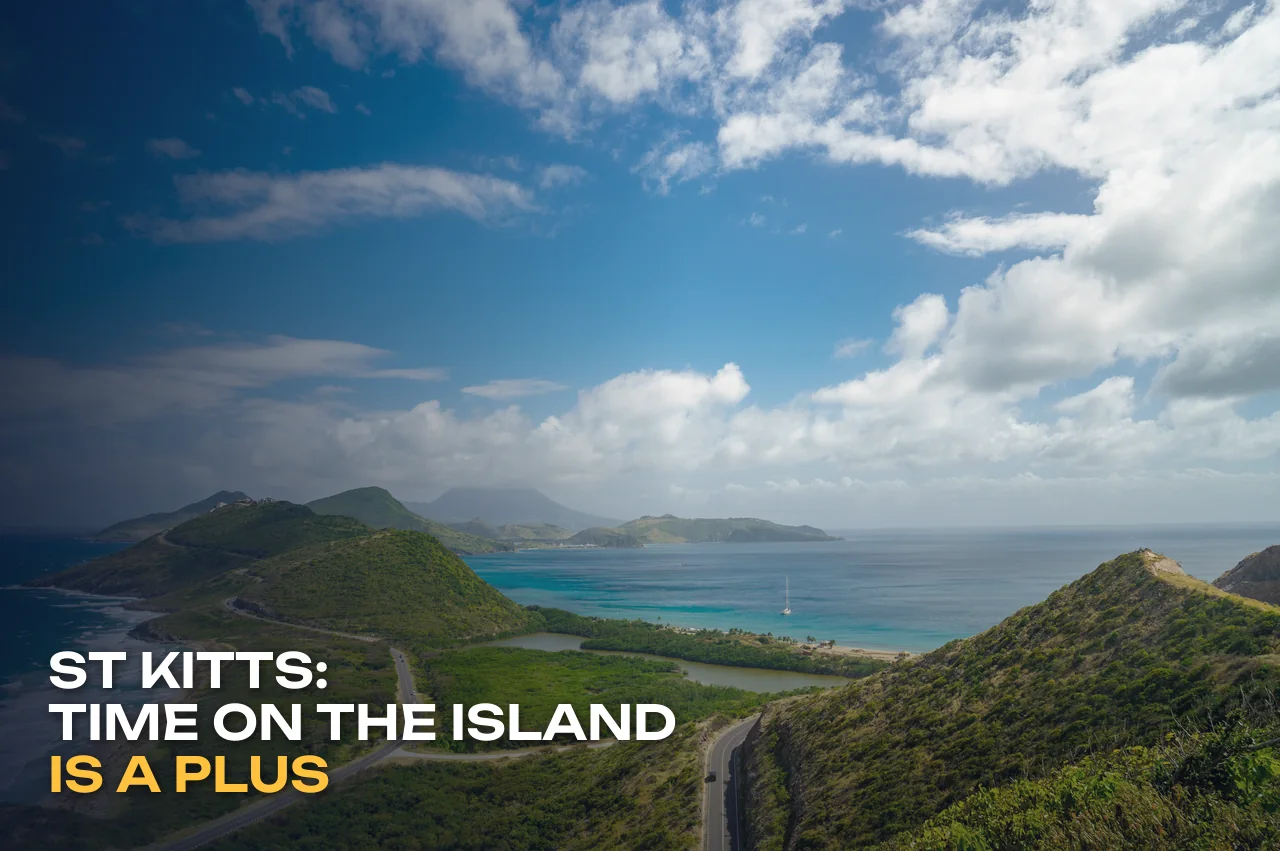
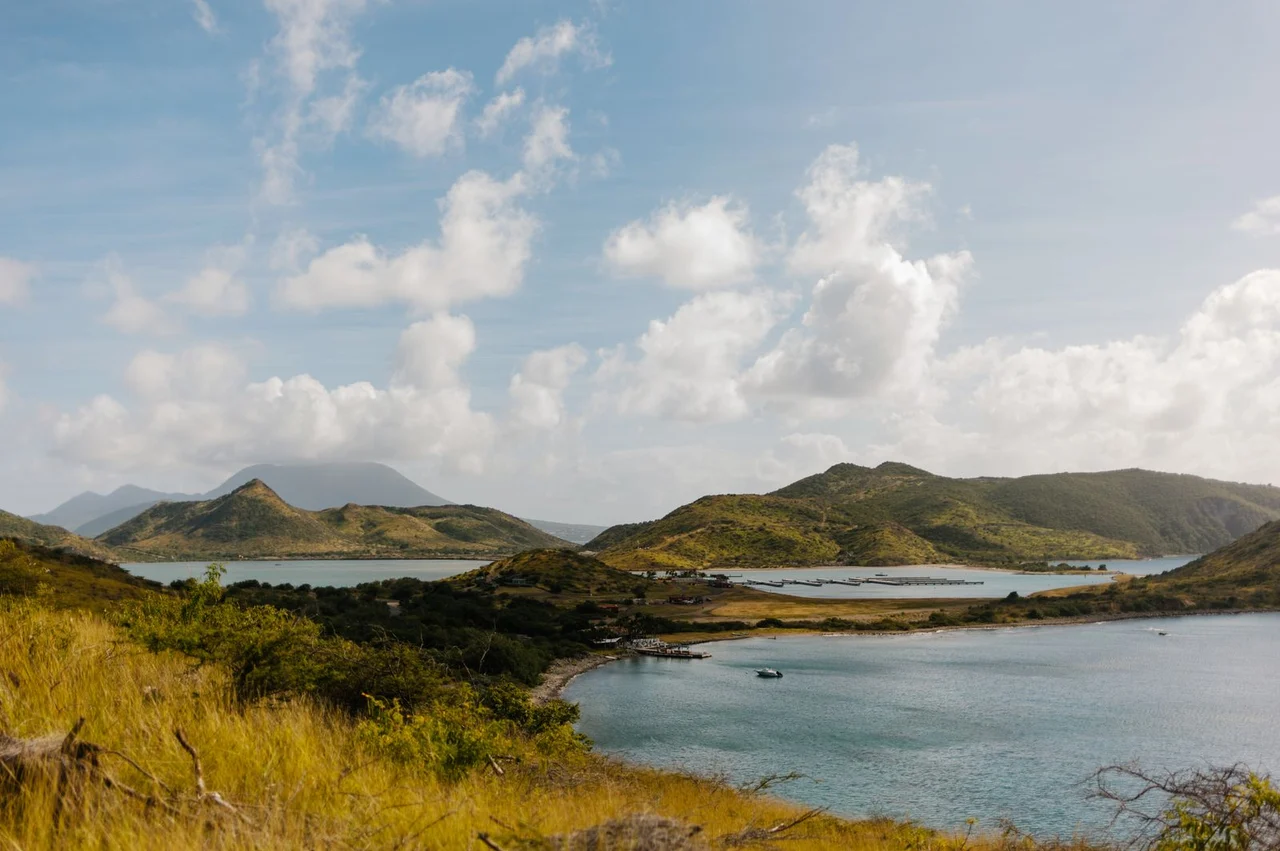
Picture a morning on St Kitts: you climb to Brimstone Hill Fortress, the Caribbean Sea below, Nevis in the haze to your right and the green slopes of Mount Liamuiga behind you. Soon a morning like that may become part of the way to this country's passport. St Kitts and Nevis has announced that citizenship by investment will require a genuine link with the Federation, including presence on the islands. But the government has not yet published how many days or from what date. I checked every official source and separated what has been announced from what is in force. My conclusion: the "30 days" rule already being sold as current does not exist today, and the trip to the island itself is more of a gift than a chore. The programme terms are on the page on St Kitts and Nevis citizenship.
In brief
- Announced. In December 2025 the Citizenship by Investment Unit introduced a genuine link with the Federation into the programme: presence and residency, economic activity, investment and engagement with the country. On 8 January 2026 Prime Minister Terrance Drew announced a residency feature for investors.
- Not published. The number of days on the island, the effective date, the counting method and the exemptions. The Government Notices section has no new legal instrument on residency.
- In force now. The SISC contribution from USD 250,000, real estate from USD 325,000, a mandatory interview and biometrics for new applicants since 14 April 2026. The investment options page still says there is no residency requirement.
- The "30 days" figure belongs to neighbouring Antigua and to regional rules under discussion. For St Kitts it is speculation, and on 28 September 2026 the Unit explicitly asked partners not to market the programme on speculation.
- If the requirement is introduced, the trip is easy to combine with biometric enrolment on the island and a week of rest.
What the government announced, and in what words
The story began not with a loud law but with careful wording. On 26 June 2025 the Citizenship by Investment Unit said it was "carefully evaluating" a possible physical presence requirement. At the same time it made two promises that still matter: there will be no sudden shifts, and stakeholders will get adequate lead time and clear guidance before any start.
On 12 July 2025 the Unit listed a minimum residency requirement among the anticipated provisions common to the five Eastern Caribbean countries and stressed that it is not designed as a deterrent but as a way to strengthen a person's tie to the country. The Unit promised to publish timelines and operational guidance separately.
On 24 September 2025 the five countries signed a regional agreement. According to the government news service SKNIS, it includes a region-wide minimum investment of USD 200,000, the regional regulator ECCIRA, mandatory biometrics for new and renewing applicants and "stronger residency requirements". No number of days is given.
The most detailed wording appeared in the December update from the Unit's Executive Chairman, Calvin St. Juste. Citizenship is now granted on the basis of a demonstrable, substantive and ongoing connection with the Federation. It includes physical presence and residency, economic activity such as setting up a business and creating jobs, investment in national priorities, and social and cultural engagement. For 2026 the update announced a transition away from passive contribution routes towards routes built on residency and participation, and a support service for new citizens called Priority One.
Finally, on 8 January 2026 Prime Minister Terrance Drew announced two measures at a press roundtable: a residency feature for investors and the collection of biometrics from future citizens around the world. Biometrics went live in April. On residency the announcement gives neither a date nor several days.
What this means for you. The direction is chosen and confirmed at the highest level. Terms on which you could plan a trip do not exist yet. Anything beyond these statements is guesswork today.
Announced, in force, unknown: the check on 21 October
In the table I sorted each claim into three baskets. Read the middle column: "announced" means the intention has been stated officially but there are no rules yet; "in force" means the condition is published and applied; "unknown" means there is no official answer at all.
| Item | Status on 21 October 2026 | Official source |
|---|---|---|
| Genuine-link requirement | announced: physical presence and residency, economic activity, investment, engagement with the country | CIU Chairman's update, December 2025 |
| Residency feature for investors | announced by the Prime Minister on 8 January 2026 | SKNIS, 8 January 2026 |
| Number of days on the island | unknown: no figure in published texts | CIU website, Government Notices section |
| Effective date | unknown: not announced | same |
| Mandatory residence today | not in force: the investment options section says there is no residency requirement | ciu.gov.kn, investment options |
| SISC contribution from USD 250,000, real estate from USD 325,000 | in force | ciu.gov.kn, investment options |
| Interview | in force, mandatory | ciu.gov.kn, 1 October 2026 |
| Biometrics for new applicants | in force since 14 April 2026 | ciu.gov.kn, biometrics section |
| Common rules of the regional regulator ECCIRA | not in force: no agreed start date | ciu.gov.kn, 28 September 2026 |
Of the ten rows two remain unknown, and both are the key ones: how many days and from what date. Until they are answered, the residency requirement stays an intention, not a rule. An applicant who files today goes through the programme on the current terms.
Today the programme runs on the old amounts and the new checks
The Unit's investment options page lists four options. A contribution to the Sustainable Island State Contribution fund (SISC) from USD 250,000. Real estate in an approved developer project from USD 325,000. Private real estate from USD 600,000. A contribution to approved public benefit projects from USD 250,000. The list of programme benefits on the same page still states that there is no residency requirement. A full family calculation is in our article on the cost of St Kitts citizenship.
- Minimum SISC contributionUSD 250,000developer real estate from USD 325,000
- Time to approval in principle120-180 daysper the Unit, 1 October 2026
- Biometrics for programme citizensby 31 July 2027new applicants enrol since 14 April 2026
- Number of days on the islandnot publishedno start date announced either
ciu.gov.kn: investment options, biometrics section, news of 28 September and 1 October 2026
The checks are stricter. The interview is mandatory for all applicants, and according to the Unit on 1 October 2026 approval in principle takes 120-180 days. Since 14 April 2026 new applicants enrol biometrics in person after approval in principle, and everyone who already holds programme citizenship must do so by 31 July 2027. From 1 September 2026 biometrics is built into passport issuance. Enrolment centres operate on St Kitts itself and abroad, including Dubai, Istanbul and London. The booking process is described in our biometrics guide.
One more line worth knowing in advance: the programme does not accept applications from citizens of Russia, Belarus, Afghanistan, Iran, Iraq and North Korea. This is stated directly in the Unit's eligibility criteria. How this applies to people with dual citizenship or long residence abroad we covered in the article on St Kitts citizenship for Russians.
What this means for you. If you are ready to apply now, plan by the published terms: the amount, the interview, biometrics. Treat the future residency requirement as a likely trip after you receive the passport, not as a condition of filing today.
Where "30 days" came from, and why it is not yet a St Kitts rule
The figure 30 came from next door. Antigua and Barbuda has long required new citizens to spend a few days in the country during the first five years. According to industry press, in July 2026 the government of Antigua tabled amendments in Parliament raising this to 30 days over five years, and the Prime Minister said the new rule is already applied in practice. The official Antigua programme website did not open during our check on 21 October, so we are re-checking the status of the amendments. A comparison of the two programmes is in St Kitts or Antigua, and the Antigua terms are on the page on Antigua citizenship.
The second pillar of "30 days" is the regional rules under ECCIRA oversight. They are often retold with specific periods, but the official SKNIS report on the agreement only mentions "stronger residency requirements". And on 28 September 2026 the St Kitts Unit clarified: the regional rules will take effect only after the regulator becomes operational and all participating states formally agree and announce a start date. Partners were asked directly not to assume dates or transitional arrangements.
At the same meeting the Unit's Chairman said something I would hang above every adviser's desk: the programme should not be marketed on speculation, especially where regulation is still under consideration or not formally introduced. When someone gives you an exact number of days and a date for St Kitts, ask for a link to a government document. Today there is no such link.
What this means for you. "30 days" is a reasonable yardstick for your own planning if you want a sense of scale. But it is not a St Kitts rule, and you should not sign a contract that records it as a current programme condition.
Why a trip to the island works for your passport
A presence requirement is easy to see as an extra burden. I see it differently. The value of a Caribbean passport rests on the trust of large countries in the people it is issued to. On 16 December 2025 the US restricted visas for citizens of Antigua and Dominica and named the reason directly: citizenship by investment without residency requirements. Since the end of 2025 the EU has had an updated visa suspension mechanism in which such programmes are a separate ground. We covered this in detail in the piece on Caribbean visa-free access to Schengen.
St Kitts is answering this challenge ahead of its neighbours. In February 2026 the US Treasury rescinded its 2014 advisory on the St Kitts programme. Every trust measure, from biometrics to residency, works to keep the passport's visa-free access to Schengen and the UK. The wider picture of change in the region is in our analysis on in-person presence in the Caribbean.
There is a human side too. A passport of a country you have never visited is like a key to a house you have only seen in photos. After a week on St Kitts you will choose a place to winter, relocate or do business from experience, not from a brochure.
I like to see these days as an investment in your own options. A week on the island gives you what no presentation can: you meet people who live and work here, see how Basseterre runs on a weekday, where local entrepreneurs have lunch and how long the drive from Frigate Bay to the port takes. After a couple of trips you have your own lawyer, your own bank manager and acquaintances you can call. For business in the region such ties are worth more than any brochure.
For children it is a gift of its own. A child who has climbed a volcano, seen a fortress whose cannons still face the sea and taken the ferry to Nevis sees a second citizenship not as a line in a document but as a place on the map where they have been. And banks and partners, who ask ever more closely about a client's link to the country of their passport, get a simple answer: entry stamps, an address where you stayed and people who know you.
What this means for you. A trip to the island strengthens the value of your passport. It is getting to know the country of your second citizenship, not time to be served.
We will check how the new St Kitts rules affect you
Tell us your nationality, your family members and when you plan to apply. We will tell you what applies on your filing date and how to plan a trip to the island.
Two islands in one federation: where St Kitts and Nevis is
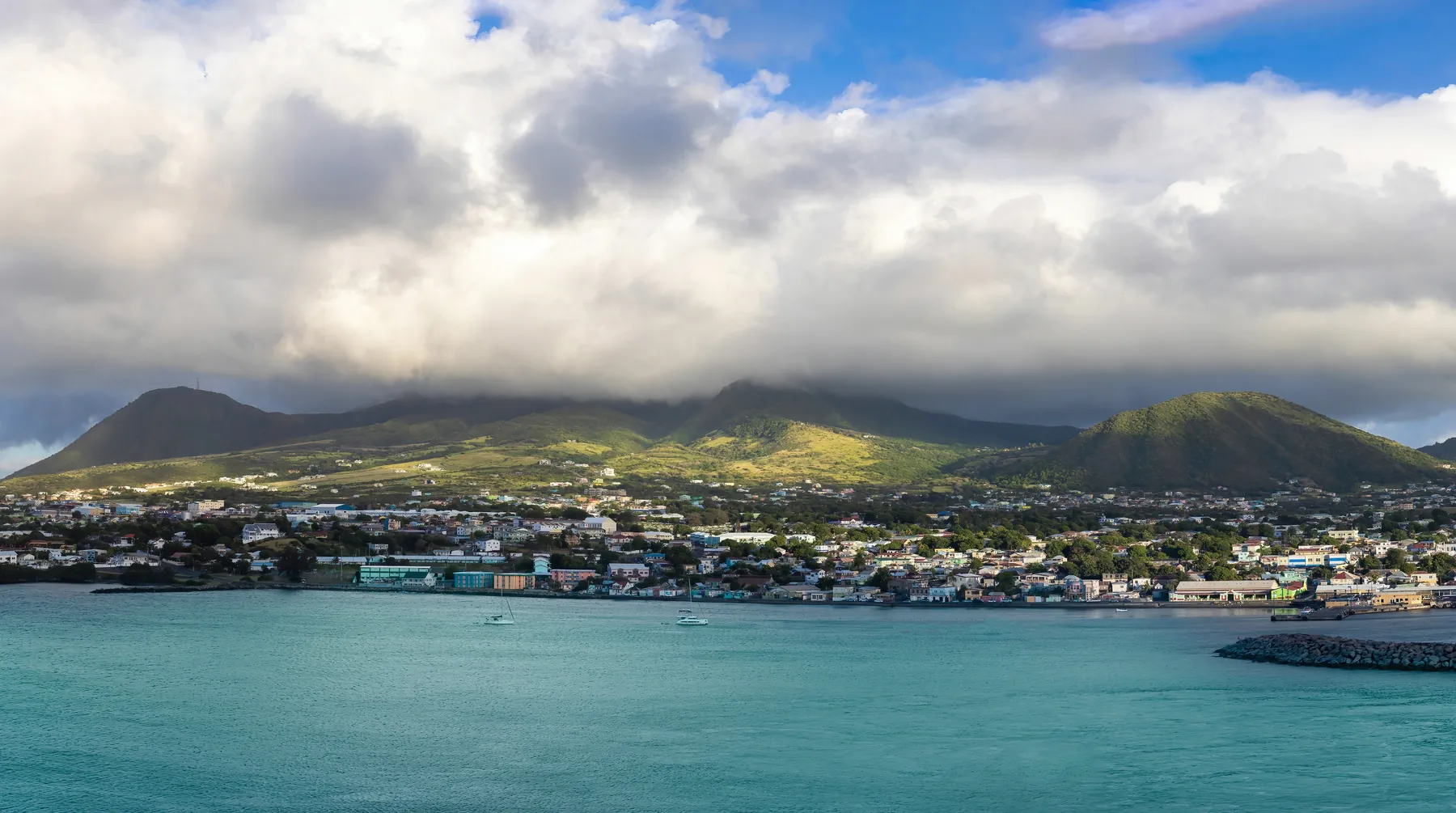
St Kitts and Nevis lies in the eastern Caribbean, in the Leeward Islands chain. According to the Tourism Authority, it is about 1,200 miles from Miami, 1,600 miles from New York and 4,000 miles from London. Puerto Rico is 55 minutes away by air, the US Virgin Islands 30 minutes. The nearest neighbours are Sint Eustatius and Saba to the north-west, Sint Maarten further north, Antigua to the east and Montserrat to the south-east.
The Federation consists of two islands. St Kitts is larger: about 68 square miles and roughly 40,000 residents, with Basseterre as the capital. Nevis is round, with a cloud-capped peak, and lies across the strait. There is no border control between the islands: enter on one and you move freely to the other. The official language is English, the currency is the Eastern Caribbean dollar, fixed at 2.70 to the US dollar, and US notes are accepted almost everywhere, though not coins. The time is four hours behind GMT, with no daylight saving.
How to fly in: nonstop flights from three countries and connections via neighbours
All international flights land at Robert Llewellyn Bradshaw International Airport, code SKB, which serves both islands. According to the Tourism Authority, nonstop flights operate from Atlanta, Miami, Charlotte, New York, Newark and Toronto, and there is a direct flight from London Gatwick. Carriers include American Airlines, British Airways, Air Canada, Delta, United and JetBlue. Schedules are seasonal, so check them on the airline's website.
From Europe and the Middle East it is easiest to fly via London, or via US hubs if you hold a US visa. The second option is a regional connection. Local airlines interCaribbean, Winair, Sunrise Airways, LIAT 20, Cape Air, Trans Anguilla and Sky High link St Kitts with neighbouring islands, so you can reach SKB via Antigua, Sint Maarten or Puerto Rico. The Makana fast ferry also runs from Sint Maarten, Saba and Sint Eustatius, docking at Port Zante in Basseterre on Mondays, Fridays and Saturdays.
Before departure you need an Electronic Travel Authorisation (eTA). It is required from everyone except citizens of the Organisation of Eastern Caribbean States. You can apply in the St Kitts and Nevis e-Border app or at knatravelform.kn up to 90 days before arrival. The fee is USD 17 per person, and the authorisation is valid for 90 days or until the passport expires. Whether you also need a visa depends on your nationality. Russia and St Kitts and Nevis have an agreement on mutual visa-free travel dated 21 September 2017. According to the consular department of the Russian Ministry of Foreign Affairs, it allows a stay of up to 90 days in every 180 without a visa. Do not confuse two things: a Russian citizen can visit the island as a tourist, but cannot apply for citizenship on a Russian passport.
The best time is December to April
St Kitts is warm all year, with an average temperature of about 27 degrees Celsius. The Tourism Authority recommends December to April, when the weather is steady and rain is scarce. The wet season runs from June to November, which is also the Atlantic hurricane season. Those who want fewer people and calmer rates can choose May or November.
If your trip falls at the end of the year, you will catch the island's biggest celebration. The Sugar Mas carnival this season runs from 11 December 2026 to 2 January 2027: parades, calypso and soca competitions, street parties. It is a vivid time for a family with children, but book accommodation for those dates early.
What to see in a week: from a UNESCO fortress to a volcano crater
Start with Brimstone Hill Fortress near Sandy Point. It is a UNESCO World Heritage Site and one of the best-preserved examples of 17th and 18th century military architecture in the Caribbean. The fortress was designed by the British and built by enslaved Africans, and the museum inside keeps that memory without embellishment. A visit takes two to three hours, and the view from the walls over the sea and neighbouring islands is worth it.
Next, Basseterre: Georgian streets, the Circus, and Port Zante with its cafes. The St. Kitts Scenic Railway, the last narrow-gauge railway in the Caribbean, takes three hours along the coast past the ruins of sugar plantations. In Old Road Town stands Romney Manor with its botanical garden and the Caribelle Batik workshop. From the Timothy Hill overlook you see the Atlantic and the Caribbean at once, and on the Atlantic coast lie the Black Rocks, solidified lava from the volcano.
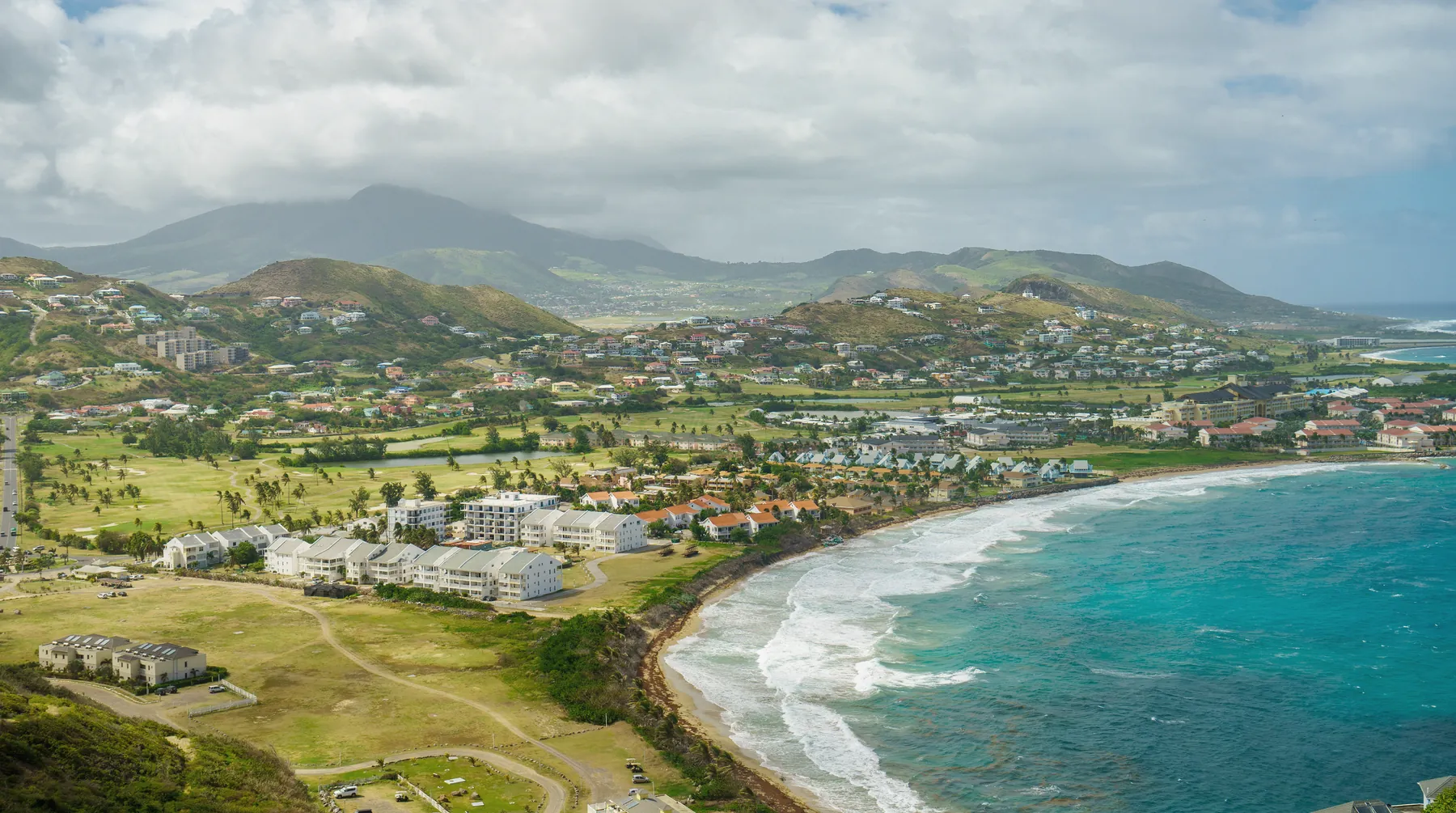
For the active. The climb up dormant Mount Liamuiga, 1,156 metres high, runs through rainforest to the crater and takes at least four hours there and back; go with a guide. On the former Wingfield Estate the Sky Safari zipline runs over the forest canopy. The beaches are on the south-east peninsula: Cockleshell Bay with views of Nevis and good snorkelling, quiet Banana Bay and Major's Bay, and South Friars Bay with its beach bars. In Frigate Bay, The Strip comes alive in the evening with local music.
Nevis deserves at least one full day. Passenger ferries run from Basseterre to Charlestown in 25-45 minutes, and a water taxi crosses the strait in 10-15 minutes. You can take a car on the car ferries from Major's Bay. On Nevis you will find Charlestown, the birthplace of Alexander Hamilton, one of the Founding Fathers of the United States, the long Pinney's Beach and the unhurried pace the island is proud of.
If you want a ready route, here is the week I recommend for a first trip. It is easy to squeeze into five days or stretch to two weeks.
- Day 1. Arrival, check-in, dinner on The Strip in Frigate Bay. No excursions: after a long flight it is better just to walk down to the sea.
- Day 2. Basseterre in the morning before the heat: the Circus, Georgian streets, Port Zante. A beach on the south-east peninsula in the afternoon.
- Day 3. The north of the island: Brimstone Hill Fortress, Romney Manor and the batik workshop, the Black Rocks on the Atlantic coast in the evening.
- Day 4. All of Nevis: the ferry to Charlestown, Hamilton's birthplace, lunch and sunset on Pinney's Beach.
- Day 5. Mount Liamuiga with a guide for the active, the scenic railway along the coast for a calmer day.
- Day 6. The sea: snorkelling at Cockleshell Bay, the zipline at Wingfield or a day by the pool.
- Day 7. A free morning, souvenirs, gathering proof of the trip into one folder, departure.
With children. The best spots for a family combine movement and history. Children of any age enjoy the railway: open carriages, the sea on one side and fields with the ruins of sugar mills on the other. Brimstone Hill Fortress has room to run and plenty to look at, and the ferry to Nevis is a small adventure in itself. For small children choose beaches with a gentle entry on the south-east peninsula and plan no more than one big outing a day: the island slows the pace by itself, and it is worth accepting that.
For business. Basseterre is the federation's business centre: ministries, banks, law firms and the Citizenship by Investment Unit are here. It makes sense to give one or two weekdays of the trip to meetings: with a bank if you want to open an account, with a lawyer, with a developer if you are choosing real estate. Seeing a development with your own eyes before buying is the most valuable thing a trip gives an investor. How this programme option works we covered in our piece on real estate in St Kitts. Book meetings in advance from home: on the island many decisions are made in person, but people's schedules are full.
Where to stay: Frigate Bay, Basseterre, the south-east peninsula or Nevis
St Kitts is small, about half an hour by car from Basseterre to the fortress in the north, but the character of its areas varies a lot. Your choice of base decides whether the trip feels like a resort, life in a small town or seclusion.
Frigate Bay. The most convenient option for a first trip. A narrow isthmus between the Atlantic and the Caribbean Sea, ten minutes from the airport and from Basseterre. Here you find resort hotels, apartments, a golf course and The Strip with bars and music in the evening. It is easiest for a family with children: everything is close, and the water on the Caribbean side is calm.
Basseterre. A town for those who are not travelling only to rest. Small hotels and guesthouses, apartments, every office within walking distance. There is no beach in the centre, but you see the island's everyday life: the market, the buses, schoolchildren in uniform. A good choice for the days when meetings are planned.
The south-east peninsula. Quiet, bays and views of Nevis. Christophe Harbour has an upscale resort, villas and a yacht marina, with Cockleshell Bay and Major's Bay beaches nearby. People come here for seclusion, and a car is a must.
The north of St Kitts. Former sugar estates turned into small hotels with gardens and history. This is for those who value atmosphere over beach facilities.
Nevis. Quieter and more intimate than its neighbour. Hotels in old plantation estates on the slopes, a resort on Pinney's Beach, villas. Nevis is a good place for the second half of a long trip, when you want peace.
For a long stay of two weeks or more, an apartment or a villa is more convenient: your own kitchen, space for children, a desk. I deliberately give no prices. I found no official statistics on accommodation costs for visitors on the federation's tourism websites, and figures from listings change from season to season. The guide is simple: the highest prices and the strongest demand fall in the dry season and over the end-of-year carnival, while in May and November the choice is wider and calmer.
What this means for you. For a first trip choose Frigate Bay, for meetings Basseterre, for peace the south-east peninsula or Nevis. On a long trip it is convenient to change base halfway.
How to plan your days on the island
The government has not yet published how many days St Kitts will require. Neighbouring Grenada offers a yardstick: its 2026 bill sets 30 days within the first five years of citizenship, with each family member spending at least five days in the country in the first year, and the days need not be consecutive. That text is not in force yet either, and a detailed review across the five countries is in our piece on the 30-day requirement in the Caribbean. For St Kitts I use this figure only as a sense of scale: to see what life with such a requirement might look like.
And it looks rather pleasant. Thirty days in five years is six days a year, one winter holiday. These days can be gathered in very different ways, and there is no right one: there is the one that suits your family.
| Option | What it looks like | Who it suits | What to think about in advance |
|---|---|---|---|
| A week every year | 6-7 days once a year, usually over the winter holidays | families with school-age children and those who fly to a warm sea every year anyway | more flights, but the island quickly becomes familiar and proof of trips builds up by itself |
| Two trips of two weeks | for example in the first and third year, 14-15 days each | people who work remotely and combine rest with business | enough time to live in two areas and on Nevis separately, and to deal with the bank and documents on weekdays |
| One long winter stay | a month or more in the dry season, December to March | people with flexible schedules, entrepreneurs, families with pre-school children | a month's accommodation is booked early, especially over carnival; if the rule requires each family member to come in the first year, one winter stay later may not be enough |
| A short visit, then a holiday | 3-4 days for biometrics and a first look, then a full trip | new applicants who enrol biometrics on the island | biometrics on the island is booked only after approval in principle and through an authorised agent |
My advice is to make the first trip in the first year after the passport is issued, with the whole family, even if it is short. First, if the rule turns out similar to Grenada's, it is the first year that will require everyone's presence. Second, the first trip shows how to build the rest: some fall in love with Nevis and come back for a month, others find it easier to come for a week every winter.
What is worth doing with any option: keep boarding passes, check the entry and exit stamps in your passport, keep accommodation bookings and receipts. If the requirement is introduced, the way to prove presence will be published with it, and a tidy folder of trips will spare you unnecessary questions. To Russian citizens without another citizenship I will say it honestly: you can visit the island as a tourist, but the programme does not accept applications on a Russian passport; details are in our piece on St Kitts citizenship for Russians.
How many days to allow and how to combine the trip with citizenship matters
While the number of days is unpublished, I suggest planning from the purpose. To get to know the country, allow a week: two days for Basseterre and the north of the island, a day for the south-east beaches, a day for Nevis, a day for the volcano or the sea, plus a margin for flights. If the government introduces a day-count requirement, such a trip can be repeated or extended, and the first one will already tell you where it is convenient to stay.
The trip is easy to combine with citizenship matters. Biometrics can be enrolled on St Kitts itself: a new applicant books after approval in principle through an authorised agent, and the process takes 15-30 minutes. The interview is held by video, on the island or at an approved location abroad, so it too can be scheduled during the trip if that suits the family. Good bases are Frigate Bay, Christophe Harbour or the plantation inns in the north.
Check the terms on your filing date
Before signing a contract, check the investment options and Government Notices sections on ciu.gov.kn. If residency rules appear there, they outweigh any retelling.
Choose a travel window
The dry season from December to April, or the calmer months of May and November. Check school holidays and public holidays.
Get an eTA and check the visa
Apply in the e-Border app or at knatravelform.kn. Separately confirm whether each family member needs a visa on their passport.
Link the trip to biometrics
If you are a new applicant, book biometrics on the island after approval in principle. Booking goes only through the official platform and an authorised agent.
Keep proof of the trip
Boarding passes, entry stamps, accommodation bookings. If a residency requirement is introduced, such documents will help show presence.
For families with children I would add three things. Enrolment centres register children according to age standards, so the whole family usually travels, which fits well with school holidays. For small children choose the calm beaches of the south-east peninsula and hotels with airport transfers. Leave the volcano climb to teenagers and adults; younger children will enjoy the railway, the fortress and the ferry to Nevis more. On registering children and parents, see the article on St Kitts citizenship for families.
Who does not need to rush now, and who the programme will not suit
There is no need to rush for those who have already applied or plan to apply on the current terms. The Unit promised stakeholders time and clear guidance before any change, and today the programme runs without mandatory residence. There is no reason to change plans urgently because of rumours about "30 days".
There is a flip side too. If it is essential for you to get a second passport without a single trip and without new obligations after receiving it, the Caribbean as a whole is moving away from that model, and so is St Kitts. If you are a citizen of Russia or Belarus with no other nationality, the programme does not currently accept your application at all, and waiting for residency rules makes no sense.
We will plan your trip to St Kitts together with biometrics
Tell us who is travelling, from which country and which months suit you. We will suggest a window for biometrics and the interview and the entry documents you need.
What remains unknown, and what to watch
Four things are unknown: how many days must be spent on the islands, from what date the rule will apply, whether it will affect those who applied earlier, and how presence will be proven. It is also unclear which investment options will remain after the announced move away from passive contributions. There are no official answers to these questions.
Three points are worth watching. The Government Notices section on ciu.gov.kn: the latest instrument published there is dated October 2024, and a new regulation on residency will appear there. SKNIS reports on parliamentary sittings and the Prime Minister's budget address at the end of the year. And the announcement of the start date for the regulator ECCIRA, which the countries must agree and communicate officially.
Before you choose a programme we carry out a programme and risk review, and we prepare the origin of funds for the application as part of source-of-funds support.
How this piece was prepared
Sources were checked on 21 October 2026. Citizenship by Investment Unit, ciu.gov.kn: news of 26 June 2025 and 12 July 2025, the Chairman's update of December 2025, the investment options, eligibility criteria, biometrics and Government Notices pages, and news of 28 September 2026 and 1 October 2026. Government news service SKNIS, sknis.gov.kn: reports of 25 September 2025, 8 January 2026 and 27 February 2026. St Kitts Tourism Authority, visitstkitts.kn, and Nevis Tourism Authority, nevisisland.com: flights, ferries, eTA, season, sights. UNESCO World Heritage Centre: description of Brimstone Hill Fortress. Russian Ministry of Foreign Affairs: notice on the entry into force of the visa-free travel agreement and the consular department's note on visa-free travel, kdmid.ru. The Grenada Citizenship by Investment (Amendment) Bill 2026 on the Grenada parliament website: the yardstick of 30 days in five years. Accommodation prices are not given: we found no official data on them. The official Antigua programme website cip.gov.ag did not open during the check. This is not a legal opinion; programme and entry terms change, so check official websites before applying and travelling.
Frequently asked
Questions people ask before deciding
01Do I have to live on St Kitts now to get citizenship?
No. As of 21 October 2026 there is no mandatory residence: the Unit's investment options page says so. The requirement has been announced for the future, but the number of days and the start date have not been published.
02Is it true that a 30-day rule already applies on St Kitts?
No official document confirms it. The 30-day figure relates to Antigua and to regional rules under discussion. On 28 September 2026 the St Kitts Unit asked partners not to assume dates or terms.
03Will the requirement affect those applying now?
That is unknown. The Unit promised stakeholders lead time and clear guidance before any start and said there would be no sudden shifts. Plan an application now on the current terms and check the Unit's website on the contract date.
04Can I enrol biometrics on the island itself?
Yes. There is an enrolment centre on St Kitts, as well as centres abroad, for example in Dubai, Istanbul and London. A new applicant books after approval in principle through an authorised agent.
05Do I need a visa to fly to St Kitts?
Everyone except citizens of the Organisation of Eastern Caribbean States needs an Electronic Travel Authorisation (eTA), with a USD 17 fee. Whether a visa is needed depends on nationality. Russia and St Kitts and Nevis have a visa-free travel agreement from 2017.
06When is the best time to fly to St Kitts?
December to April: dry and warm. May and November are quieter. June to November is the wet season and the Atlantic hurricane season.
About the author
Related materials
What to read next
 ArticlePros of St. Kitts citizenship in 2026: how a passport is useful
 ComparisonMalta, Türkiye or St. Kitts: which passport gives more visa-free travel in 2026
 AnalysisWhat is due diligence and why the Caribbean is rejecting applications
Personal programme selection is conducted by Anna Kovalevskaya, Head of Legal, BRIDGES.
We will assess St Kitts citizenship for your situation
Tell us your nationality, your family members and your timing. We will tell you which terms apply on your filing date and how to plan a trip to the island.
