Residency · Cyprus
How to maintain permanent residence in Cyprus in 2026: conditions for maintaining status

Updated: June 2026·11 min read·Expert reviewed
Terms and costs verified: June 2026
Contents
Cyprus permanent residence under Regulation 6(2) is issued for life - and many people calm down after receiving the card. In vain: the status is indefinite, but not unconditional. To prevent it from being cancelled, the holder must comply with a set of simple but strict rules - and the main one is not about language or residence. We'll look at what exactly needs to be done to make the card work for decades, what is possible (for example, renting out housing), and what is not possible without the risk of losing EU residency.
The main rule: visit Cyprus once every 2 years
Permanent residence permit of Cyprus, issued according to program Regulation 6(2), is issued indefinitely. This is its strong point: unlike temporary residence permits, the card does not need to be renewed annually, the collection of documents and proof of income are not required. But “indefinitely” does not mean “forever under any circumstances.” Status has one key condition for maintaining it, and the easiest way to violate it is through inattention.
The main rule is simple: the permanent residence permit holder is obliged to visit Cyprus at least once every two years. It is enough to physically enter the island - formally, even one day is enough. No one counts how many hours you spent on the premises; The very fact of crossing the border and the entry stamp is important. This rule is enshrined in immigration law and applies specifically to those permanent residence holders who have received investor status and permanently live outside of Cyprus.
The mirror wording of the same condition sounds harsher and is important to remember: you cannot be absent from Cyprus for more than two years in a row. If more than two years have passed between two visits, the basis for cancellation of status arises automatically - the Ministry of Internal Affairs has the right to revoke the card. Therefore, in practice, we recommend that clients plan a trip at least once every year and a half, leaving a reserve in case of illness, force majeure or border closures.
We will calculate the budget for your family
A full estimate: contributions, fees and our work for your family.
Full list of status maintenance conditions
A visit every two years is the main, but not the only obligation. For permanent residence to remain in force, the holder must simultaneously fulfill several conditions. They logically follow from the basis on which the status was obtained: investment in real estate plus stable foreign income. If any of these pillars disappears, the authorities have a formal reason to reconsider the status.
- Visit to the island. Minimum one entry every two years. Absence for more than two years is grounds for cancellation.
- Preservation of real estate. The object on the basis of which permanent residence was issued must, as a rule, be kept in ownership. Selling without replacing it with an equivalent asset puts the status at risk.
- Income retention. The applicant must continue to have guaranteed income from abroad at the level of program requirements (from 50,000 euros basic plus family allowances).
- Clean reputation. No criminal record and threat to public order - the condition remains for the entire duration of the status, and not just at the time of application.
- Valid health insurance. The policy for the applicant and family members must remain current.
In practice, the authorities do not monitor compliance with these conditions on a daily basis. The check occurs at characteristic moments: when updating a card, when changing family composition, when applying for the next status or citizenship. That is why it is better to maintain compliance with the conditions constantly, and not to “tighten up” in a hurry before a visit to the migration service. We discuss in detail the basic requirements for the program itself in a separate guide on the conditions for obtaining permanent residence in Cyprus.
Is it necessary to preserve the property?
This is the question that is asked most often: “I bought an apartment, received permanent residence - can I sell it?” The short answer is that the base object generally needs to be owned for as long as you want to maintain the status. Real estate here is not a one-time entrance ticket, but a permanent confirmation that the investment connection with Cyprus is not severed.
The logic of the regulator is this: permanent residence is issued for a specific investment. As long as the property is your property and meets the threshold (from 300,000 euros plus VAT for new-build housing first sale, or a commercial property as option B), the basis of the status is preserved. As soon as the object is sold and is not replaced by anything, the original basis disappears - and the Ministry of Internal Affairs has the right to raise the issue of cancellation. This does not happen instantly or automatically, but the risk is real and should not be underestimated.
A practical conclusion follows from this: real estate for permanent residence should be treated as a long-term asset, and not as a speculative transaction “bought, received a card, sold.” If a family's plans change, the issue is resolved not by selling it outright, but by carefully replacing the property. We discuss the subtleties of choosing and holding an object in the material about real estate for permanent residence in Cyprus.
Is it possible to rent out the property?
Yes - and this is one of the pleasant features of Cypriot permanent residence. The law does not require that you live in the purchased apartment or even come to it. The property can be rented out for a long-term lease and receive passive income, while the fact of renting out does not harm the status in any way: the main thing is that the property remains your property and continues to be the basis for permanent residence.
There are two nuances here, and both are tax, not migration. First: rental income in Cyprus is taxed on a progressive scale of income tax, as well as a defense contribution for tax residents - so the rental scheme should be calculated together with a tax consultant. Second: if you are calculating foreign income to maintain status, income from Cypriot rentals is usually not counted towards this 50,000 euros - the program requires income from sources outside Cyprus. That is, Cyprus rent is a pleasant bonus to the property’s profitability, but not a replacement for the required foreign income.
Separately, we note short-term rentals through sites like Airbnb: in Cyprus, there is mandatory registration of the property in the registry and tax rules. This is not prohibited, but requires registration. If the goal is to quietly hold the asset and receive rent, a long-term lease agreement is simpler and more predictable.
What will happen when selling the property: the main nuance
Selling real estate is the most common way to accidentally lose permanent residence. Since the object is the basis of the status, its sale without preparation breaks the very investment connection on which the permit rests. Formally, after such a transaction, the Ministry of Internal Affairs has the right to review and cancel the status.
But this does not mean that real estate can never be sold. There is a correct way: replacing the asset. If you want to exit one property and enter another, the correct sequence is to first purchase a new suitable property of equal or greater value, which itself meets the requirements of the program, and only then part with the old one. In this case, the basis of the status is not interrupted for a day: the previous investment is immediately replaced by a new one.
It is the “hole” that is dangerous - the period when the old object has already been sold, but the new one has not yet been sold. Therefore, any restructuring of the real estate portfolio for permanent residence must be planned in advance and preferably accompanied legally so that the transition goes smoothly. This is a case where the sequence of steps is more important than the steps themselves: if you make a mistake in the order of actions, you can lose your status even if you maintain an equivalent investment.
We will find the right basis for residency in Cyprus
We calculate the budget and timing for your family and list the documents you need.
What is NOT required to maintain permanent residence
Cypriot permanent residence is valued precisely for what it does not contain. Many holders, out of habit from other programs, are afraid of requirements that actually do not exist. Let's list what NOT to do to sleep peacefully:
- Permanent residence is not required. You are not required to live in Cyprus. You can live anywhere in the world and come to the island only once every two years.
- There is no minimum number of days per year. There is no rule to “live N days in a year.” The only time guideline is not to miss a visit longer than two years.
- No language needed. The Greek language exam (level B1) is required only for naturalization into citizenship, but not for maintaining permanent residence.
- There are no integration tests. There is no need to take exams on knowledge of history, culture or laws.
- There is no annual renewal. The status is indefinite; it does not need to be renewed every year, like a temporary residence permit.
It is this minimalism that makes the program convenient for those who want an “alternate airfield” in the EU without the obligation to move there. We have collected a complete list of benefits of status in the review advantages of permanent residence in Cyprus.
Renewal of permanent residence card: status unlimited, document - no
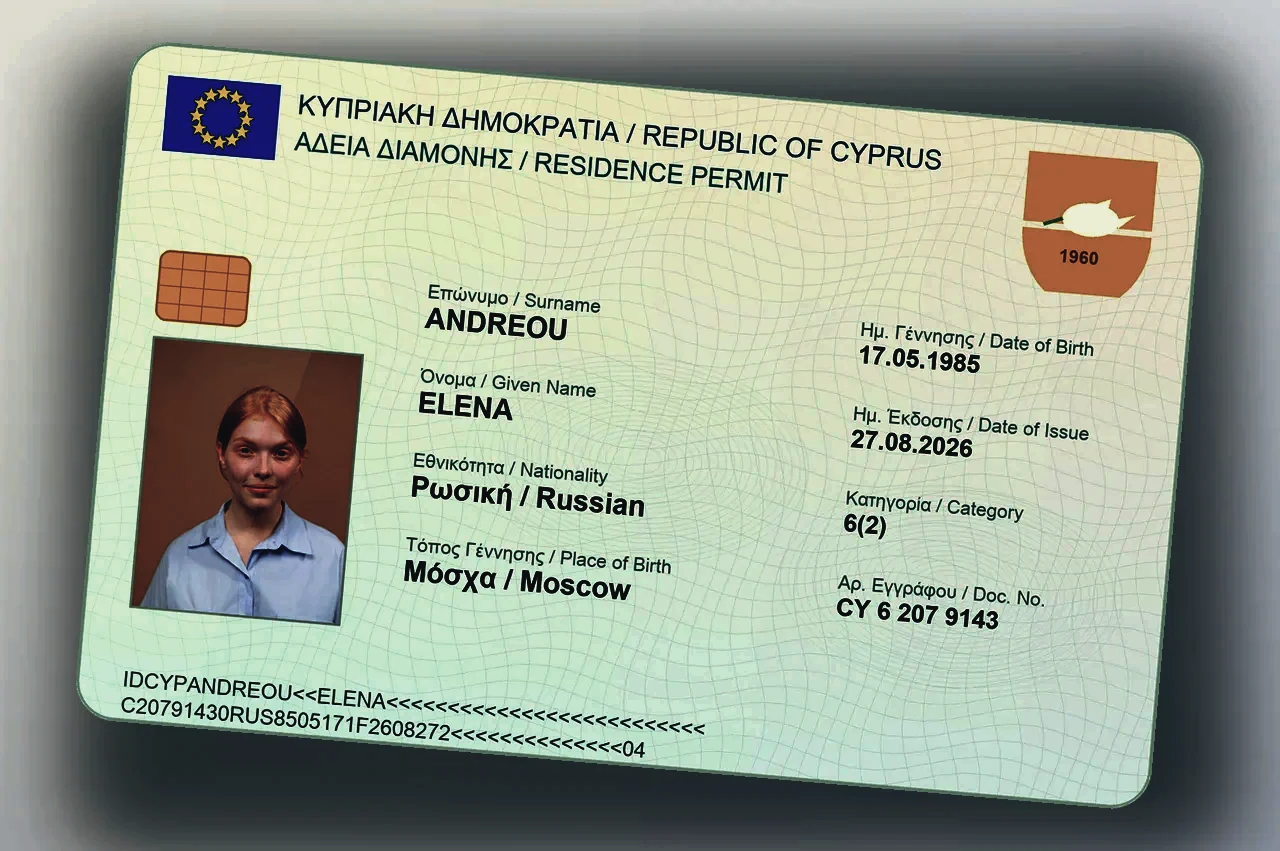
It is important here to separate two concepts that are often confused. The legal status of permanent residence itself is indefinite: it does not “expire” by date. But a plastic card (a physical document confirming status) may require updating. This is a normal technical procedure and has nothing to do with loss of status.
The card is updated in typical cases: when personal data changes (new passport, change of surname), when the plastic is worn out or lost, and also if required by migration rules based on the validity period of a specific document. Separately, it is worth keeping in mind the situation with a long absence: if the holder leaves Cyprus for a long time and then re-establishes contact with the island, the document may require re-issuance. Updating the card in itself is a formality, but you shouldn’t delay it so that you always have a valid document on hand for banks, border crossings and status confirmation.
Practical advice: Check the date on the card and the status of personal data at least once a year and plan ahead for an update visit if necessary. It is convenient to combine document updating with a mandatory “control” visit to the island - this way one trip solves two tasks at once.
How does permanent residence affect tax residency?
This is perhaps the main misunderstanding around Cypriot permanent residence. Many people think: “I have received permanent residence, which means I have become a Cypriot tax resident and I pay taxes in Cyprus.” This is wrong. Immigration status and tax residency are two completely different things that are determined by different rules and do not follow from one another.
Permanent residence is the right to live in Cyprus and enter the island. A visit every two years is enough to maintain this status, but absolutely not enough to become a tax resident of Cyprus. Tax residence is determined separately and requires actual presence:
- Rule 183 days. If you spend more than 183 days in Cyprus in a calendar year, you automatically become a tax resident for that year.
- 60 day rule. You can become a tax resident by spending only 60 days a year on the island, subject to additional conditions: doing business or working in Cyprus, having permanent residence and not having tax residence in another country for the same year. Since 2026, the last condition has been softened - it is no longer necessary to prove the absence of residence in another country for the 60-day rule.
The conclusion is simple: a permanent residence permit holder who comes once every two years remains a tax resident of his country of residence, and not of Cyprus. If the goal is Cyprus tax residency with its benefits (zero tax on dividends for non-dom, no inheritance tax), you need to consciously select days of presence. This greatly simplifies permanent residence, but does not automatically make you a tax resident.
“The most common reason why a client risks losing Cypriot permanent residence is not at all complex legal subtleties, but a simply missed visit. The status is indefinite, and the person relaxes: he received the card, went about his business, and after a little over two years he remembers the island. I advise you to treat your biennial visit as a hard deadline and come with a reserve. The second most common is the hasty sale of real estate: the object here is not a one-time ticket, but a permanent basis of status, and it must be sold only through a pre-arranged replacement with an equivalent asset. And the third thing I remind everyone of: permanent residence and tax residency are two different things. A visit every two years retains your status, but does not make you a tax resident of Cyprus.”
Table of responsibilities of a permanent residence permit holder
Let’s summarize all the conditions for maintaining status in one table - it’s more convenient to keep in mind what needs to be done and with what frequency, and what the consequences of violating each point are.
| Duty | Periodicity | Consequence of violation |
|---|---|---|
| Visit to Cyprus | at least once every 2 years | grounds for revocation of status |
| Preservation of the property | constantly | risk of permanent residence permit revocation when selling without replacement |
| Maintaining overseas income | constantly | review of status upon loss of income |
| Valid health insurance | constantly | claims during verification and updating |
| Clean reputation (no criminal record) | constantly | cancellation of status |
| Updating a map (document) | as needed / when changing data | lack of a valid document |
Please note: most responsibilities must be performed on an ongoing basis, not just once. The only condition with a clear frequency is a visit every two years. Everything else is maintaining the state in which the status was issued.
Frequent mistakes that cause you to lose your status
Over the years of practice, we have seen a set of typical situations in which Cyprus permanent residence holders risked their status - almost always through negligence, and not because of a real problem. Knowing these pitfalls saves nerves and money.
- “Forgot to come.” The most common. The man received the card, went about his business, and after more than two years remembered the obligatory visit. It is treated with a calendar reminder and a trip once every year and a half.
- Hasty sale of real estate. They sold the property for the sake of a profitable deal without arranging for a replacement - and exposed the basis of the status. Solved by pre-planned replacement of the asset.
- Disappearance of income. If a business or source of passive income has been closed, or no longer meets the threshold, questions arise during verification.
- Expired document. The status is valid, but the card is outdated or the data on it is irrelevant - and difficulties begin at the bank or at the border.
- Tax confusion. Not the loss of status itself, but an expensive mistake: a person considers himself a Cypriot tax resident without accruing days, and does his tax planning incorrectly.
Almost all of these mistakes have one thing in common: they arise not because of the strictness of the rules, but because of inattention to simple responsibilities. Systematic control of dates and assets eliminates 90% of risks.
What about the status of family members?
Cyprus permanent residence applies to the family of the main applicant: spouse and dependent children under 25 years of age. The logical question is whether the same conditions for maintaining status apply to them. In general, yes: family members are tied to the status of the main applicant, and as long as he complies with his obligations (keeps real estate, income, comes once every two years), their status is maintained.
Growing children require special attention. The child's status as a dependent is valid as long as he meets age and other dependency criteria. When a child outgrows the threshold (25 years) or ceases to be a dependent - for example, begins to work and live independently - his situation must be reviewed in advance. This is not a “loss” in a negative sense, but a natural transition: a matured child, if desired, formalizes his own status.
It is also important for each family member to comply with a visit to the island once every two years and maintain a valid document. In practice, families arrive together, so that the control visit is completed by one common trip. If the composition of the family changes (marriage, birth of a child, divorce), this is a reason to update documents and check how the changes affect everyone’s status.
When authorities check compliance with conditions
Cyprus does not conduct daily monitoring of each permanent residence permit holder - the migration service does not have the resource to track in real time who arrived and when. But this is no reason to relax: compliance checks arise at predictable moments, and you need to approach them prepared.
Typical control points: updating or replacing a card, changing family composition, applying for the next immigration status or citizenship, as well as any application to government authorities where the status is confirmed. At these points, you may be asked to confirm that the property is still owned, income is maintained, insurance is valid, and visits to the island have been made. The entry stamps in the international passport are your main argument here, so it is better to keep old passports with stamps.
It’s also worth knowing about the protection tool. If the holder's case has been delayed or unfairly decided by the Ministry of Internal Affairs, the applicant has the right to a pre-trial claim (Legal Notice) addressed to the Minister. This is a legal way to speed up a pending case or challenge an unreasonable refusal before going to court. In practice, a well-drafted claim often resolves the problem without lengthy proceedings. Publishes current administrative requirements official portal of the Republic of Cyprus gov.cyandMinistry of Interior of Cyprus.
Cyprus and Schengen permanent residence: an important fair disclaimer
Since we are talking about maintaining and using status, it is important to speak about Schengen - there are many myths around this. Cyprus is a full member of the European Union, but is not yet part of the Schengen area. This means that the Cyprus permanent residence card itself does not provide the right to visa-free travel within Schengen countries in the same way as a residence permit from a Schengen member state would.
In practice, to travel to Schengen, a Cyprus permanent residence holder still relies on the visa regime of his citizenship: if you, for example, have a passport of a country that requires a Schengen visa, Cyprus permanent residence does not cancel it. At the same time, you, as a permanent residence holder, do not need a visa to enter Cyprus itself - you enter the island freely.
We deliberately focus on this, because unscrupulous software sellers sometimes promise “a free Europe on the map of Cyprus.” This is not true, and making plans based on false expectations means one day facing a problem at the border. Cyprus provides strong EU resident status, a basis for future citizenship and a comfortable life on the island - but the Schengen issue must be assessed soberly, based on your current citizenship.
We will send a document checklist for your case
Leave your details: we will put together documents and timelines for your family.
A simple plan to avoid losing permanent residence
Let's summarize everything that has been said into a practical algorithm. If you follow these steps, your EU resident status will work for you for decades without any surprises.
- Keep a calendar of visits. Plan a trip to Cyprus once every year and a half - with a margin of up to the critical two years. Keep your passports with entry stamps.
- Hold the object. Don't sell your foundation property impulsively. Plan any portfolio restructuring by replacing an asset of equal or greater value.
- Keep track of your income and insurance. Maintain your foreign income at the required level and renew your medical policy for the whole family.
- Check the document. Once a year, check the date and data on the card, plan the update in advance and combine it with a follow-up visit.
- Separate status and taxes. Remember: permanent residence does not automatically make you a tax resident. For Cyprus tax residence, enter 183 or 60 days consciously.
If you want to delegate control over the status and not keep it all in your head - contact BRIDGES GLOBAL specialists: we guide the client after receiving the card, remind them about visits, help with updating documents and replacing assets so that the status is not interrupted. Full description of the program is on the page Cyprus permanent residence by investment.
- Cypriot permanent residence vs Cypriot citizenship: what to choose
- Cyprus Permanent Residency Law: Regulation 6(2)
- Northern Cyprus Citizenship (TRNC): what yes
- How much does Cyprus citizenship cost
- Cyprus permanent residence or Turkish residence permit: what to choose
- Investing in Cyprus real estate: guide
Frequently asked
Questions people ask before deciding
01How often do you need to come to Cyprus to maintain permanent residence?
At least once every two years. It is enough to physically enter the island; formally, even one day is enough. The main thing is not to allow a gap between visits longer than two years, otherwise there will be grounds for cancellation of status.
02What happens if I don’t come to Cyprus for more than two years?
Absence from the island for more than two years in a row is a formal basis for revocation of permanent residence. The Ministry of Internal Affairs has the right to cancel the card. This does not always happen instantly, but the risk is real, so you should not skip the visit.
03Do I need to live permanently in Cyprus to maintain my status?
No. Permanent residence is not required. You can live in any country in the world and come to Cyprus only once every two years. There is no minimum number of days per year to maintain permanent residence.
04Do I need to keep the purchased property?
As a rule, yes. The object on the basis of which permanent residence has been issued must usually remain in ownership for the entire duration of the status. Selling without replacement with an equivalent asset puts the status at risk of revocation.
05Is it possible to rent out real estate with permanent residence?
Yes, you can rent out your home; this does not harm your status - the property remains your property. Rental income is subject to tax in Cyprus. Please note: income from Cypriot rentals is usually not counted towards the required foreign income.
06What happens if I sell a property?
The sale of the underlying object without preparation breaks the investment connection and gives the authorities the right to reconsider the status. The correct way is to first purchase a new suitable object of equal or greater value, and only then sell the old one.
07Is knowledge of the Greek language required to maintain permanent residence?
No. The language exam (level B1) is only required for naturalization into Cypriot citizenship. To obtain and maintain permanent residence, a language is not required, nor are integration tests.
08Do I need to renew my permanent residence status every year?
The status itself is indefinite and does not expire; it does not need to be renewed annually. Only the physical card may require updating - when personal data changes, the document wears out, or due to migration rules.
09Is it difficult to update your permanent residence card?
No, this is a technical formality. The card is updated when the passport or last name is changed, the plastic wears out, and also if the rules require it. It is convenient to combine the update with a mandatory visit to the island - one trip completes both tasks.
10Does permanent residence make me a tax resident of Cyprus?
No. Immigration status and tax residency are two different things. A visit every two years is enough to maintain permanent residence, but not enough for tax residency. For it you need to spend 183 days on the island or 60 days if additional conditions are met.
11Does Cyprus permanent residence permit visa-free entry into Schengen?
By itself - no. Cyprus is part of the EU, but not yet the Schengen area, so the permanent residence card does not cancel the visa regime for your citizenship for Schengen countries. As a permanent residence holder, you can enter Cyprus itself freely.
12Do my family members still have permanent residence?
Yes, the status of the spouse and dependent children under 25 years of age is tied to the status of the main applicant and continues as long as he fulfills his obligations. It is also important for each family member to comply with the biennial visit and keep the document current.
Transparency
How this material was prepared
- Author
- Anna Kovalevskaya, head of Legal, BRIDGES
- Terms and costs last verified
- June 2026
- Sources
- official government authorities of the relevant country and state publications
- Methodology
- government minimum requirements are stated separately from due diligence charges, state fees, legal and banking costs
Sources and methodology
Figures, terms and timelines are checked against official sources as of June 2026. Link availability verified in August 2026. Third-party blogs and agent websites are not used as a source of programme terms.
- [1]Ministry of Interior of the Republic of CyprusResidence conditions and statuses for foreign nationalswww.moi.gov.cy/moi/moi.nsf/index_en/index_en
- [2]Cyprus Tax DepartmentTax residency and rateswww.mof.gov.cy/mof/tax/taxdep.nsf/index_en/index_en
Methodology: tables and charts state government minimum investment requirements; due diligence charges, state fees, legal, banking and other costs are calculated separately and are not included in the minimum thresholds.
About the author
Related materials
What to read next
 ArticleCyprus citizenship by descent: right of blood in 2026
 ComparisonNorthern and Southern Cyprus: Key Differences and Where to Buy Real Estate in 2026
 AnalysisWhat is due diligence and why the Caribbean is rejecting applications
Residency in Cyprus: timelines and requirements
Grounds, document list, presence requirements and what is needed for renewal.