BRIDGES Insights · Thailand
Thailand cuts visa-free stays to 30 days: what changed for Russians and how to stay longer

Updated: October 2026·14 min read·Expert reviewed
Terms and costs verified: October 2026
Contents
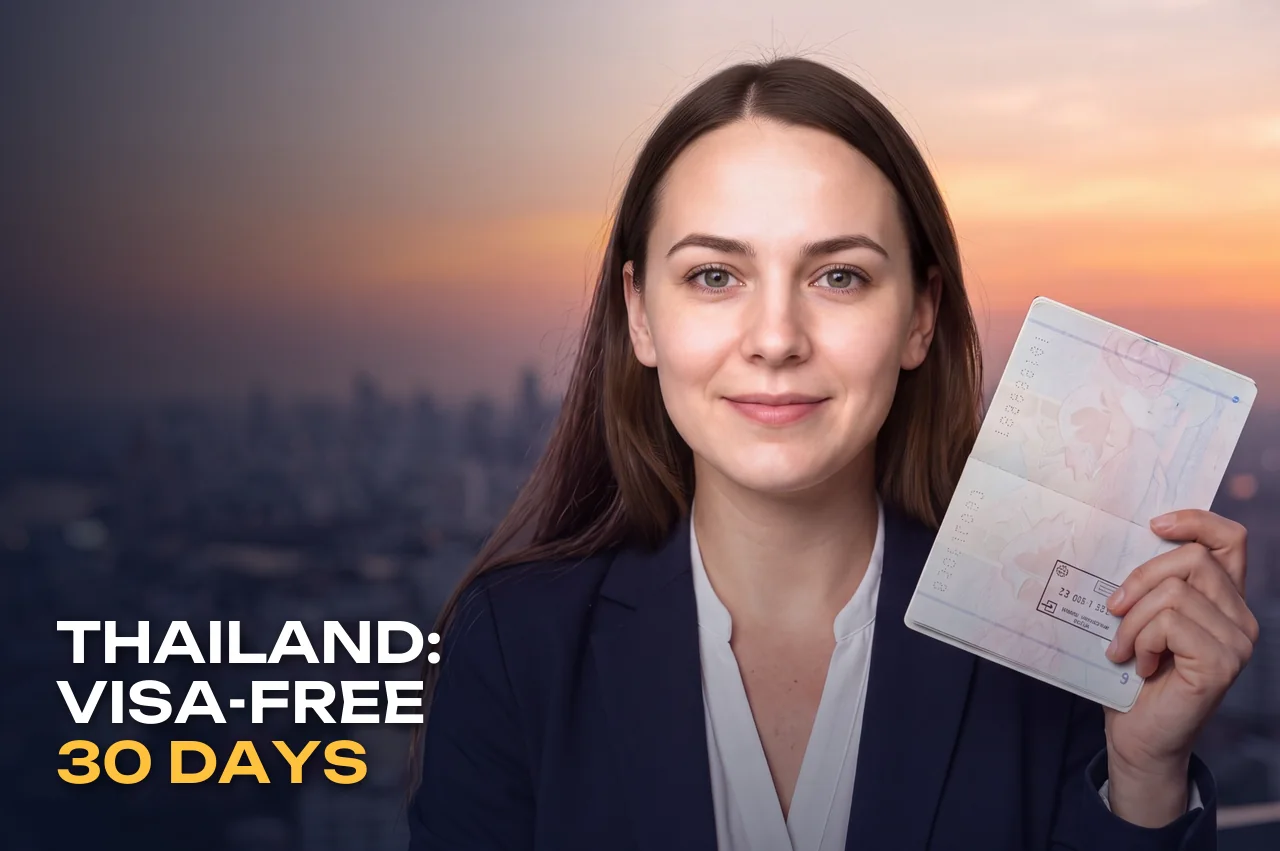
Since 15 September 2026 Thailand admits tourists without a visa for 30 days instead of 60. This is no longer a plan or a debate: the Interior Ministry notifications were published in the Royal Gazette on 31 August and have been in force for a month. The rule affects Russian citizens directly, though on a different legal basis than Europeans. Below I break down what changed, how to extend your stay now and which visa to choose if you are going for the winter, to work from Thailand or for good. Remote workers should look first at the DTV visa for Thailand.
In brief
- The decision has been taken and applies from 15 September 2026. The 60-day visa exemption in place since 15 July 2024 has been revoked.
- The new exemption is 30 days and for tourism only. The list covers 60 countries and territories instead of 93.
- Russia is not on that list: Russians enter visa-free for 30 days under a bilateral agreement. In practice their stay was also cut from 60 to 30 days.
- The stay can be extended once, by up to 30 days, at an immigration office. The fee is THB 1,900 and the decision is at the officer's discretion.
- Anyone who entered before 15 September with a 60-day stamp keeps that period.
- For longer stays there remain the tourist visa, the 5-year DTV, the retirement visa, the 10-year LTR and Thailand Privilege membership.
What changed on 15 September
The Thai government revised the whole visa-free entry regime, not only the length of stay. The cabinet approved the idea on 19 May 2026, approved the draft documents with amendments on 14 July, and on 26 August they were signed by the Prime Minister and the Minister of Interior. On 31 August four Interior Ministry notifications appeared in the Royal Gazette and took effect 15 days later, on 15 September.
The first notification revoked the 60-day exemption of 15 July 2024. The second introduced a new 30-day exemption for nationals of 60 countries and territories: all EU states, the UK, the US, Canada, Australia, Japan, India, the UAE, Turkey, Georgia, Ukraine and others. The third added visa on arrival for Azerbaijan, Belarus and Serbia. The fourth introduced a 15-day exemption for Seychelles and Mauritius.
What the exemption is for also matters. The old scheme allowed tourism, short business trips and urgent work. The new one, according to the notification, allows entry for tourism. Some Thai embassies also mention short business trips in their announcements, but work without a visa is clearly excluded. Whether the urgent work permit of up to 15 days can still be used after visa-free entry has not yet been clarified by the Thai Department of Employment.
There is also a limit for land borders: visa-free entry through a land checkpoint is allowed no more than twice per calendar year. Nationals of Malaysia, Brunei, Indonesia and Singapore are exempt. The government named its reasons plainly: fighting fraud, illegal work and transnational crime.
- 15.07.202460-day visa-free entry for 93 countries and territories, Russia included
- 19.05.2026Cabinet approves the return to 30 days
- 14.07.2026Cabinet approves the draft Interior Ministry notifications with amendments
- 31.08.2026Four Interior Ministry notifications published in the Royal Gazette
- 31.08.2026New DTV application rules: apply by nationality or place of residence
- 15.09.2026New rules in force: 30 days, tourism only, 60 countries
Thai Ministry of Foreign Affairs, Royal Thai Government Gazette, Thai embassies
What this means for you. If you go to Thailand on holiday for two or three weeks, almost nothing has changed for you. If you lived there for half a year on visa-free entries with border runs, that approach no longer works.
Does it affect Russian citizens
It does, but by its own logic. Russia was among the 93 countries of the old 60-day exemption. It was not included in the new 30-day list because Russians have a separate basis: the 2005 intergovernmental agreement between Russia and Thailand on waiving visa formalities. Under it a Russian citizen with an ordinary passport may enter, leave and stay in Thailand without a visa for up to 30 days.
Both sides confirmed this. The consular department of the Russian Foreign Ministry stated that from 15 September the terms of the 2005 agreement apply to Russians and the visa-free stay does not exceed 30 days. The Director-General of the Consular Affairs Department of the Thai Foreign Ministry, Mangkorn Pratoomkaew, answering a question from a Russian state news agency, confirmed that Russians keep 30 days under the agreement and may apply to the Immigration Bureau if they want to stay longer.
The Russian ambassador to Thailand recalled the background: a few years ago Thailand unilaterally gave Russians up to 90 days, then 60, and has now returned to the period in the agreement. For a tourist this means 30 days is not a temporary measure but the baseline, independent of the Thai cabinet's mood. Thailand granted the extensions beyond the agreement on its own and withdrew them on its own.
One question remains open. The "two land entries a year" limit is written into the notification on the unilateral exemption. Whether it applies to Russians entering under the agreement has not been officially clarified. I would assume a border officer may ask about frequent entries in any case, and would not build a plan on back-and-forth trips via Laos or Cambodia.
For Russians choosing a country to winter in or move to without a visa, we gathered the options in the review where to move from Russia without a visa. Thailand stays on it, now with a one-month caveat.
- Visa-free per entry30 dayswas 60 until 14 September 2026
- Extensionup to 30 daysat an immigration office, THB 1,900
- In force from15.09.2026by date of entry
- Basis for Russiaagreementbilateral, 30 days
Thai Ministry of Foreign Affairs, Russian MFA consular department, Thai Immigration Bureau
Has the decision been taken
It has, and it is in force. In spring and summer 2026 it was reported as a plan: the cabinet decision of 19 May still required Interior Ministry notifications, and the start date moved several times. Now the documents are published, and border officers give 30 days to everyone entering from 15 September 2026.
The transition rule is simple: the date of entry counts. If you entered on 14 September and got a 60-day stamp, you keep that period until the date in the stamp or the electronic record. It will not be cut retroactively. If you left and came back after 15 September, the new entry gives 30 days.
I also checked the TDAC arrival card. It has been mandatory for all foreigners since 1 May 2025, Russians and children included. It is filled in online no earlier than three days before arrival. The new visa-free rules did not abolish it.
What this means for you. Do not wait for a reversal or softening. The decision has passed every stage, and the baseline for Russians is fixed by an agreement, not a temporary concession.
How to extend a visa-free stay
Extension works as before. You go to an immigration office before the stamp expires, file form TM.7 with your passport, a photo and, as a rule, an onward ticket. The fee is THB 1,900. The extension is granted once, for up to 30 days. The decision rests with the officer: if they suspect you are working or living in the country permanently, they may refuse.
I worked out what this means in days. Before, a Russian got 60 days on entry and could extend by another 30: 90 days in total for one entry and one fee. Now it is 30 days plus a 30-day extension, 60 days. To spend four months in Thailand you need two entries, two extensions and an exit in the middle. Fees come to THB 3,800, plus tickets, plus the risk of questions from the border officer on the second entry.
The cost of a mistake has risen. Overstaying in Thailand carries a fine of THB 500 per day, capped at THB 20,000. A long overstay leads to an entry ban. With a 30-day period it is much easier to get the dates wrong than with 60, especially if you landed at night and the stamp runs from the arrival date.
How this looks for a family choosing between Thailand and the Emirates for the winter is shown in the comparison UAE or Thailand in 2026.
What this means for you. On visa-free entry you can comfortably stay up to two months. Anything longer is better arranged with a visa before you travel than assembled from border runs.
We will find the right visa for a long stay in Thailand
Tell us how long you are going for, whether with family, and what you will be doing. We will tell you which visa fits and which documents to gather.
Which visas remain
I put into a table the grounds on which a Russian can live in Thailand for longer than a month. All visas are now filed through the e-Visa system: Thailand moved all its consulates to it from 1 January 2025.
| Basis | Stay per entry | What you need | Who it suits |
|---|---|---|---|
| Visa-free under the agreement | 30 days + extension up to 30 | passport, onward ticket, TDAC card | holidays up to two months |
| Tourist visa TR | 60 days + extension up to 30 | application through e-Visa before travel | wintering up to three months |
| DTV | 180 days + extension up to 180, 5-year visa | THB 500,000 in the account, a basis, police certificate | remote workers, courses, sport, treatment |
| Retirement Non-O | up to a year with extension | age 50+, THB 800,000 or income of THB 65,000 a month | retirees |
| LTR | 10 years (5 + 5) | income from USD 80,000 a year or assets from USD 1m | wealthy, professionals, retirees |
| Thailand Privilege | 5-20 years | membership fee from THB 900,000 (Gold tier) | those who want no income proof |
The short rule of choice is this. A winter of two or three months - the tourist visa. Half a year or more, if you work remotely or study - DTV. Age 50 or over and money in the account - the retirement visa. Significant capital or high income - LTR. No wish to gather income certificates - Thailand Privilege.
How Thailand compares with other countries for remote work is covered in the review of the top 10 countries for digital nomads in 2026.
DTV: a five-year visa
The Destination Thailand Visa appeared at the same time as the 60-day exemption, on 15 July 2024, and outlived it. It is a 5-year multiple-entry visa. Each entry gives 180 days, which can be extended locally by another 180. The fee is THB 10,000. The main financial condition is a balance of THB 500,000 in your account. It is not a payment to the state: the money remains yours.
There are two bases. The first is remote work for foreign employers or clients: you need a contract or client agreements. The second is "soft power" programmes: Thai boxing, cooking courses, medical treatment, study. There is no age limit, and a spouse and children are processed as dependants.
Since 31 August 2026 filing has become stricter. According to Thai embassies, the application must be filed at the consulate of your country of citizenship or permanent residence, not at any convenient one. A police clearance certificate and proof of residence in the country of filing have been added. For a Russian staying in Thailand visa-free this means "popping over to Laos to get a DTV" no longer works unless you live in Laos. You must apply from Russia or from a country where you hold a residence permit.
Terms, the document package and the funds calculation are set out on the page DTV in Thailand, in the DTV visa guide and in the article on the digital nomad visa in Thailand. Where to start if you are only moving to remote work is in the piece on how to become a digital nomad.
What this means for you. If you plan to winter in Thailand several years in a row, a DTV for THB 10,000 is cheaper and calmer than assembling visa-free stays from exits and extensions every winter.
LTR: ten years for capital and income
The Long-Term Resident Visa is issued by the Thailand Board of Investment. It runs for 10 years: first 5, then another 5 if the conditions are still met. The fee is THB 50,000 per person. Instead of reporting every 90 days, you report once a year. A spouse and up to four dependants are processed together with the main applicant.
There are four categories. Wealthy global citizen: assets of at least USD 1 million and at least USD 500,000 already invested in Thailand in government bonds, a Thai company or property. Wealthy pensioner aged 50+: passive income of at least USD 80,000 a year, or at least USD 40,000 plus an investment of USD 250,000. Work-from-Thailand professional: income of at least USD 80,000 a year over the past two years and an employer with revenue of at least USD 50 million over three years. Highly skilled professional in targeted industries.
The advantages of LTR: overseas income is exempt from tax, and highly skilled professionals pay 17% on income in Thailand. The drawback is the high threshold: this visa is for those who genuinely move capital to Thailand or earn well above average.
Thailand Privilege: membership instead of certificates
Thailand Privilege is the former Thailand Elite. It is not an investment but a paid membership: you pay once and receive a visa for the whole membership term without proof of income. According to the programme operator as of August 2026, the Gold tier costs THB 900,000 for 5 years, Platinum THB 1,500,000 for 10 years, Diamond THB 2,500,000 for 15 years, and Reserve THB 5,000,000 for 20 years, by invitation only.
The most affordable Bronze tier at THB 650,000 for 5 years was introduced as temporary. Sources differ on the deadline for applications, so before applying I would check its status with the operator directly. The money is not refunded, and once the term ends the membership must be bought again at the new price.
If you are over 50
Retirees have a separate Non-Immigrant O visa based on age. The conditions: age 50 or over and either THB 800,000 in a Thai bank account, or confirmed income of at least THB 65,000 a month, or a combination. The visa is extended for a year inside the country, without exits.
This is the least expensive route to a long life in Thailand, but it requires discipline: the account balance is checked, and you must notify immigration of your address every 90 days. Details are on the page Thailand retirement visa and in the review of where a Russian pensioner can relocate.
What to do depending on your goal
- A holiday of up to 30 days. Change nothing: a passport valid for at least six months, an onward ticket, the TDAC card three days before arrival.
- A trip of 31-60 days. Fly visa-free and plan your immigration office visit in advance: a 30-day extension, THB 1,900, filed before the stamp expires.
- A winter of 2-3 months. Get a tourist visa through e-Visa before the trip. It gives 60 days on entry and another 30 by extension.
- Half a year or longer with remote work. Apply for DTV from Russia or a country where you hold residence. Keep THB 500,000 in the account in advance, not on the day of filing.
- A family move with capital. Compare LTR and Thailand Privilege: the former is cheaper if you qualify by income or assets, the latter is simpler on documents.
- Buying a home. A visa is not granted for a flat in itself. Plan the purchase and the visa separately, and treat the flat as an investment.
What is happening now with Russian demand for homes in Thailand can be seen in our analysis of purchases in the third quarter of 2026.
Common mistakes
The first mistake is assuming 60 days were kept for Russians because of the agreement. No: the agreement gives exactly 30 days. Sixty was a unilateral Thai concession, withdrawn for everyone.
The second is counting on a "border run". Leaving for a neighbouring country and re-entering formally gives a new 30 days, but the border officer sees repeated entries in the database. Being refused entry at the border costs more than any visa: you lose tickets, accommodation and time.
The third is working on visa-free entry. The new exemption is tied directly to tourism. Even remote work for a foreign employer formally requires a suitable visa, and that is what DTV is for.
The fourth is applying for DTV from Thailand via neighbouring countries. Since 31 August 2026 consulates accept applications by citizenship or place of residence. A trip to Phnom Penh or Vientiane without residence there will end with the documents being refused. How visa requirements look in neighbouring countries for holders of other passports is covered using the example of visa-free Asia with a Vanuatu passport.
What this means for you. The most expensive mistake under the new exemption is getting the date wrong. Set a reminder for a week before the stamp expires on the day you land.
My conclusion
Thailand is not closing to Russians. It is returning to the rules that applied before 2023: a month without a visa for rest, and proper visas for everyone who wants to live there longer. The decision has been taken, published and is in force, and there is no point waiting for it to be reversed.
For a two-week tourist the change is invisible. For those who wintered for half a year visa-free with border runs, it is a signal to switch to a visa. I advise choosing by length of stay: up to two months - visa-free with an extension, up to three - a tourist visa, beyond that - DTV, the retirement visa or LTR. If in doubt, write to us: we will find a visa for your period and your family.
How this piece was prepared
This piece is based on the Thai Ministry of Foreign Affairs announcements on the revision of the visa exemption and visa on arrival schemes from 15 September 2026, the Thai Interior Ministry notifications in the Royal Gazette of 31 August 2026, statements by Thai embassies, statements by the consular department of the Russian Foreign Ministry and the Russian ambassador to Thailand, the answer of the Consular Affairs Department of the Thai Foreign Ministry to a Russian state news agency, and the rules of the Thai Immigration Bureau, the Thailand Board of Investment on the LTR visa and the Thailand Privilege operator. Data checked as at 16 October 2026. This is not legal advice on a specific trip.
Frequently asked
Questions people ask before deciding
01How many days can a Russian stay in Thailand without a visa?
Since 15 September 2026, 30 days under the 2005 bilateral agreement between Russia and Thailand. It can be extended once, by up to 30 days, at an immigration office.
02Is the decision in force or only a plan?
It is in force. The Thai Interior Ministry notifications were published in the Royal Gazette on 31 August 2026 and took effect on 15 September 2026.
03What if I entered before 15 September with a 60-day stamp?
You keep the period until the date in the stamp. The new 30 days apply to entries from 15 September 2026.
04How much does a visa-free extension cost?
The fee is THB 1,900. You must apply before the stamp expires, and the immigration officer decides.
05What is the overstay fine?
THB 500 for each day of overstay, capped at THB 20,000. A long overstay leads to an entry ban.
06Can I work remotely on visa-free entry?
The new exemption is granted for tourism. For remote work there is the 5-year DTV visa with stays of up to 180 days per entry.
07Can I get a DTV while in Thailand?
Since 31 August 2026 the application is filed at the consulate of your country of citizenship or permanent residence. You cannot apply via a neighbouring country without residence there.
About the author
Related materials
What to read next
 ArticleThe digital nomad visa in Thailand: the LTR Visa in 2026 — terms and how to apply
 ComparisonAntigua and Barbuda or Grenada: Family Passport for Large Families in 2026
 AnalysisWhat is due diligence and why the Caribbean is rejecting applications
Personal programme selection is conducted by Anna Kovalevskaya, Head of Legal, BRIDGES.
We will find the right visa for living in Thailand
Tell us your period, family size and source of income. We will compare DTV, the retirement visa, LTR and Privilege for your case.
