Updated 09.10.2026
 Legal structures · Private foundations
A private foundation in Panama the classic model at an accessible price
The Panamanian private interest foundation is copied from the Liechtenstein model — the same organs, the same principle, but many times cheaper. A working instrument for succession and for consolidating assets when European jurisdictions are unavailable or excessive.
- We speak plainly about the reputational constraints of the jurisdiction
- We line up the bank in advance — that is the bottleneck for Panamanian structures
- We prepare the source-of-funds file before the establishment
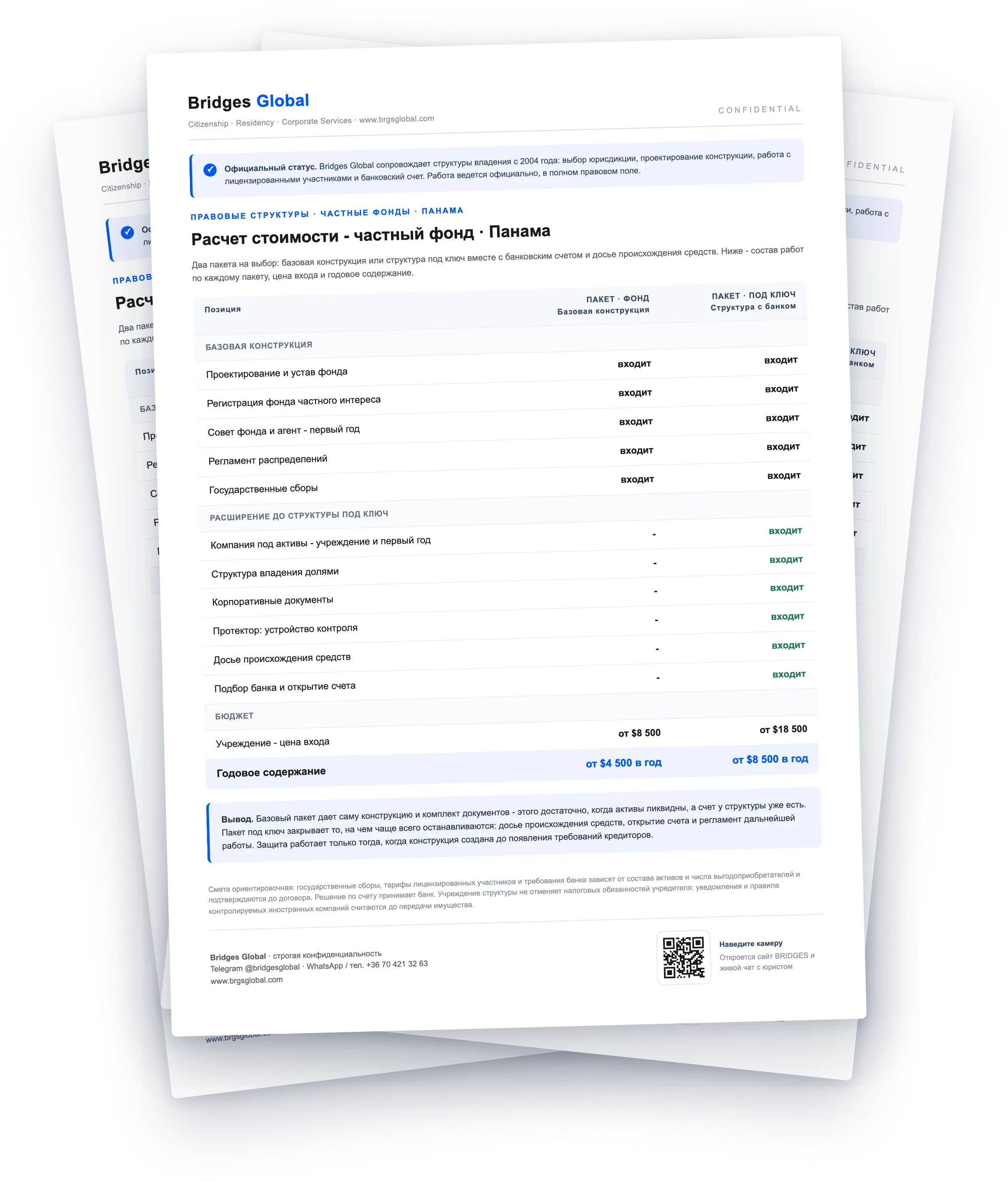
The guide figures depend on the composition of the assets, the number of beneficiaries and the bank’s requirements. The exact quotation for the set-up and the annual upkeep is fixed before the agreement.
Applicability
Is Panama the right structure for your task
01 Main purpose
02 Assets
03 Beneficiaries
04 Bank account needed
The selector does not give a legal opinion: applicability is confirmed after the analysis of assets, family and tax residence.
The structure
What a Panamanian foundation is
A Fundación de Interés Privado is a legal person without members, created on the model of the Liechtenstein foundation. It owns assets, distributes them under its charter and is run by a council. What differs from the prototype is the price and the reputation of the jurisdiction.
The charter, the council, the protector, the beneficiaries — the structure repeats the European model but costs three to four times less.
The assets pass under the foundation’s charter: inheritance procedures and disputes do not reach property that belongs to the foundation.
Registration takes two to three weeks — appreciably faster than European jurisdictions.
Unlike EU jurisdictions, Panama applies no sanctions restrictions by citizenship — where the origin of the capital is transparent.
Fit
Who a Panamanian foundation suits — and who it does not
A plain filter, reputational risks included.
- The task is succession planning on a moderate budget
- European jurisdictions are unavailable under the sanctions rules
- The assets are company shareholdings, accounts and portfolios outside Europe
- You need a quick and straightforward structure without long checks
- You are ready to settle the banking question in advance
- You need an account with a first-tier European bank: Panamanian structures are treated warily
- The priority is an impeccable reputation for the structure: look at Liechtenstein or Singapore
- The main task is protection from creditors: the Cook Islands and Nevis trusts are stronger
- A dispute has already begun: a late transfer can be set aside
Roles
The legal structure and the governing bodies
The civil-law model: the organs of a legal person instead of trust roles.
Transfers the assets and approves the charter. After the transfer they do not own them personally.
The governing body: decisions on the assets and the distributions strictly within the charter.
The controlling figure: approving key decisions, changing the composition of the council.
The family, the children, you yourself. They receive distributions under the charter; the names are not published.
Protection
The legal limits of using the structure
The strengths together with the limits — the reputational ones included.
The property belongs to the foundation: it does not form part of the founder’s estate and is not divided on divorce.
Capital passes under the foundation’s rules, bypassing the inheritance procedures of the founder’s country.
The structure is created quickly and costs appreciably less than its European counterparts.
The jurisdiction applies no sanctions restrictions by citizenship.
The limits we state plainly: the structure does not protect against claims that arose before the assets were transferred — such transfers can be set aside. It does not cancel the tax obligations of the founder and the beneficiaries and does not make assets invisible: the exchange of information and the duty to declare both operate. Criminal proceedings, sanctions regimes and maintenance lie beyond what any structure can do. Anyone who promises otherwise is misleading you. Separately, on reputation: Panama remains under the heightened attention of international organisations and of individual countries. In practice that means longer checks at banks and refusals by some European institutions to work with the structure. We say this before the work begins and line up the bank in advance rather than after the registration.
Prices
The options for the structure and the cost
The «from» prices are for a standard structure with a confirmed source of funds. The exact quotation is fixed by the agreement.
from $8,500
Annual upkeep: upkeep thereafter from $4,500 a year
Succession planning on a moderate budget
Included
- Design and the foundation charter
- Registration of the private interest foundation
- The foundation council and the agent — the first year
- The rules for distributions
- Government fees
from $12,500
Annual upkeep: upkeep thereafter from $6,500 a year
The assets are held by an underlying company
Included
- Everything in the «Foundation» package
- A company to hold the assets — formation and the first year
- The structure for holding the shareholdings
- The corporate documents
from $18,500
Annual upkeep: upkeep thereafter from $8,500 a year
The complete circuit with the banking question settled
Included
- Everything in the «Foundation + company» package
- The protector: the control arrangement
- The source-of-funds file
- Choosing the bank and opening the account
- The rules for distributions
The package does not include the bank’s own charges, legal work in the countries of the assets when real estate and shareholdings are transferred, or a professional controller if you want one.
What drives the quote
The factors that affect the cost of the project
The packages cover the standard tasks. Here is what moves the budget — and it is counted before the agreement, not after.
Accounts and portfolios are simple. Real estate and shareholdings require lawyers in the countries where they are held.
Every country of assets adds a check and the formalities of the transfer.
Capital from several sources over a long period takes longer to assemble.
Banks differ in what they require: for some the basic pack, for others an extended one.
If the account is needed with a demanding bank, the work on the file and the correspondence is greater.
In the quotation we separate our own fee, the administrator’s fees and the government charges. The total is fixed by the agreement — there are no charges beyond the quotation.
Cost of ownership
The cost of the structure over three years
A structure costs money not only when it is created: administration, reporting and bank compliance recur every year.
- Creating the structure and the documents
- Registration and government fees
- Opening the structure’s bank account
- The first year of administration
- Administration of the structure
- Reporting and mandatory notifications
- Bank compliance and the KYC refresh
- Support of distributions to beneficiaries
- Administration of the structure
- Reporting and mandatory notifications
- Bank compliance and the KYC refresh
- A review of the structure as circumstances change
What each year contains depends on the jurisdiction, the assets and the bank’s requirements. We prepare the three-year calculation together with the set-up quotation — before the agreement.
Tax
Taxation, reporting and disclosure
Panama applies the territorial principle: income from sources outside the country is not subject to local tax. Your own obligations are determined by your country of residence.
Income earned outside Panama is not subject to Panamanian tax. Domestic income is taxed under the general rules.
A foundation is a foreign structure: participation is declared, and where there is control the CFC rules apply.
Panama takes part in the automatic exchange: information on accounts goes to the beneficiaries’ country of residence.
A closed register is maintained with access for the competent authorities. There is no public search.
We do not build arrangements to conceal income and we do not work with funds whose origin is not evidenced by documents.
Banking
The banking infrastructure of the foundation
This is the main bottleneck of a Panamanian structure — we deal with it before the registration, not after.
The UAE, Hong Kong, Singapore and certain Latin American banks. European banks treat Panamanian structures with reserve.
Who the founder and the beneficiaries are, where the capital came from, why Panama in particular, whether there is any connection with the jurisdiction.
Because of the jurisdiction’s reputation the documentary requirements are above the usual: the chain has to be flawless.
We choose the bank before the foundation is established: first we confirm it is willing in principle, then we register.
A refusal by a bank is not the end: we work out the reason and go to the next one with the file corrected. No one guarantees approval, and neither do we.
Documents
Documents and information for the establishment
We assemble the pack once — the same pack goes to the administrator and to the bank.
- 01Personal documents Passports and proof of address: the founder, the foundation council, the beneficiaries.
- 02The source of the capital Sale agreements, bank statements, dividend resolutions, tax returns.
- 03The list of assets What is going into the foundation: accounts, portfolios, real estate, shareholdings — with the title documents.
- 04Tax residence The countries and the taxpayer numbers of every party: the notifications and the reporting depend on them.
- 05The rules for distributions Who receives funds, when and on what conditions — these rules go into the foundation’s charter.
- 06Current obligations Claims, debts, guarantees and disputes: they determine whether the protection works at all.
No documents are needed at the first consultation — we work through the task in words.
Comparison
Compare Panama with other structures
| Panama | |
|---|---|
| Setup | from $8,500 |
| Annual | upkeep thereafter from $4,500 a year |
| Timing | 2-3 weeks |
| Typical use | The task is succession planning on a moderate budget |
Select up to two jurisdictions above. A detailed legal comparison is prepared for the specific task.
Process
The stages of establishing the structure
From the review of the task to a finished structure with an account.
What is being consolidated or protected, who the beneficiaries are, whether there are current disputes. We say plainly whether the structure is needed at all.
1-2 daysThe charter, the organs, the rules for distributions, the controller’s powers, the composition of the assets to be transferred.
3-5 daysIdentity documents and source-of-funds evidence for the administrator and the bank.
1-2 weeksThe constitutive documents, the appointment of the officers, registration.
2-3 weeksMoving the assets into the structure with correct formalities in the countries where they are held.
Opening the structure’s account and setting the rules for the work that follows.
Comparison
Panama against the alternatives
The main parameters side by side, so that the choice is an informed one.
| Panama | UAE · RAK | Curaçao | Liechtenstein | |
|---|---|---|---|---|
| Form | Foundation | Foundation | Foundation | Foundation |
| Establishment | 2-3 weeks | 2-3 weeks | 3-4 weeks | 4-6 weeks |
| How banks treat it | With reserve | Well | Moderately | Excellently |
| Access for Russian citizens | Open | Open | Open | Only with EU residence |
| Cost from | $8,500 | $9,500 | $11,500 | $28,000 |
The comparison is as at the date the page was updated; whether it applies to your case is confirmed once the profile has been reviewed.
FAQ
Questions and answers
Legally the foundation works: the 1995 law has been applied for decades. But the jurisdiction’s reputation is lower than the European one, and that shows at the banks: the checks take longer and some European institutions will refuse to work with it. We say this before the work begins, not after.
The local administrators’ fees and the government charges are lower and the procedures are shorter. The saving is real, but it is partly offset by the effort at the banking stage.
Yes, the jurisdiction applies no sanctions restrictions by citizenship. There is one requirement and it is firm — a transparent and documented origin of the capital.
Panama takes part in the automatic CRS exchange. Data on the structure’s accounts goes to the beneficiaries’ country of tax residence — that is the norm, not a failure.
Technically yes, but we more often recommend banks in the UAE or Asia: they give better service and wider possibilities for international settlements.
From $4,500 a year: the foundation council, the agent, keeping the registration in good standing. With a company and an account it is higher. The exact figure is in the quotation before the agreement.
Calculation
Structure and budget: Panama
Describe the assets, the family and the task. We will come back with the applicable structure, the setup budget and the annual upkeep.
A structure does not cancel existing creditor claims or the tax obligations of the settlor. Where the task cannot be solved lawfully, we say so before the engagement.