Residency · Malta
Yacht registration in Malta: the Maltese flag, VAT leasing, and commercial charter

Updated: June 2026·11 min read·Expert reviewed
Terms and costs verified: June 2026
Contents
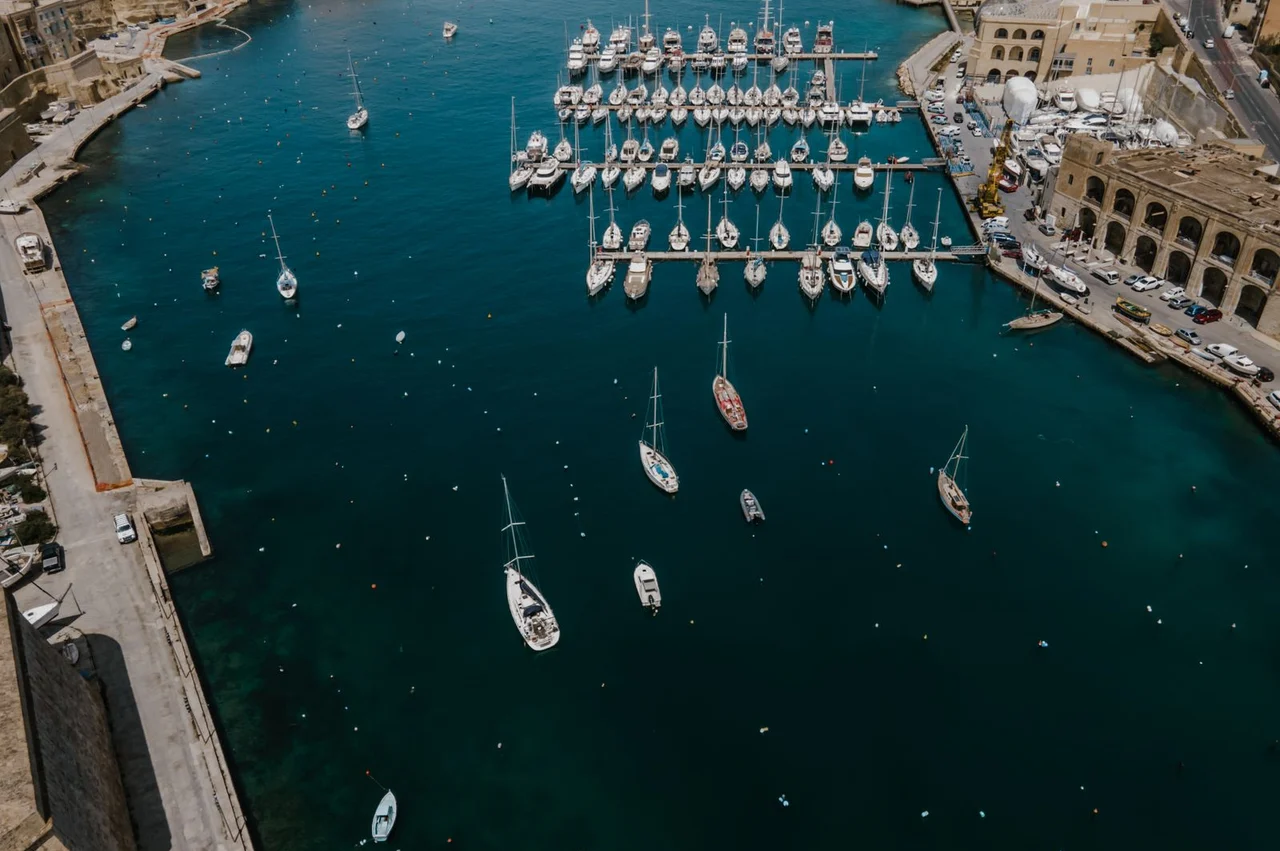
The Maltese flag long ago stopped being just a line on the stern. It's Europe's largest ship registry and one of the world's largest, on the Paris MoU white list, and a full EU flag. For a yacht or superyacht owner this means predictability, access to European ports with no extra checks, and a set of legal tax-efficiency tools - from the tonnage fee to the VAT leasing scheme. Below we break it down in order: how the Maltese flag differs for a vessel from others, how private and commercial yacht registration in Malta works, what the Commercial Yacht Code is, how yacht VAT leasing in Malta works in 2026, and what requirements are placed on the owner and company.
Why the Maltese flag is chosen for vessels more than others
When an owner compares flags, they look not at patriotism, but at three things: reputation, taxes, and ease of operation. Malta covers all three. It's a sovereign state, an EU and Schengen member, with the euro and English as an official language - meaning documents, correspondence, and legal practice are clear to an international owner with no translator.
Malta's registry is Europe's largest and one of the world's largest by tonnage, and for superyachts it confidently leads the EU. Behind this statistic lies mature infrastructure: banks, lawyers, classification societies, and surveyors who know Maltese rules by heart.
- An EU flag - the vessel is considered European in any port of the Union.
- The Paris MoU white list - port state control checks are less frequent and milder.
- There are no crew nationality restrictions - the captain and crew can be hired from any country.
- Free sale and mortgage of the vessel with no artificial barriers.
- Political, fiscal, and social stability.
In other words, a yacht carries the Maltese flag not for exotic appeal, but for peace of mind: predictable rules, recognized status, and a clear exit upon sale.
Private and commercial yacht registration in Malta: what's the difference
The first decision determining the whole subsequent structure - what you use the vessel for. Both the registration regime, taxes, and safety requirements depend on this.
Private (pleasure) registration- a yacht for the owner's and family's personal leisure. It can't be chartered for pay commercially. Equipment and certification requirements are softer, document flow simpler.
Commercial registration- the vessel is used to generate income: charter, corporate events, transporting no more than 12 passengers with no cargo. Here Malta's safety codes take effect, and access to tonnage taxation appears.
| Registration type | What for | The key feature |
|---|---|---|
| Private (pleasure) | Personal leisure, no paying guests | Simplified requirements, a VAT leasing option |
| Commercial under 24 m | Paid charter, up to 12 passengers | The sCYC code, the tonnage fee |
| Commercial from 24 m (a superyacht) | Chartering large vessels | The CYC code, annual surveys |
In practice many owners start with private registration, then convert the vessel to commercial status when they decide to earn through charter.
The Commercial Yacht Code: commercial yacht registration in Malta
Commercial yacht registration in Malta relies on two Transport Malta technical codes. They describe requirements for construction, safety, life-saving equipment, and crew - determining which passengers can be on board and where.
- Small Commercial Yacht Code (sCYC)- for vessels 12 to 24 meters long. The code's version has been updated in recent years for current standards.
- Commercial Yacht Code (CYC)- for vessels 24 meters and up. Launched back in 2006 and updated in 2025. Classic superyachts fall under it.
A yacht 15 meters or longer that carries no cargo, takes no more than 12 passengers on board, and is operated by the owner or the company owning it for commercial purposes is considered commercially registered.
After a successful initial survey, the vessel is issued a Certificate of Compliance (COC) for commercial operation, valid for 5 years. During this term, vessels over 24 meters undergo annual surveys - this is the price for the right to legally earn through charter under the EU flag.
How the procedure goes: from a provisional certificate to a permanent one
Maltese registration is structured in two stages, and this is convenient: the vessel can be flagged very quickly, and the paperwork finalized on the go.
- Provisional (temporary) registration.The vessel is entered into the registry for up to 6 months. A provisional certificate can be issued within 2-3 working days - this is exactly why Malta is often chosen for an urgent sale-purchase deal.
- Document collection.Within six months (the period is extendable by up to another 6 months total), documents on ownership, deregistration from the previous registry, vessel class, and insurance are filed.
- Permanent registration.After all documents and the survey are checked, the vessel gets a permanent certificate.
For commercial vessels, certification under the relevant code (sCYC or CYC) proceeds in parallel, with a five-year COC issued.
This two-stage scheme removes the buyer's main headache: no need to wait weeks to officially get the flag - first the flag, then calm arrangement of the rest.
We will find the right basis for residency in Malta
We calculate the budget and timing for your family and list the documents you need.
Requirements for the owner and company
Far from only a Maltese can register a vessel under the Maltese flag. The registry is open to a broad circle of owners, and this is one reason for its popularity with international owners.
- EU citizens and residents - directly as individuals.
- EU legal entities - companies registered within the Union.
- Foreign owners from non-EU countries - through a Maltese company, an EU-resident company, or another foreign company whose legal personality the Registrar recognizes.
In practice non-residents most often register the vessel to a Maltese company - convenient for management, taxes, and subsequent sale. The minimum issued share capital of such a company is roughly 1,200 euros, and the base cost of registering it is around 245 euros. More on the mechanics of Maltese structures - in our articleregistering a company in Malta.
Transport Malta's government fees start at around 115 euros and depend on gross tonnage, type, and age of the vessel.
A tonnage fee instead of profit tax
For commercial vessels Malta offers the tonnage tax regime - one of the key arguments in favor of the flag. Instead of regular profit tax, the shipowner pays a fixed fee calculated from the vessel's gross tonnage, not from profit earned through charter.
The economic sense is simple: the vessel's income isn't subject to corporate tax if it's operated by a Maltese shipping organization and falls under the regime. This makes the financial result predictable - the owner knows their tax burden in advance regardless of a good or weak charter season.
- The regime applies to vessels under the Maltese flag, and in some cases to vessels of other registries.
- The tonnage fee depends on the vessel's gross tonnage and age.
- The regime complies with EU requirements for state support of shipping.
The tonnage fee is about commercial operation. For a private yacht generating no income, a different tool takes center stage - VAT.
VAT leasing for a yacht in Malta: how the scheme works
The yacht VAT leasing scheme is Malta's yacht regime's calling card and the reason the VAT rate on a yacht can be made one of the lowest in the EU. The logic is built on the actual use principle (use and enjoyment): VAT is charged only on the part of the lease when the vessel was genuinely in EU territorial waters.
As a general rule, the VAT rate in Malta is 18%, and it applies when the place of service is in Malta. But if the vessel's actual use is factored in, VAT is charged only for time spent in EU waters. For the part when the yacht operated outside EU waters, no VAT is charged. The more the vessel sails outside the EU, the lower the effective rate.
How the mechanism works in practice:
- A Maltese company with a valid Maltese VAT number acts as the lessor.
- A yacht leasing agreement with usage conditions is concluded between the lessor and the lessee.
- The lessee - a non-taxable person (uses the vessel for personal purposes, not for business).
- The vessel is handed over to the lessee in Malta.
- The lessor keeps documentary and technical data on actual use - ship logs, GPS/AIS data.
- Once a year the lessor files a return with the Commissioner for Revenue.
An important caveat for 2026: the EU has tightened its approach to use-and-enjoyment schemes in recent years, so specific coefficients and the calculation procedure need to be checked against current rules before a deal. The base principle - VAT is paid only for time in EU waters - remains in effect.
Commercial charter under the Maltese flag
If the goal is to earn from chartering the vessel, commercial registration reveals its full potential. Under the Maltese flag you can legally conduct charter activity in EU waters, taking up to 12 paying passengers on board.
For chartering large vessels (24 meters and up) Malta has set separate rules: the vessel must comply with the Commercial Yacht Code, have a valid COC, a qualified crew, and insurance coverage for commercial risks. This isn't bureaucracy for its own sake - it's exactly compliance with the code that opens access to the legal European charter market and insurance at normal rates.
- Up to 12 passengers, no cargo transport.
- Compliance with sCYC or CYC depending on the vessel's length.
- The ability to apply the tonnage regime to charter income.
- Access to EU ports as a European vessel.
Commercial status and the tonnage fee work together: you get the right to earn through charter and a predictable tax burden on that income.
“The main mistake I see time and again is that the owner first buys the yacht, then comes for the flag and taxes. This is the reverse order. The Maltese regime is good exactly for its flexibility: the tonnage fee for charter, VAT leasing for a private vessel, a fast provisional flag for an urgent deal. But each of these tools needs to be built into the structure BEFORE the purchase and tailored to the vessel's specific routes and the family's plans. And separately on VAT leasing: the EU has noticeably tightened its approach to use-and-enjoyment calculations in recent years, so I always ask to double-check old pretty effective-rate figures against current rules. A well-designed structure isn't about minimum tax at any cost, but about transparency that will withstand bank compliance, an audit, and a future sale of the vessel.”
VAT leasing or the tonnage regime: which to choose
These two tools are often confused, though they solve different tasks. The choice depends on whether you earn on the vessel or use it for yourself.
| Parameter | VAT leasing | The tonnage tax regime |
|---|---|---|
| Who for | A private yacht, personal use | A commercial yacht, charter |
| Which tax it reduces | VAT on the vessel's value | Tax on charter profit |
| Calculation base | Time in EU waters | The vessel's gross tonnage |
| Result | A low effective VAT rate | A fixed, predictable fee |
Sometimes structures are combined, but there's no universal answer: it's given only by an analysis of the specific vessel, its routes, and the owner's plans. So the decision is better designed in advance, not adapted to a boat already bought.
Malta is more than a flag: residency and business
A yacht under the Maltese flag often becomes the owner's first contact with the jurisdiction - and then comes the realization that Malta addresses other family and capital tasks too. The registry operates within the same ecosystem as the island's residency and tax regimes.
- Malta permanent residency (MPRP)- a lifelong resident status for the family, a path to EU long-term resident status.
- Malta tax residency- the remittance basis regime and special programmes for wealthy individuals.
- Malta's corporate taxes- the imputation and refund system, an effective rate for foreign shareholders.
- Registering a company in Malta- a legal entity convenient for registering the vessel.
The flag + company + residency combination gives the owner a single, coherent perimeter: the vessel, the structure, and personal status don't conflict, but work toward a common result.
Common mistakes and risks
Most problems with the Maltese flag arise not from the registry itself, but from hasty decisions on shore. Here's what most often costs owners money and nerves.
- The wrong regime from the start.A private yacht can't be chartered for pay - this is a violation that surfaces at the first check.
- Calculating VAT leasing without factoring in EU changes.Old coefficients may no longer apply - the scheme needs to be built for the current 2026 rules.
- Weak documentation of use.Without ship logs and GPS/AIS data, the tax authority may not recognize time outside EU waters.
- Ignoring survey deadlines.An overdue annual survey for a vessel over 24 meters paralyzes charter.
- Sanctions risks.Owners from certain jurisdictions need enhanced compliance - more on this below.
Each of these mistakes is fixable at the planning stage and extremely costly after the fact.
What owners from Russia and Belarus should know
This question is asked most often, and the answer here is only a one. Malta is an EU jurisdiction, and it applies pan-European sanctions restrictions. After 2022, intake of a number of applications from citizens of Russia and Belarus under some programmes was restricted, and source-of-funds checks became stricter.
What this means in practice for yacht registration:
- All procedures remain strictly legal - no circumvention of sanctions.
- Enhanced compliance: the origin of the vessel and funds is checked more thoroughly.
- The ownership structure must be transparent and pass bank KYC.
- In certain cases restrictions are possible - they need to be checked individually.
We don't promise to bend the rules - we help build vessel ownership so it's transparent, passes checks, and doesn't create problems for the owner in the future.
An expert's word: how to design the structure in advance
The tax and regulatory side of the Maltese flag requires not a template, but an individual calculation. Below is a practitioner's view on where to start.
We will send a document checklist for your case
Leave your details: we will put together documents and timelines for your family.
Where to start: a step-by-step procedure
If you're just approaching the Maltese flag, the sensible route looks like this. It saves both time and money, because key decisions are made before the deal, not after.
- Determine the vessel's purpose- personal leisure or commercial charter. The whole subsequent design depends on this.
- Design the ownership structure- most often a Maltese company at the right stage.
- Choose the tax tool- VAT leasing for a private yacht or the tonnage regime for charter.
- Apply for provisional registration- the flag within 2-3 working days, documents are finalized afterward.
- Get certifiedunder sCYC or CYC, if the vessel is commercial.
- Obtain a permanent certificateand start operating.
Ready to discuss your yacht and select the optimal regime -contact us. Current Transport Malta requirements can always be checked onthe regulator's official website.
Frequently asked
Questions people ask before deciding
01Who can register a yacht under the Maltese flag?
EU citizens and companies - directly. Owners from non-EU countries register the vessel through a Maltese company, an EU-resident company, or another foreign company with legal personality recognized by the Registrar. Non-residents most often use a Maltese company.
02How long does yacht registration in Malta take?
A provisional (temporary) certificate can be issued within 2-3 working days. After that there's up to 6 months (extendable by another 6 total) to gather documents and move to permanent registration.
03What's the difference between private and commercial registration?
A private (pleasure) yacht - for personal leisure, it can't be chartered for pay, requirements are softer. Commercial - for income (charter up to 12 passengers), subject to the sCYC or CYC codes, and gives access to the tonnage regime.
04What is the Commercial Yacht Code?
This is Transport Malta's technical code for commercial yachts. sCYC applies to vessels 12-24 meters, CYC (launched in 2006, updated in 2025) - to vessels from 24 meters. After the survey a five-year Certificate of Compliance (COC) is issued.
05How does VAT leasing for a yacht in Malta work?
VAT is charged only on the part of the lease when the vessel was actually in EU waters (the use and enjoyment principle). No VAT is charged for time outside EU waters, so the effective rate can be one of the lowest in the EU.
06What VAT rate in Malta applies to a yacht?
The base rate is 18%. But through the leasing scheme, factoring in the vessel's actual use, the real (effective) rate drops proportionally to the time spent outside EU territorial waters.
07Have the VAT leasing rules changed in 2026?
The EU has tightened its approach to use-and-enjoyment schemes in recent years. The base principle (VAT only for time in EU waters) remains, but specific coefficients and the calculation procedure need to be checked against current rules before a deal.
08What is the tonnage fee, and who does it suit?
The tonnage regime replaces profit tax with a fixed fee based on the vessel's gross tonnage. It suits commercial yachts operated by a Maltese shipping organization and makes the tax burden predictable.
09Can commercial charter be conducted under the Maltese flag?
Yes. The vessel must be commercially registered, comply with sCYC or CYC, have a valid COC, a qualified crew, and insurance. Up to 12 paying passengers are allowed on board, with no cargo transport.
10How much does registration and maintenance cost?
Transport Malta's government fees start roughly at 115 euros and depend on the vessel's tonnage, type, and age. Costs for a Maltese company (capital around 1,200 euros) and annual surveys for commercial vessels over 24 meters are added.
11Can a yacht under the Maltese flag be mortgaged or sold?
Yes. The Maltese registry doesn't impose artificial restrictions on selling or mortgaging a registered vessel. This is one of the reasons the flag is convenient for deals and financing.
12Is registration available to owners from Russia and Belarus?
Malta applies EU sanctions restrictions, intake of a number of applications is restricted, and source-of-funds checks are stricter. All procedures remain strictly legal, with no circumvention of sanctions; enhanced compliance and a transparent ownership structure are needed. Each case is checked individually.
Transparency
How this material was prepared
- Author
- Robert Haas, corporate Lawyer, BRIDGES
- Terms and costs last verified
- June 2026
- Sources
- official government authorities of the relevant country and state publications
- Methodology
- government minimum requirements are stated separately from due diligence charges, state fees, legal and banking costs
Sources and methodology
Figures, terms and timelines are checked against official sources as of June 2026. Link availability verified in August 2026. Third-party blogs and agent websites are not used as a source of programme terms.
- [1]Identità MaltaResidence, citizenship and documentsidentita.gov.mt
Methodology: tables and charts state government minimum investment requirements; due diligence charges, state fees, legal, banking and other costs are calculated separately and are not included in the minimum thresholds.
About the author
Related materials
What to read next
 ArticleMaltese citizenship by descent: through parents, grandparents and roots
 ComparisonCitizenship of Cyprus or Malta in 2026: comparison of paths to an EU passport
 AnalysisWhat is due diligence and why the Caribbean is rejecting applications
Personal programme selection is conducted by Anna Kovalevskaya, Head of Legal, BRIDGES.
Tax residency in Malta: how it is determined
When tax residency arises, how double taxation is avoided and what the tax authority checks.