BRIDGES Insights · Portugal
Portugal: 690,000 citizenship applications await a decision as the queue grows 38% in a year
Updated: October 2026·11 min read·Expert reviewed
Terms and costs verified: October 2026
Contents
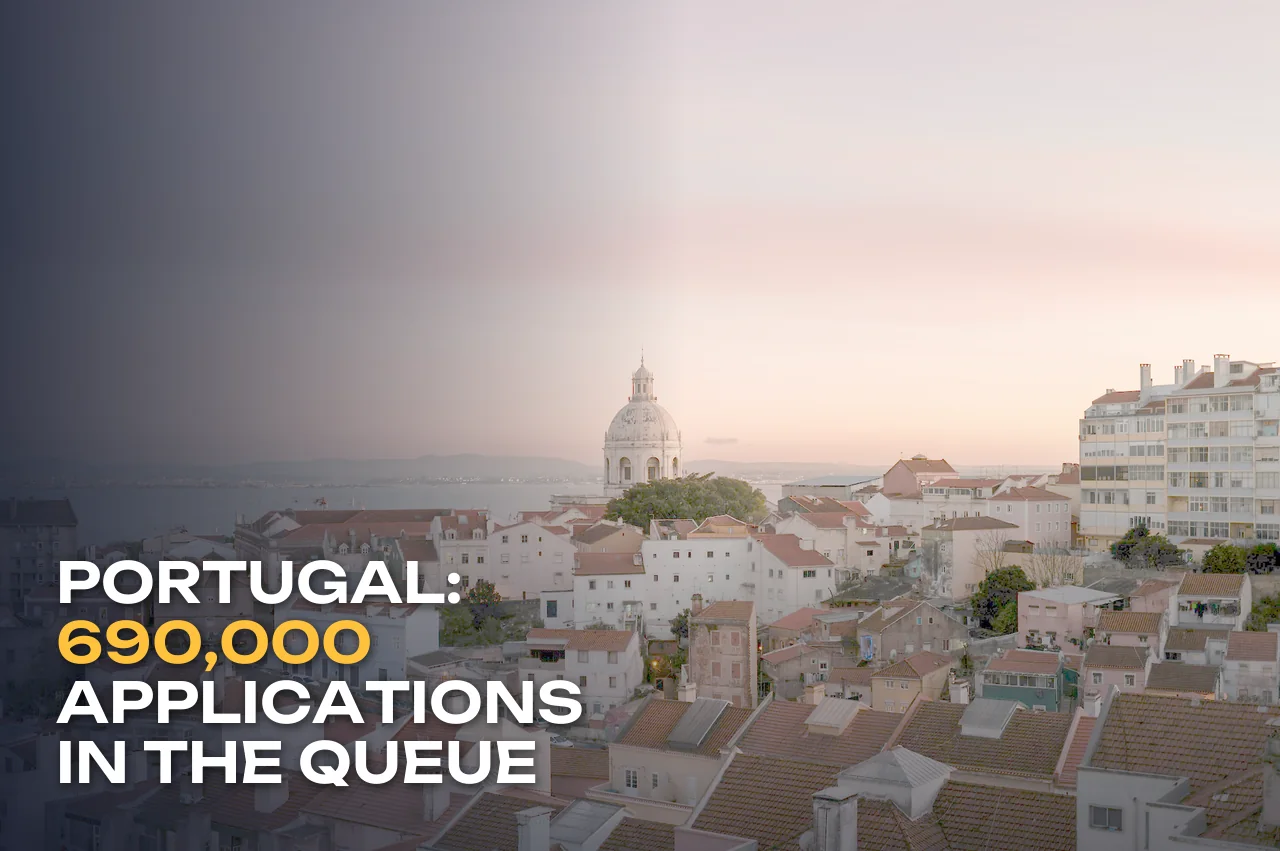
On 30 June 2026, 690,480 citizenship applications were awaiting a decision at Portugal's Institute of Registries and Notary, IRN. That is 38% more than a year earlier. The Ministry of Justice gave the figures to the Portuguese press, and in October they became the main argument in the debate about waiting times. The government is responding with hiring and dedicated backlog teams. I explain who is in the queue, what the state is doing and how to act if your application is already filed or you are only about to apply.
In brief
- On 30 June 2026, 690,480 citizenship applications were awaiting a decision at IRN, 38% more than a year earlier. The Ministry of Justice figures are cited by the Portuguese press.
- The largest groups in the queue are applications by residence (26%) and from descendants of Sephardic Jews (23%).
- Since 19 May 2026 a new nationality law has applied: the basic residence period for naturalisation has risen to 10 years. Applications filed earlier are decided under the old rules.
- On 19 August 2026 the government reported 78 staff in backlog teams, 113 new registrars in 2026 and the hiring of 485 registry officers.
- Do not expect a quick fix: the queue is growing faster than it is being cleared.
Who is waiting for Portuguese citizenship?
The queue is not uniform. According to figures cited by the press, a quarter of applications were filed by foreigners who have lived in Portugal for the required period. Almost as many come from descendants of Sephardic Jews: Portugal narrowed this route sharply in 2022, but earlier applications are still being decided. Next come spouses of Portuguese citizens, and grandchildren and children of Portuguese citizens born abroad.
| Basis of the application | Share of the queue on 30.06.2026 |
|---|---|
| Naturalisation by residence in Portugal | 26% |
| Descendants of Sephardic Jews | 23% |
| Marriage or civil union with a Portuguese citizen | 13% |
| Grandchildren of Portuguese citizens born abroad | 11% |
| Children of Portuguese citizens born abroad | about 10% |
| Other grounds | about 17% |
Most of the load falls on two central archives, in Lisbon and Porto. Back in 2025 the registry workers' union reported more than 140,000 nationality cases in the Porto archive alone, with an acute staff shortage. Waiting times in the two cities differ by years depending on the ground, so comparing your case with stories on social media is pointless.
What this means for you. If your application is based on residence or on marriage to a citizen, you are in the largest part of the queue. Count on years rather than months, and plan travel and documents with that margin.
19 May 2026: the new law and older applications
On 19 May 2026 Organic Law 1/2026 amending the nationality law came into force. For naturalisation by residence the basic period rose to 10 years, and to 7 years for citizens of Portuguese-speaking countries. Applications pending on 19 May are decided under the previous law and its residence periods.
This matters for the queue. Those who filed before 19 May kept the old conditions but stand in the same long queue. Those applying now get the new residence periods and join the end of the queue. Waiting times by ground are covered in the article on Portuguese citizenship timelines, and the conditions in the review on naturalisation.
What this means for you. If you applied before 19 May 2026, the new law does not affect you: your case is decided under the old rules. If you have not applied, check how many years of residence will count under the new law before gathering documents.
113 registrars and backlog teams: the state's response
On 19 August 2026 the Portuguese government reported on its plan for IRN backlogs. In six weeks, according to the Minister of Justice, 52 of 61 offices with backlogs were brought back on track and more than 26,000 applications and submissions were processed. The teams working only on accumulated cases have 78 staff, 41 of them on nationality.
Backlog team staff work only on accumulated cases: property, company and vehicle registration, and nationality.
Portuguese government, 19 August 2026
The main bet is on people. In 2026 IRN is getting 113 new registrars, and the government has announced the hiring of 485 registry officers. But new staff need training, and judging by the 30 June data the queue grew by more than a third in a year. So I do not expect waiting times to fall noticeably in the coming months.
What this means for you. The state acknowledges the problem and is investing resources, but the queue is still growing. I would not build plans around a quick Portuguese passport in 2027.
We will check your Portuguese citizenship application
Tell us the ground, the filing date and the process number if you have one. We will tell you what stage the case is at and what to do so it is not held up over documents.
An application's path through IRN, from filing to passport
To understand where a case is stuck, it helps to know what it goes through. A citizenship application is filed with IRN: in person at registry offices or online through a lawyer or solicitor. The case is assigned to one of the central archives, in Lisbon or in Porto, where it waits its turn for analysis.
Then a registrar checks the documents. If something is missing, IRN sends a request, and the case stops until you reply. For naturalisation by residence IRN also requests information on the applicant's security from the AIMA migration agency and the police. After a positive decision the citizenship is registered, and only then can you apply for a citizen card and passport.
- Filing and registration of the case at IRN.
- Waiting for analysis in the Lisbon or Porto archive: the longest part.
- Document check and, if needed, a request for missing items.
- Requests to AIMA and the police for naturalisation by residence.
- Decision and registration of citizenship.
- Citizen card and passport.
What this means for you. Most of the wait falls on the second step, and you cannot influence it. The third step, document requests, depends on you: a complete file first time saves months.
Checking the documents that most often hold a case up
When the queue is measured in years, an extra document request adds months more. So the file should be put together so the registrar has no questions. Below are the documents on which cases stop most often.
| Document | Purpose | Common stumbling block |
|---|---|---|
| Birth certificate | proves identity and origin | a full-form copy with apostille and translation is needed |
| Criminal record certificates | from the country of nationality and countries where you lived | they expire while the case waits |
| Proof of Portuguese language | for naturalisation by residence | a certificate below the required level or not recognised |
| Proof of legal residence | confirms the period lived in Portugal | gaps in the permit caused by renewal delays |
| Marriage or kinship documents | for citizenship by marriage or descent | inconsistent spelling of names across documents |
Naturalisation by residence requires a confirmed level of Portuguese, as a rule A2. The certificate must be recognised in Portugal. Citizenship by marriage depends on the length of the marriage or civil union, more than three years, and a proven connection to Portuguese society. Since 2022 descendants of Sephardic Jews must prove a real connection to Portugal, for example through inheritance or regular travel; older applications are decided under the rules on the filing date.
Names are a separate problem. If the surname is spelled differently in the birth certificate, passport and marriage certificate, the registrar will ask for an explanation. Such discrepancies are best corrected or explained in writing before filing. We prepare criminal record certificates from different countries and their translations to one standard, as described on the page on criminal record certificates.
What this means for you. If your case is already filed, check whether certificates have expired and whether discrepancies have appeared in your documents. If you are only preparing, put together a complete file and check the names in every document.
The size of the queue in numbers
The figures are worth putting side by side. If the queue grew by 38% in a year to 690,480 cases, a year earlier it held about 500,000 applications: this is our calculation from Ministry of Justice data. In six weeks of work by the backlog teams, according to the government, more than 26,000 applications and submissions were processed, and not only on nationality but also on property, company and vehicle registration. Even if all of them concerned citizenship, that would be under 4% of the queue.
Delays in Portugal are not limited to citizenship. In the article on golden visa queues we looked at how the migration agency decides investment residence cases. The picture is similar: more applications than can be processed, and waiting times growing faster than staff are hired.
For an applicant the conclusion is simple: there are no grounds to expect shorter waiting times in the coming year. Plan your move, your children's schooling, a home purchase and travel on the basis that a Portuguese passport will come in years, and until then your residence permit is your mainstay.
What this means for you. The queue is growing faster than it is being cleared. That is no reason to give up on Portuguese citizenship, but it is a reason not to build plans around short timelines.
Why do people in the same queue get different waiting times?
Waiting times depend on three things. The first is the archive: Lisbon and Porto work under different loads, and cases on the same ground can move years apart in the two cities. The second is the ground: cases of children of Portuguese citizens, especially minors, usually move faster than naturalisation by residence or marriage. The third is the completeness of the file: a case with a document request loses months.
So comparing your case with friends' stories is pointless unless the archive, the ground and the filing date match. The only guide to your own case is the process number and its status on the portal.
What this means for you. If your case is taking longer than a friend's, it is not necessarily a mistake. Check the status and any requests before drawing conclusions.
Living in Portugal while the case waits for a decision
A citizenship application does not give a right to live in Portugal. While the case runs, you live on your residence permit, and it must be renewed on time. The AIMA migration agency is also working with delays, so start renewal early rather than in the last month.
A gap in legal residence may raise questions in the citizenship case itself if it is based on residence. If a renewal is delayed, keep proof of filing. If you are only choosing a route to Portugal, it is worth comparing residence grounds, for example the D7 visa for financially independent people.
If a family has filed several applications, for example for spouses and children, they are handled as separate cases, and decisions may come at different times. Children of Portuguese citizens sometimes obtain citizenship faster after the parent's citizenship is registered than the parent's own case took, so the order of filing within a family is worth planning in advance. Keep the numbers of all processes and check the status of each separately.
What this means for you. Your residence permit is the main support for the years of waiting. Watch the expiry of your card as closely as the status of your citizenship case.
What to do if you are in the queue or about to apply
Check your status online
You can follow your case on the Ministry of Justice nationality portal using the process number. IRN recently moved the system to a new platform: if the status looks odd, check it against letters from IRN.
Answer requests at once
A request for a missing document stops the case. Replying on the last day of the deadline costs months.
Keep documents fresh
Criminal record certificates and extracts expire. If your case drags on, be ready to renew them. How we obtain criminal record certificates is described on the page on criminal record certificates.
Do not pay for promises to speed things up
There is no lawful way to buy a place in the queue. If someone offers acceleration for money, treat it as a warning sign.
Plan your status while you wait
During the process your right to live in Portugal comes from your residence permit. Make sure it does not expire: renewals at AIMA are delayed too.
If you are only choosing a route to Portugal, it is worth comparing residence options, for example the D7 visa for financially independent people. On golden visa delays, see the article on golden visa queues.
How this article was prepared
The number of applications on 30 June 2026, the year-on-year growth and the make-up of the queue are cited from Portuguese Ministry of Justice data published by the Portuguese press; we did not find an official table on the IRN website. Information on government measures comes from the Portuguese government statement of 19 August 2026. The number of cases in the Porto archive is from a 2025 statement by the registry workers' union. The entry into force of the new law follows Organic Law 1/2026. This article does not replace advice on your own case.
Frequently asked
Questions people ask before deciding
01How many Portuguese citizenship applications are awaiting a decision?
On 30 June 2026, 690,480, which is 38% more than a year earlier. These are Ministry of Justice figures cited by the Portuguese press.
02Does the new law affect me if I applied in spring 2026?
If your application was filed before 19 May 2026, it is decided under the previous law and its residence periods.
03How many years must I live in Portugal for citizenship now?
Under the new law, in force since 19 May 2026, the basic period is 10 years, and 7 years for citizens of Portuguese-speaking countries.
04Can the process be speeded up?
There is no lawful way to buy a place in the queue. Answering IRN requests quickly and keeping documents fresh helps avoid stoppages.
05What is the government doing about the queues?
On 19 August 2026 the government reported backlog teams of 78 staff, 113 new registrars in 2026 and the hiring of 485 registry officers.
About the author
Related materials
What to read next
 ArticleTime frame for obtaining Portuguese citizenship in 2026: how long to wait at each stage
 ArticlePortuguese citizenship by naturalization in 2026: qualification 10 years, language A2, test
 AnalysisPortugal's golden visa: 6,000 decisions out of 46,000 and a 50-month wait
Personal programme selection is conducted by Anna Kovalevskaya, Head of Legal, BRIDGES.
We will check your Portuguese citizenship application
Tell us the ground and the filing date. We will tell you what stage the case is at and how to avoid delays.
